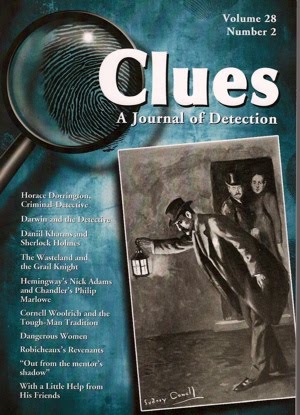
Volume 28, no. 2 of Clues: A Journal of Detection has been published, which offers among its highlights:
• Hilary A. Goldsmith on Darwinian echoes in Conan Doyle
• Clare Clarke on Arthur Morrison's Horace Dorrington, criminal-detective
• Christine Photinos on whether Cornell Woolrich can be considered a member of the US hard-boiled school
• Laura Vorachek on Vera Caspary's rewriting of Mary Elizabeth Braddon's Lady Audley's Secret (1862) in Bedelia (1945)
• Patricia Gaitely on the supernatural in James Lee Burke
A particularly interesting article is Lisanne Sauerwald's analysis of Russian absurdist writer Daniil Kharms (1905–42), who was so enamored of Sherlock Holmes that he dressed like an English gentleman and encoded Holmes's Russian name, Kholms, into his pseudonym, Kharms. Sauerwald also notes that Conan Doyle's name appeared on 1920s lists of censored authors in Russia. Some of the passages included in this article have been translated into English for the first time.
For the table of contents with article abstracts, go here. For online access and subscription information, go here. For indices from Clues vols 1 to 28, go here.
Featuring History of Mystery/Detective Fiction and Other Literary Ramblings of Elizabeth Foxwell
Showing posts with label Charles Darwin. Show all posts
Monday, September 13, 2010
Thursday, September 02, 2010
Charles Darwin and H. G. Wells.
The National Library of Medicine's online exhibition on Charles Darwin discusses Darwin's influence on others, including
H. G. Wells and The Time Machine (1895).
Update: A TLS review of Michael Sherborne's new Wells bio appears here.
About the image: Rod Taylor in The Time Machine (dir. George Pal, 1960)
H. G. Wells and The Time Machine (1895).
Update: A TLS review of Michael Sherborne's new Wells bio appears here.
About the image: Rod Taylor in The Time Machine (dir. George Pal, 1960)
Friday, January 29, 2010
1891: Galton's fingerprint classification system.
The online exhibition "Trailblazing: Three and a Half Centuries of Royal Society Publishing"
includes "1891: The Proof That Fingerprints Are Unique," which discusses the still-used classification system for fingerprints developed by Sir Francis Galton, a cousin of Charles Darwin.
About the image: Galton's fingerprints, from the cover of his book Finger Prints (1892)
includes "1891: The Proof That Fingerprints Are Unique," which discusses the still-used classification system for fingerprints developed by Sir Francis Galton, a cousin of Charles Darwin.About the image: Galton's fingerprints, from the cover of his book Finger Prints (1892)
Labels:
Charles Darwin,
fingerprints,
Francis Galton,
Royal Society
Subscribe to:
Posts (Atom)

