 |
| G.K. Chesterton |
Showing posts with label James Lee Burke. Show all posts
Showing posts with label James Lee Burke. Show all posts
Wednesday, July 16, 2014
Religion and fictional detectives.

Wednesday, October 09, 2013
James Lee Burke on latest Robicheaux novel.

Wednesday, March 23, 2011
Clues 29.1 issued: Christie, Spencer-Fleming, Borges, Temple, et al.

• Maria Hebert-Leiter on detecting crime after Hurricane Katrina (including analysis of James Lee Burke and several stories from New Orleans Noir, ed. Julie Smith)
• Stephen Knight on the work of Australian author Peter Temple
• Linda S. Maier on similarities between Jorge Luis Borges (who wrote detective fiction under pseudonyms) and Wilkie Collins
• Pamela S. Saur on the novels of Austrian author Gerhard Roth that can be read as murder mysteries
• Rachel Schaffer on sources of moral authority in Julia Spencer-Fleming's series
• Sarah E. Whitney on emotional violence in the neglected novels of Mary Westmacott (aka Agatha Christie)
 |
| Holmes and Watson on the trail with the "staunch hound" Pompey. Illustration by Sidney Paget, "The Adventure of the Missing Three- Quarter" |
• Janice Shaw on Frank Moorhouse's use of whodunit techniques in Lateshows
• Elyssa Warkentin on women in two early fictionalizations of the Jack the Ripper murders
• Reviews of Thrillers: 100 Must Reads, Detective Fiction in a Postcolonial and Transnational World, and Investigating Identities: Questions of Identity in Contemporary International Crime Fiction
Particularly fascinating is Emanuela Gutkowski's explanation using linguistic theory of just how Christie fools the reader regarding the murderer's identity in The Murder of Roger Ackroyd (1926). Readers should not be daunted by the word theory; the author clearly explains each point and illustrates it with examples from Christie's book.
Tuesday, January 25, 2011
Unlikely Mystery Fan #1: Bill O'Reilly.
First in a series on unexpected individuals who enjoy or enjoyed mystery-related works and authors.
Who knew that Fox's Bill O'Reilly is so fond of thrillers? The list of Reilly's favorite books from his Web site includes the following mysteries or thrillers (none by women):
 • The Neon Rain by James Lee Burke
• Red Storm Rising by Tom Clancy
• Rising Sun by Michael Crichton
• L.A. Confidential by James Ellroy
• Casino Royale by Ian Fleming
• The Eagle Has Landed by Jack Higgins
• The Godwulf Manuscript by Robert B. Parker (first Spenser novel)
Who knew that Fox's Bill O'Reilly is so fond of thrillers? The list of Reilly's favorite books from his Web site includes the following mysteries or thrillers (none by women):
• Red Storm Rising by Tom Clancy
• Rising Sun by Michael Crichton
• L.A. Confidential by James Ellroy
• Casino Royale by Ian Fleming
• The Eagle Has Landed by Jack Higgins
• The Godwulf Manuscript by Robert B. Parker (first Spenser novel)
Monday, September 13, 2010
Clues 28.2: Cornell Woolrich, Vera Caspary, Arthur Conan Doyle, James Lee Burke, et al.
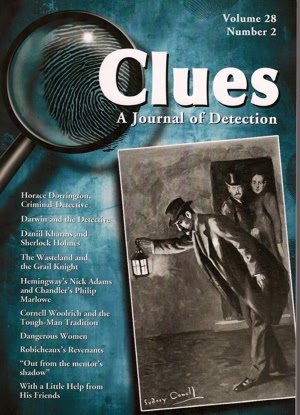
• Hilary A. Goldsmith on Darwinian echoes in Conan Doyle
• Clare Clarke on Arthur Morrison's Horace Dorrington, criminal-detective
• Christine Photinos on whether Cornell Woolrich can be considered a member of the US hard-boiled school
• Laura Vorachek on Vera Caspary's rewriting of Mary Elizabeth Braddon's Lady Audley's Secret (1862) in Bedelia (1945)
• Patricia Gaitely on the supernatural in James Lee Burke
A particularly interesting article is Lisanne Sauerwald's analysis of Russian absurdist writer Daniil Kharms (1905–42), who was so enamored of Sherlock Holmes that he dressed like an English gentleman and encoded Holmes's Russian name, Kholms, into his pseudonym, Kharms. Sauerwald also notes that Conan Doyle's name appeared on 1920s lists of censored authors in Russia. Some of the passages included in this article have been translated into English for the first time.
For the table of contents with article abstracts, go here. For online access and subscription information, go here. For indices from Clues vols 1 to 28, go here.
Monday, May 18, 2009
LSU Press: Rough times ahead?
 Jennifer Howard of the Chronicle of Higher Education reports that Louisiana State University Press, publisher of James Lee Burke's The Lost Get-Back Boogie and distinguished titles in Southern literature and history, faces trouble due to state budget cuts. If it does not receive its usual university subsidy of some $800,000, it faces "really tough decisions," according to press director Mary Katherine Callaway. I interpret that to mean cuts in the publishing program and perhaps layoffs.
Subscribe to:
Posts (Atom)