
Showing posts with label G. K. Chesterton. Show all posts
Showing posts with label G. K. Chesterton. Show all posts
Monday, October 26, 2020
Mystery tropes of the Golden Age.

Monday, August 24, 2020
Clues 38.2: Genre b(l)ending.
 |
Volume 38, number 2 of Clues: A Journal of Detection, guest edited by Maurizio Ascari (University of Bologna), has been published on the theme "Genre B(l)ending: Crime's Hybrid Forms." Below are the abstracts for the issue. Contact McFarland to order the issue or a Clues subscription.
Update, 9-14-20. The ebook versions are now available: Google Play, Kindle, Nook.
Introduction: Make It New, but Don’t Forget / MAURIZIO ASCARI (University of Bologna)
G. K. Chesterton’s Postmodern Anti-Detective Story: Generic Innovation
and Transgression in “The White Pillars Murder” / NILS CLAUSSON (University of Regina, Canada)
G. K. Chesterton’s undervalued story “The White Pillars Murder” anticipates
the postmodern anti-detective story in the way it transgresses the conventions
of the Holmes-style analytic detective story and subversively introduces political
critique into a genre, the Golden Age country house mystery, widely regarded as
either apolitical or conservative.
Murder, Mayhem, and Madness: John Dickson Carr’s Gothic Detective Stories / STEFANO SERAFINI (University of Toronto)
This essay investigates the contact zones between gothic and detective fiction within the early work of the significant yet largely neglected author John Dickson Carr. By revealing the transgressive and contaminated character of his narratives, this essay also provides a more nuanced picture of interwar crime-writing, the literary boundaries of which were constantly violated and renegotiated.
The Cowboy and the Detective: The Case of Craig Johnson / ANTOINE DECHÊNE
This essay focuses on Craig Johnson’s charismatic protagonist Walt Longmire, the county sheriff of Absaroka, Wyoming. A cowboy-detective par excellence, Longmire embodies the interrelationship between the Western and detective fiction while offering a good example of “glocal literature”—that is, a form of literature that is both global and local.
James Church’s A Corpse in the Koryo and His Inspector O Series: A Noir/Spy Thriller Hybrid Set in North Korea / DAVID C. WRIGHT JR. (Misericordia University)
Analysis of A Corpse in the Koryo, the first book in the Inspector O series by James Church, shows that this series featuring a North Korean detective constitutes a successful genre hybrid: a hard-boiled detective thriller, à la Raymond Chandler, combined with a spy novel in the style of John le Carré.
Monday, March 23, 2020
Update: Chesterton home saved.
 |
| G. K. Chesterton. NYPL. |
Monday, January 20, 2020
Chesterton home at risk.
 |
| G. K. Chesterton, 1904. NYPL |
Monday, January 06, 2020
The life of a mystery writer.

Monday, October 30, 2017
Haycraft on Chesterton.
 |
| Howard Haycraft. From the 1927 Univ of Minnesota Gopher |
Monday, August 07, 2017
Chesterton declines an invitation in verse.
 |
| G. K. Chesterton, 1915. Library of Congress, Prints and Photos Div. |
Monday, June 19, 2017
The first hundred years of detective fiction.
 |
| Illustration from Lawrence L. Lynch, Dangerous Ground (1885) |
Wednesday, November 02, 2016
Richard Atwater on detective novels, 1930.
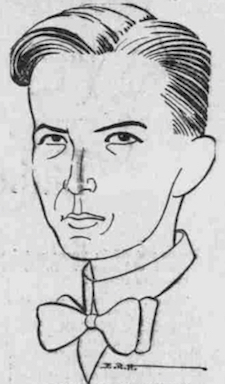 |
| Illustration of Richard Atwater, frm 21 Oct 1922 Bisbee Daily Review |
• G. K. Chesterton, The Man Who Was Thursday (1908). Chesterton's classic tale of unlikely agent Gabriel Syme infiltrating an anarchist group
• James Branch Cabell, The Cream of the Jest (1917). It is unusual to characterize this book as a detective work, as it is a satire—a fictional work with fantasy elements within a fictional work.Tongue planted firmly in cheek, Atwater then floated his idea for a detective novel, in which a valet named Rudy offends because of his crooning (one suspects that Atwater was no fan of Rudy Vallee), and decorators "mistaking Rudy for the new wall paper, . . . paste him to the wall of the master's study. As the master never studies, nobody discovers the error, and the crime is never known" (15).
Wednesday, October 19, 2016
Frances Chesterton, wife of G. K.

Of related interest: Frances Chesterton being mistaken for The Lodger author Marie Belloc Lowndes and her response: "I am quite willing to feel honored by [the] mistake, but they [Hilaire Belloc and Marie Belloc Lowndes] might feel aggrieved." Belloc (brother of Marie Belloc Lowndes) and G. K. Chesterton were close friends.
Monday, August 01, 2016
The Armed Services editions and mysteries.
 |
| Cover of Armed Services edition of Rex Stout's Not Quite Dead Enough (1945) |
To mention a few mystery-related elements in the book:
- One of the authors listed as banned in Germany:
G. K. Chesterton
- "The most popular genre was contemporary fiction . . . followed by historical novels, mysteries, books of humor, and westerns" (79–80).
- Among the earliest Armed Services editions: Earl Derr Biggers, Seven Keys to Baldpate; W. R. Burnett, Little Caesar; Daphne du Maurier, Jamaica Inn; and Graham Greene, The Ministry of Fear
- Some of the last Armed Services editions published in 1947: John Dickson Carr, The Sleeping Sphinx; Manning Coles, With Intent to Deceive; Erle Stanley Gardner, The Case of the Fan-Dancer's Horse; Hilda Lawrence, Death of a Doll; Richard and Frances Lockridge, Think of Death; Ngaio Marsh, Final Curtain; Craig Rice, ed., Los Angeles Murders; and Kelley Roos, Ghost of a Chance.
- BookTV footage of Manning talking about the book in 2015
- Books in Action: The Armed Services Editions (ed. John Y. Cole, 1984)
Wednesday, July 16, 2014
Religion and fictional detectives.
 |
| G.K. Chesterton |
Wednesday, May 29, 2013
Chesterton, Sayers articles of interest.
 |
| Illustration of Chesterton from Hearst's International (Nov 1921) |
• "Two Essays on George MacDonald by G. K. Chesterton" introd. Daniel Gabelman (Scottish novelist MacDonald, best known for At the Back of the North Wind [1871], was the grandfather of mystery author-screenwriter Philip MacDonald). In one essay, Chesterton calls George MacDonald "one of the most remarkable men of our time."
• "Dorothy L. Sayers's Writings about Work, the Economy and Social Conditions: An Annotated Bibliography" by Christine M. Fletcher
Caroline Barta's "'That Precarious Balance': Harmonizing Temperance in Dorothy L. Sayers's Gaudy Night" is not yet posted from the 2012 issue.
Wednesday, May 22, 2013
It came from the archives: G. K. Chesterton.
 |
| G. K. Chesterton, NYPL |
Tuesday, May 29, 2012
Happy birthday, G. K. Chesterton.
 |
| Illustration of Chesterton from Hearst's International (Nov 1921) |
• Read his "A Defense of Detective Stories" (1901).
• Read his "The Admiral Eats His Hat: How to Write Detective Stories" (1921). ". . . the very design of a detective story is a matter not of creation but of construction. . . . let the villain [be] . . . a very viper on the hearth."
• Read his "On Detective Novels" (1922). "...the detective story is . . . a drama of masks and not of faces."
• Watch Chesterton at Worcester College (1931).
Wednesday, May 09, 2012
Dickens, Drood, and Holmes.
 |
| Claude Rains as John Jasper in The Mystery of Edwin Drood (1935) |
Tuesday, January 17, 2012
Chesterton, Greene, et al: Bloomsbury auction results.
 |
| E. C. Bentley, from The Bookman 37 (1913) |
• Strand magazine vols 1–16, 1891–98, which contain the Adventures and Memoirs of Sherlock Holmes (illust. Sidney Paget): £100 (approx. US$153).
• E. C. Bentley, Trent's Last Case (1913), with G. K. Chesterton's The Wisdom of Father Brown (1914) and some Agatha Christie works, £110 (approx. US$168).
• Raymond Chandler, 1st English ed. of The Big Sleep (1939), £260 (approx. US$400).
• G. K. Chesterton, 1st ed. of The Man Who Was Thursday (1908), £60 (approx. US$92).
• Graham Greene, 1st ed. of The Third Man and The Fallen Idol (1950), £240 (approx. US$368).
(Hat tip to PhiloBiblos)
Monday, December 12, 2011
BBC Radio 4 Extra: Xmas w/the Detectives.
 |
| Thomas Hardy, NYPL |
(And here is Anthony Gardner on the intriguing stories behind Hardy's Christmas cards)
Tuesday, September 20, 2011
Journal gems from JSTOR.
JSTOR announced on Sept. 6 that it would permit free access to issues of certain periodicals published before 1923 (list here). This means unfettered access to items such as the following:
• "The Modern Novel," by Amelia E. Barr, North American Review, Nov. 1894. "...[I]f people enjoy the game between criminals and detectives, the question is simply whether the exhibition is, or is not, a moral one—whether the details of crime, the telling of how it was done, how it was concealed, and how it was found out, may not be a kind of criminal school, for those whose inclinations lead them in that direction" (593–94).
• "Detective Surveillance of Anarchists," by Robert A. Pinkerton (son of Allan Pinkerton), North American Review Nov 1901. "The picture of the anarchist drawn by most people, a bearded, drunken, lazy creature, is not at all in line with the facts" (616).
• "A Short-Story Reading List," by Raymond W. Pence, English Journal May 1920. Recommends the following for teaching students about effective writing:
--G. K. Chesterton. The Innocence of Father Brown, The Wisdom of Father Brown.
--Arthur Conan Doyle. "The Adventure of the Dying Detective," "The Dancing Men," "The Final Problem," "The Norwood Builder," "A Scandal in Bohemia," "Silver Blaze," "The Speckled Band."
--Henry James. "The Turn of the Screw"
--Arthur Morrison. "On the Stairs"
--Edgar Allan Poe. "The Gold Bug," "The Murders in the Rue Morgue," "The Purloined Letter."
--Melville Davisson Post. Stories from Uncle Abner: "The Doomdorf Mystery," "An Act of God," The Straw Man," "The Adopted Daughter."
--Robert Louis Stevenson. "Markheim," "Dr. Jekyll and Mr. Hyde"
• "The Modern Novel," by Amelia E. Barr, North American Review, Nov. 1894. "...[I]f people enjoy the game between criminals and detectives, the question is simply whether the exhibition is, or is not, a moral one—whether the details of crime, the telling of how it was done, how it was concealed, and how it was found out, may not be a kind of criminal school, for those whose inclinations lead them in that direction" (593–94).
 |
| William A. Pinkerton, left, and Robert A. Pinkerton, ca. 1855. Library of Congress |
• "A Short-Story Reading List," by Raymond W. Pence, English Journal May 1920. Recommends the following for teaching students about effective writing:
--G. K. Chesterton. The Innocence of Father Brown, The Wisdom of Father Brown.
--Arthur Conan Doyle. "The Adventure of the Dying Detective," "The Dancing Men," "The Final Problem," "The Norwood Builder," "A Scandal in Bohemia," "Silver Blaze," "The Speckled Band."
--Henry James. "The Turn of the Screw"
--Arthur Morrison. "On the Stairs"
--Edgar Allan Poe. "The Gold Bug," "The Murders in the Rue Morgue," "The Purloined Letter."
--Melville Davisson Post. Stories from Uncle Abner: "The Doomdorf Mystery," "An Act of God," The Straw Man," "The Adopted Daughter."
--Robert Louis Stevenson. "Markheim," "Dr. Jekyll and Mr. Hyde"
Thursday, June 30, 2011
The cheery Chesterton.

Subscribe to:
Posts (Atom)