Showing posts with label recommended reading. Show all posts

Monday, May 11, 2020

BFI choices, works with cinema and mystery.

"Flick Lit" presents recommendations by the British Film Institute's Sight & Sound contributors of 100 novels that deal with cinema. The piece states that George R. Sims's "Our Detective Story" (1897) is the "earliest crime drama involving film."

The following mystery-related works are included:

Monday, July 22, 2019

The nefarious state of Wisconsin.

In the Wisconsin State Journal, several mystery authors (such as Victoria Houston, who writes the Loon Lake mystery series with fly-fishing enthusiast and chief of police Lewellyn Ferris) discuss why the state is such an inviting setting for mystery.

Monday, April 01, 2019

The many comforts of mysteries.

In the Financial Times, Charlotte Mendelson enumerates the reasons why mysteries are a comfort when personal life is tough: plots, good people confronting bad things, the triumph of the detective, the many different kinds and numbers of mysteries, and the quality of writing.

Friday, October 19, 2018

Friday's Forgotten Books:
The Hidden Wrath by Stella Phillips (1968).

What am I supposed to do with them, send them round the doors asking "Does your daughter, lodger, neighbour have homicidal tendencies?"
—Inspector Furnival, The Hidden Wrath 99
In The Hidden Wrath, a college library community confronts the murder of the chief cataloguer of the county library who was spearheading the cataloguing of its collection and was "gauche, earnest, a bit of a bore" (6). So why was she a threat? Inspector Matthew Furnival and Sergeant Reg King must sort through a plethora of suspects. Is it the warden or his wife? Is it the college secretary, who had dark secrets in his past and a crush on the victim? Is it the secretary's spouse, who doubles as college housekeeper, is weary of her husband's serial infatuations, and chafes at village life? Is it a volunteer cataloguer who yearns to break free of her querulous invalid father? Is it the new college graduate at a bit of a loose end? Is it the scion of a distinguished family? Is it the jaded director of a production of the Scottish play? Or is it someone else?

This novel is ideal for bibliomystery fans, featuring passages of exquisite writing, superb portrayals of characters' lives, and hints of disquiet at home for Furnival.

Retired librarian Stella Phillips (1927–?) wrote eight novels. The Hidden Wrath is the second featuring Furnival and King. The others are Down to Death (1967), Death in Arcady (1969), Death Makes the Scene (1970), Death in Sheep's Clothing (1971), and Three May Keep a Secret (2004). Novels outside the series include Dear Brother, Here Departed (1975) and Yet She Must Die (1973). (see photo of Stella Phillips)

Monday, April 23, 2018

Dorothy B. Hughes's classic mystery library.


Claude Rains and Edward Norris in They Won't Forget (1937),
adaptation of Ward Greene's Death in the Deep South
In the 13 Nov 1977 Los Angeles Times, author-critic Dorothy B. Hughes made 23 selections for a classic mystery library. Hughes defined a classic as "a book to which you return over and again ... primarily because for you it satisfies a hunger for the felicity of beauty and craft..."(N3). For Hughes, "style is the most important element in any mystery, let alone a classic" (N3).

Hughes did not include any works by Arthur Conan Doyle and Erle Stanley Gardner (although Hughes would publish a biography of Gardner), explaining that in the case of these and some other authors (such as Ellery Queen), their body of work constitutes the classic rather than a single book. Hughes's choices for her classic mystery library are the following:
  • Eric Ambler, A Coffin for Dimitrios. "a hunt-and-search story with a background of the Near East leading to Paris"
  • Edgar Box [Gore Vidal], Death in the Fifth Position. " . . . the world of the ballet, presented with perception and verisimilitude"
  • Vera Caspary, Laura. "an enviable creator of plots which twist and turn and startle."
  • Raymond Chandler, Farewell, My Lovely. "his making of poetry out of the tawdry was indeed something unforgettable"
  • Agatha Christie, The Murder of Roger Ackroyd and And Then There Were None. "two classic books"
  • Len Deighton, The Ipcress File. "Deighton . . . devised a new style."
  • Helen Eustis, The Horizontal Man. "a true academic background against which the tragicomedy is played."
  • William Faulkner, Intruder in the Dust. "a mystery sensation"
  • Michael Gilbert, Close Quarters. "he has built a cathedral and its close, and has peopled it with verisimilitude."
  • Graham Greene, Brighton Rock. "two sad insignificant persons revealed in their small moment of significance."
  • Ward Greene, Death in the Deep South. "a classic of the regional and one of the first dealing with ethnic problems"
  • Dashiell Hammett, The Maltese Falcon. "a classic romantic-adventure"
  • H. F. [Gerald] Heard, A Taste for Honey. "Another of the instant classics"
  • Francis Iles [Anthony Berkeley Cox], Before the Fact."a book whose plot must remain secret"
  • Charlotte Jay [Geraldine Halls], Beat Not the Bones. "the primitive culture of Africa in collision with the 20th century"
  • John le Carre [David Cornwell], The Spy Who Came in from the Cold. "tragic power"
  • Meyer Levin, Compulsion. "a classic of major proportion"
  • Marie Belloc Lowndes, The Lodger. " . . . a true crime story, in fiction form"
  • Ngaio Marsh, Death of a Fool. "breath-taking"
  • E. Phillips Oppenheim, The Great Impersonation. "a landmark"
  • Dorothy L. Sayers, The Nine Tailors. "background became not just background, but important"
  • Josephine Tey [Elizabeth MacKintosh], The Daughter of Time. "Simply written but brilliant in premise and performance."
  • Ad for They Won't Forget (from the film pressbook)


Wednesday, November 02, 2016

Richard Atwater on detective novels, 1930.

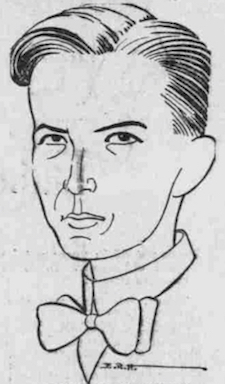
Illustration of Richard Atwater, frm
21 Oct 1922 Bisbee Daily Review
Richard Atwater (1892–1948) was coauthor of the Newbery Award-nominated Mr. Popper's Penguins, a classics professor at the University of Chicago, and a frequent contributor to Chicago newspapers. In a 7 Jun 1930 article in The Chicagoan, Atwater asserted that "there are only six detective novels in existence: the rest being a rewriting of the same plots" (15). The following were his picks for the two best detective novels partly because "neither . . . has a butler in it":
• G. K. Chesterton, The Man Who Was Thursday (1908). Chesterton's classic tale of unlikely agent Gabriel Syme infiltrating an anarchist group
• James Branch Cabell, The Cream of the Jest (1917). It is unusual to characterize this book as a detective work, as it is a satire—a fictional work with fantasy elements within a fictional work.
Tongue planted firmly in cheek, Atwater then floated his idea for a detective novel, in which a valet named Rudy offends because of his crooning (one suspects that Atwater was no fan of Rudy Vallee), and decorators "mistaking Rudy for the new wall paper, . . .  paste him to the wall of the master's study. As the master never studies, nobody discovers the error, and the crime is never known" (15).

Monday, February 15, 2016

Review: Tipping the Valet, by K. K. Beck.

Valet Tyler Benson faces more than just cranky customers in Tipping the Valet: A Workplace Mystery, K. K. Beck's first mystery in more than 15 years. Tyler's father has saddled him with a huge debt after pursuing a losing culinary scheme, placing the family in danger of losing their home; his fellow valets seem embroiled in something shady; and the attractive hostess of Ristorante Alba where he works does not seem to realize he exists. Further complications ensue when an attempt is made on the life of dot.com entrepreneur and restaurant patron Scott Duckworth, his father's former boss, and a body is found in a trunk that just so happens to have Tyler's fingerprints on it. Hapless but scary Eastern European gangsters pressuring the restaurant owners also add to Tyler's problems.

Beck's trademark sense of humor and sure plotting provide an enjoyable read for mystery fans. It's great to have her back.

Monday, November 17, 2014

Academe: Still more notable espionage novels.

Wright State University's Martin Kich has finished his series on "National (In)Security: Fifty Notable American Espionage Novels" on the Academe blog. Some of the latest entries:
Upton Sinclair, ca. 1906. NYPL
• Holly Roth, The Content Assignment (aka The Shocking Secret, 1954). When a female CIA agent disappears, a British journalist sets out to find her. Sadly, Roth died at age 48 after falling off a boat.
• Upton Sinclair, World's End (1940). The first in a series with spy Lanny Budd by the author of The Jungle.
• Ross Thomas,  The Cold-War Swap (1966). Thomas's Edgar-winning debut.

• Trevanian, The Eiger Sanction (1972; film 1975). The first in a series with assassin Jonathan Hemlock.
• Leon Uris, Topaz (1967, Hitchcock film 1969). A Soviet spymaster defects.
All of the posts can be found here.

Friday, September 26, 2014

Friday Forgotten Book:
Atwater's Crime in Corn Weather (1935).

Was William Breen at that moment on a train or an airplane on his way to unextraditable ease with a few hundred thousands of the bank's funds in a modest suitcase at his feet? Mr. Vane knew how it could have been done. He had worked out a perfect system years ago. Now, of course, it would be too late—for him. Why hadn't he done it first? He pretended he believed it was his moral uprightness that had prevented, but as a matter of fact he was afraid of airplanes and got desperately seasick even in a rowboat on the lake. Of such things are virtue made sometimes. (Crime in Corn Weather 51)
A tyrannical banker from a rural town in the Midwest disappears, and his neighbors suspect foul play in Mary Meigs Atwater's only mystery novel. Atwater's focus is the effect of the event on the residents, and there is a great deal of wisdom in her observations of people seeking to capitalize on the case (merchants, reporters) and those with sadder legacies (a World War I veteran, a young woman, a henpecked husband). Younger readers may not know what a switchboard is, and there is one appearance of the six-letter "N" word (in reference to a lawn jockey) that contemporary readers may find disconcerting.

Mary Meigs Atwater (1878–1956) was referred to as the "dean of American handweaving" and as "gun toting" and "chain smoking" in the Interweave Press 1992 reprint of Crime in Corn Weather (iii). She was a granddaughter of Montgomery C. Meigs, the Union quartermaster general during the Civil War who later played a key role in the development of Arlington Cemetery, the Pension Building (now the National Building Museum), and the Washington Aqueduct. Her sister, Bryn Mawr professor Cornelia Meigs, received a Newbery Medal for Invincible Louisa, a biography of Louisa May Alcott. In the Interweave Press edition of Crime in Corn Weather, there is a tantalizing reference to an unpublished mystery manuscript by Atwater.

Monday, July 14, 2014

Academe: Notable American espionage novels.

James Fenimore Cooper. NYPL
For the blog of Academe magazine (published by the American Association of University Professors), Martin Kich (Wright State University) is crafting a series of posts on "Fifty Notable American Espionage Novels" (he is up to no. 29). His choices include the following:

James Fenimore Cooper, The Spy (1821)
Richard Congdon, The Manchurian Candidate (1959)
Brian Garfield, Hopscotch (1975)
Dorothy Gilman, The Amazing Mrs. Pollifax (1970)
James Grady, Six Days of the Condor (1975)
Bill Granger, The November Man (1979)
Nicholas M. Guild, The Summer Soldier (1978)
Noel Hynd & Christopher Creighton,  The Krushchev Objective (1987)
Aaron Latham, Orchids for Mother (1977)
Robert Littell, The Amateur (1981)

Thursday, July 03, 2014

CBC's "100 Novels That Make You Proud to Be Canadian."

CBC Books (of the Canadian Broadcasting Corp.) has issued its list of "100 Novels That Make You Proud to Be Canadian," which includes the following mystery works:

• Linwood Barclay,
No Time for Goodbye
• Giles Blunt, Forty Words for Sorrow 
• Will Ferguson, 419
• Louise Penny, Still Life
• Andrew Pyper, Lost Girls

Wednesday, May 14, 2014

Rose Macaulay's Mystery at Geneva (1922).

"They must be found, gentlemen. Alive or (unthinkable thought) dead, they must be found. The Assembly must do nothing else until this sinister mystery is unravelled. We must employ detectives. We must follow every clue."
Miss Longfellow said, "My! Isn't it all quite too terribly sinister!" (Rose Macaulay, Mystery at Geneva 110)
Rose Macaulay by W. W. Seaton
Shadowland Mar-Aug 1923
In catching up with U-Ghent professor Kate Macdonald's podcast Why I Really Like This Book, I was intrigued by the episode on Dame Rose Macaulay's Mystery at Geneva (1922). I was familiar with Macaulay (1881–1958) as a satirical novelist (for example, The Towers of Trebizond) and an inspiration to younger Somervillians Vera Brittain and Winifred Holtby, but did not know about this mystery sidelight that features Macaulay's feminist commentary and a journalist investigating disappearing delegates from the League of Nations. "A mystery without distinction," sniffed the Bookman. "[... E]veryone will enjoy Miss Macaulay's running fire of lively and humorous comment upon the human comedy and the fools we mortals are," countered N. P. Dawson in Shadowland. "A fascinating novel," adds Kate (whose specialties include thriller writers John Buchan and Dornford Yates).

Friday, January 31, 2014

MacKinlay Kantor's It's about Crime (1960).

After reading MacKinlay Kantor's "The Grave Grass Quivers" (1931; see my post here), I wanted to read some of his other mystery work. In December 1960, he published It's about Crime, which includes "The Grave Grass Quivers" and 10 other short stories. The January 28, 1961, issue of the Saturday Review called the collection a "[f]ine pro job, as expected."

The collection provides much fascinating material and is a quick read. It is best suited to those who like hard-hitting mystery prose (for example, Kantor refers to a bullet as a "lead messenger"), and younger readers might need a tutorial from their elders as to past conventions such as a night letter.

In "Sparrow Cop," Nick, a rookie assigned to the zoo, receives a lot of ribbing about his job from his brother the seasoned cop ("you can never tell about bears," the latter says), yet Nick's encounter with an unaccompanied child leads to something far more sinister and gives his smart-aleck brother his comeuppance. "Rogues' Gallery" offers an unusual method for fingering criminals. The detective in "Something Like Salmon" must connect a bunch of fragmented clues provided by a lunch counter proprietor to find a gang of bank robbers. In "Nobody Saw Him Fall," an observant janitor who moonlights as Santa Claus figures out who framed him for murder (with Kantor commenting on class). An interesting twist occurs in "The Shadow Points," as a man thinks he has devised the perfect way to recover the valuable items from a long-ago robbery. The humorous "The Strange Case of Steinkelwintz" features an amateur sleuth on the trail of a missing baby-grand piano.

Kantor, Pulitzer Prize winner for Andersonville (1955) and writer of the story that became the film Gun Crazy (1950), died in 1977. His son, Tim, offers reflections in My Father's Voice: MacKinlay Kantor Long Remembered (1988).

Monday, November 04, 2013

More on "Best of" lists.

On the Times Literary Supplement blog, Michael Caines discusses the
Amelia B. Edwards, from
Harper's Magazine. NYPL
100 Best Novels list from 1898 that was created by editor-critic Clement K. Shorter, placing it alongside David Bowie's more recent list (Bowie's selections include Truman Capote's In Cold Blood and Edward Bulwer Lytton's Zanoni). The privileging of dead authors over living ones on such lists also is discussed.
There are quite a few books on Shorter's list that may provoke head scratching among today's readers, but Shorter does include the following:
• Gothic milestones The Castle of Otranto and The Mysteries of Udolpho (by Horace Walpole and Ann Radcliffe respectively)

• Catherine Crowe's Susan Hopley (maidservant solves crime; see also Dante Gabriel Rossetti's drawings of characters from this work)

• Wilkie Collins's The Woman in White

• Sheridan Le Fanu's Uncle Silas

• Amelia B. Edwards's Barbara's History (Edwards was a successful novelist before she became a cofounder of the Egypt Exploration Fund and an inspiration for Elizabeth Peters's Amelia Peabody Emerson)

Monday, June 11, 2012

What they're reading on the L.

Commuters waiting for southbound
trains, Chicago, 1941. Library of
Congress, Prints & Photographs Div.
The Chicago Tribune has this cool rendering of what some commuters are reading by L stop. Some picks: On Writing and Night Shift by Stephen King; The Best Paranormal Crime Stories Ever Told ed. Martin H. Greenberg; The Devil in the White City by Erik Larson; and Tinker, Tailor, Soldier, Spy by John le Carre.

Friday, March 18, 2011

Friday's Forgotten Books:
Josephine Bell's Murder in Hospital (1937).

It was not his fault if a nurse was so ill-bred as to get herself murdered... — Josephine Bell, Murder in Hospital 30
A nurse found strangled in a hospital laundry launches the first mystery novel of Josephine Bell and the debut of series sleuth Dr. David Wintringham. In Murder in Hospital Wintringham, medical registrar at St. Edmund's Hospital, sees disquieting occurrences in cases featuring star physician Sir Frank Jamieson; soon the instances of patients who have inexplicably died assume far greater significance. Enlisting fellow physicians Richard Williams, Rachel Ludwick, and Tony Hutchings to chase down details among patients, staff, doctors, and students, Wintringham begins to uncover a more sinister pattern and comes face to face with a serial killer.

In this book Bell has interesting things to say about medical ethics, race relations, and the position of women in medicine and has a fine sense of irony. The New York Times deemed the method of murder too difficult for readers to grasp, but I did not find it so. Readers may appreciate the following comment by the highly starched hospital matron: "... I should have thought you could have got all you want out of modern novels. I find most of them so full of sex as to be quite unreadable" (179). Sadly, Murder in Hospital is out of print.

Detection Club member and British Crime Writers Association cofounder Josephine Bell (aka Doris Bell Collier Ball, 1897–1987) was a physician before she became a full-time writer in 1954. She published more than 60 books over the course of her long career. Well-regarded novels include The Port of London Murders (1938), Death in Clairvoyance (1949), and New People at the Hollies (1961). She contributed an essay to Michael Gilbert's Crime in Good Company (1959).

Thursday, March 17, 2011

Dorothy B. Hughes picks, best mysteries of 1953.

Glenn Ford in
The Big Heat
(1953,
dir. Fritz Lang)
Calling 1953 "not ... the best year in mystery writing," author-critic Dorothy B. Hughes selected her favorite mysteries of the year in a December 6, 1953, column for the Washington Post. They were:

• Christianna Brand, Fog of Doubt. "Artful puzzle."

• Leslie Ford, Washington Whispers Murder."Tells, with the bite of intelligent scorn, a terrifying story."

• Max Franklin [Richard Deming], Justice Has No Sword. "This one has the professional touch of a star reporter."

• Michael Gilbert, Fear to Tread. "Another great Michael Gilbert novel."

• Charlotte Jay, Beat Not the Bones. "The first important mystery of the year."

• Ira Levin, A Kiss before Dying. "Another big first, written by a 23-year-old."

• René Masson, Green Oranges. "Masson is one of the great discoveries of this decade."

• William McGivern, The Big Heat. "Today's first-ranking novelist of the hard-hitting mystery."

• Josephine Tey, The Singing Sands. "Her noted blend of detecting excitement and beautiful writing."

Tuesday, March 15, 2011

The Times' recommended mysteries, 1936.

Eden Phillpotts, NYPL
"So prolific are our masters of mystery and detection," wrote the Times of London on July 24, 1936, "that it is only possible to make a brief selection from their latest contributions" (9). Here is what was recommended:

• Margery Allingham, Flowers for the Judge

• E. C. Bentley and H. Warner Allen, Trent's Own Case

• Thomas Burke, Murder at Elstree. "makes our flesh creep."

• Agatha Christie, The A.B.C. Murders; Murder in Mesopotamia

• G. Belton Cobb, No Alibi

• Freeman Wills Crofts, The Loss of the "Jane Vosper"

• [Margaret] Leonora Eyles, They Wanted Him Dead. Eyles was married to D. M. Murray, editor of the Times Literary Supplement.

• R. Austin Freeman, The Penrose Mystery 

• Georgette Heyer, Behold, Here's Poison

• Charles J. Kenny [Erle Stanley Gardner], This Is Murder

• L[eonard]. A[rthur]. Pavey, Forward from Youth. Summary from the London Mercury, 34 (1936): "Brian Ferrands, a victim of shell-shock, is found lying dead of exposure. His friend, Denis Wantage, is induced to search into the dead man's past to find the true reason for his suicide." Pavey was a World War I veteran.

• Eden Phillpotts, A Close Call

• Edward Shanks, Old King Cole. "an unusual 'thriller.'" Mystery author Martin Edwards is distantly connected to Shanks by marriage.

Thursday, November 11, 2010

Best Minnesota mysteries:
Mabel Seeley, Thomas Gifford.

The blog 150 Best Minnesota Books opens a conversation on Minnesota whodunits, mentioning Mabel Seeley's The Chuckling Fingers (1941) and Thomas Gifford's The Wind Chill Factor (1975), Seeley's The Listening House (1938) appears on the Haycraft-Queen Cornerstone list of essential mystery works. Gifford (1937–2000) was an Edgar nominee for The Cavanaugh Quest (1976). Seeley (1903–91) served on MWA's first board of directors, and four of her works are back in print thanks to Afton Historical Society Press.

For more on recommended Minnesota literature, see this Star Tribune article, which quotes former mystery bookseller Steve Stilwell.

Friday, October 22, 2010

Friday's Forgotten Books: Charlotte Armstrong's The Chocolate Cobweb (1948).

 . . . [W]ho is to guarantee that evil itself wouldn't answer?
—Charlotte Armstrong,
The Chocolate Cobweb 53
 At the urging of author Dorothy Cannell, I read Charlotte Armstrong's The Chocolate Cobweb (1948) and thought its edge-of-the-seat suspense and masterful writing fitting for Patti Abbott's Forgotten Books series. The Chocolate Cobweb was filmed as Merci pour le chocolat (dir. Claude Chabrol, 2000) and features Isabelle Huppert.

Art student Amanda Garth is diverted when she learns that she may have been switched at birth with the son of noted artist Tobias Garrison. Via this episode, she wangles an introduction to Garrison and his immediate circle: his fluffy wife, Ione; his remote son, Thone; and his old actress friend, Fanny Austin. But all is not well. Was the death of Thone's mother, Belle, really an accident? Is the motherly Ione implicated in cold-blooded murder? And are dark events happening all over again?

Charlotte Armstrong Lewi (1905–69) received the Edgar for Best Novel for A Dram of Poison (1956), a favorite book of critic Anthony Boucher. Her novel The Unsuspected (1946) is on the Haycraft-Queen Cornerstone list of essential mystery works and was filmed with Claude Rains. Author Jan Burke, in a Clues column, fittingly dubbed Armstrong's work "suburban noir."