Showing posts with label Leslie Ford. Show all posts

Monday, August 03, 2026

New Clues CFP: Mid-twentieth-century American women crime writers.

There is a new call for papers for a Clues: A Journal of Detection theme issue on the work of mid–twentieth-century American female crime writers. The guest editors are Erin A. Smith (University of Texas at Dallas) and Clare Rolens (Palomar College). Proposals are due 15 January 2027, with full essays of 5,000 to 6,000 words due 1 August 2027. 


Monday, July 07, 2014

Vintage Paperback Index, BGSU.

Edgar winner
Lawrence G. Blochman
from UC-Berkeley's
The Blue and Gold
(1922)
As a fan of Dell mapbacks, I'm enjoying prowls through the 1940s-70s cover art in the Vintage Paperback Index at Bowling Green State University's Browne Popular Culture Library. Mystery authors represented include Lawrence Goldtree Blochman, Robert M. Coates, George Harmon Coxe, Mignon G. Eberhart, A. A. Fair (aka Erle Stanley Gardner), Leslie Ford, Brett Halliday, Dashiell Hammett, Geoffrey Homes, Baynard Kendrick, Helen McCloy, Zelda Popkin, Mary Roberts Rinehart, Rex Stout, and Phoebe Atwood Taylor. It's also not without its pleasant surprises such as the inclusion of Lloyd C. Douglas (The Robe, Magnificent Obsession) for Doctor Hudson's Secret Journal and C. W. Grafton (father of Sue) for The Rope Began to Hang the Butcher and The Rat Began to Gnaw the Rope. In addition, there are items for western fans (The Law at Randado by Elmore Leonard) and sci-fi aficionados (Rocket to the Morgue by Anthony Boucher; Invasion from Mars ed. Orson Welles).

Tuesday, October 25, 2011

New light on the neglected.

An unexpected sidelight to the Authors Guild's lawsuit against HathiTrust is the attention it has garnered for authors and works that may have been neglected in recent years (although I was stunned that J. R. Salamanca's The Lost Country [1958] initially was included in HathiTrust's orphan works list. Prof. Salamanca was a major presence at University of Maryland––College Park when I was a student there and has just signed an ebook deal for one of his works).

James Gould Cozzens,
from the cover of the
Jan. 4, 1936, Saturday
Review of Literature
One work initially on HathiTrust's orphaned list (pulled when the heir of the estate, Harvard, was revealed) was Pulitzer Prize winner James Gould Cozzens's first novel, Confusion (1924), which he published at age 21 and is deemed by Daniel S. Burt in The Chronology of American Literature (2004) to be "pretentiously overwritten" (371). Cozzens himself ended up not thinking much of the novel, which focuses on the search by a young Frenchwoman to realize her ambitions.

Cozzens is on the Haycraft-Queen Cornerstone list for his fine novel The Just and the Unjust (1942; about the effects of a murder on a small town, especially its implications for the ambitious assistant DA. A 1942 issue of Esquire chose The Just and the Unjust as a good Christmas present for an "average reader," along with Maugham's The Hour before the Dawn).

Cozzens also wrote "Foot in It" (Redbook 1935; repr. as "Clerical Error," EQMM June 1950 and Muller & Pronzini, eds., Chapter & Hearse; adapted for Tales of the Unexpected, 1983). Raymond Chandler thought highly of Cozzens's Guard of Honor (1948). Gordon Van Ness has written an interesting essay about Cozzens's work in honor of Cozzens biographer Matthew J. Bruccoli, including Cozzens's criticism of Fitzgerald, Dos Passos, and Capote as well as his own work: "To learn to write and to write decently is simply a much longer and harder thing than is generally admitted" (203).

I also found that full text of Leslie Ford's The Girl from the Mimosa Club (1957, selected by Mystery Loves Company bookstore as one of the best mysteries of the 20th century) is in the HathiTrust library. After consulting with author Marcia Talley (who knows a lot about Ford's oeuvre and personal background), checking copyright records, and reviewing copyright law, I think it probably did go out of copyright.

Thursday, March 17, 2011

Dorothy B. Hughes picks, best mysteries of 1953.

Glenn Ford in
The Big Heat
(1953,
dir. Fritz Lang)
Calling 1953 "not ... the best year in mystery writing," author-critic Dorothy B. Hughes selected her favorite mysteries of the year in a December 6, 1953, column for the Washington Post. They were:

Christianna Brand, Fog of Doubt. "Artful puzzle."

Leslie Ford, Washington Whispers Murder."Tells, with the bite of intelligent scorn, a terrifying story."

Max Franklin [Richard Deming], Justice Has No Sword. "This one has the professional touch of a star reporter."

Michael Gilbert, Fear to Tread. "Another great Michael Gilbert novel."

• Charlotte Jay, Beat Not the Bones. "The first important mystery of the year."

Ira Levin, A Kiss before Dying. "Another big first, written by a 23-year-old."

René Masson, Green Oranges. "Masson is one of the great discoveries of this decade."

William McGivern, The Big Heat. "Today's first-ranking novelist of the hard-hitting mystery."

Josephine Tey, The Singing Sands. "Her noted blend of detecting excitement and beautiful writing."

Tuesday, December 08, 2009

Happy birthday, Leslie Ford.

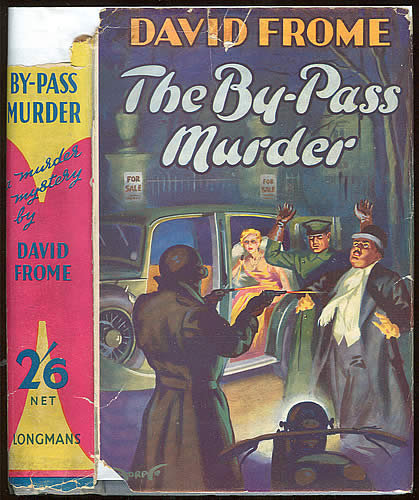
Zenith Jones Brown—aka Leslie Ford, David Frome, and Brenda Conrad and a descendant of the illustrious Calvert family of Maryland—was born today in Smith River, CA, in 1898. Her numerous mystery works include The By-Pass Murder (1932), The Strangled Witness (1934), Ill Met by Moonlight (1937), The Simple Way of Poison (1937), Three Bright Pebbles (1938), and The Girl from the Mimosa Club (1957, selected as one of Mystery Loves Company's Best Mysteries of the Century). She died in Baltimore in 1983.