Showing posts with label Cornell Woolrich. Show all posts

Monday, September 29, 2025

Clues 43.2: Disability and Detective Fiction.

Volume 43, no. 2, of Clues: A Journal of Detection has been published—a theme issue on Disability and Detective Fiction, guest edited by Susannah B. Mintz (Skidmore College) and Mark Osteen (Loyola Univ Maryland). See below for the abstracts. Contact McFarland for a copy of the issue or a subscription.

Update, 11 Jan 2026: Kindle version and Nook version available.

Update, 18 Jan 2026: Google Play version available.

Introduction: Disability and Detective Fiction
 / Susannah B. Mintz and Mark Osteen 


“The blindest of the blind”: Blind Men, Beggars, and Murderers in Catherine Crowe’s Crime Fiction / Emily Cline
Catherine Crowe portrays literal and figurative blindness in the proto-detective stories Men and Women (1843), Lilly Dawson (1847), and “The Blind Witness and His Dog” (1849).  Embodied and metaphorical blindness propose competing forms of knowledge, sympathetic and diagnostic, revealing the optocentric biases that limit the Victorian criminal court’s means of detection. 


Seeing Is (Dis)believing: Mary Elizabeth Braddon’s Classification of Disability in The Trail of the Serpent  / Roshnara Kissoon (Teachers College, Columbia University)
This essay examines the depiction of disability in Mary Elizabeth Braddon’s The Trail of the Serpent (1860), which features a nonverbal detective protagonist. Braddon’s novel elucidates, and contributes to, a taxonomy of disability that intersects with its nuanced class system, ultimately revealing the limits of both, despite its innovative portrayal. 


Broken Bones: Isolation, Mobility, and Interdependence in Rear Window / Mark Osteen 
This essay demonstrates how the sleuthing of L.B. Jefferies, his girlfriend Lisa, and his nurse Stella metaphorically reassembles Mrs. Thorwald, Rear Window’s murder victim. Jefferies’s disability eventually enables him to recognize not only his but also neighbors’ interdependency and results in his metamorphosis into a more compassionate neighbor and lover. 

“Do you see?”: Disability and “Seeing” Evidence in Thomas Harris’s Red Dragon / Darren Gray 
Red Dragon subverts crime fiction’s tropes of the monstrous criminal and extraordinary detective by exploring both disabled and nondisabled viewpoints. Through disfigured and speech-impaired criminal Francis Dolarhyde, investigator Will Graham, and the blind Reba McAllen, Thomas Harris exposes the subjectivity of perception and the impacts of ableism, marginalization, and prejudice. 


Disabilities and Stephen King’s Detectives / Michael J. Blouin (Milligan Univ)
Stephen King has repeatedly returned to characters with disabilities to explore what it means to be human, intersecting with King’s under-examined forays into detective fiction. Although King’s depictions of individuals living with disabilities remain problematic, his bestselling works offer fecund sites for ruminating upon the relationship between disabilities and detective stories. 

Monday, May 22, 2023

"Directed by Ida Lupino: Macabre Television."

Ida Lupino.
On June 24 at the Billy Wilder Theater, UCLA Film & Television Archive will salute some of Ida Lupino's directing contributions to TV mystery and horror through the program "Directed by Ida Lupino: Macabre Television," showing the episodes "A Crime for Mothers" (Alfred Hitchcock Presents),  "Guillotine" (Thriller; screenplay by Charles Beaumont, based on a story by Cornell Woolrich), and "The Masks" (Twilight Zone).

Monday, May 01, 2023

Hardboiled programs, DeKalb (IL) Public Library.

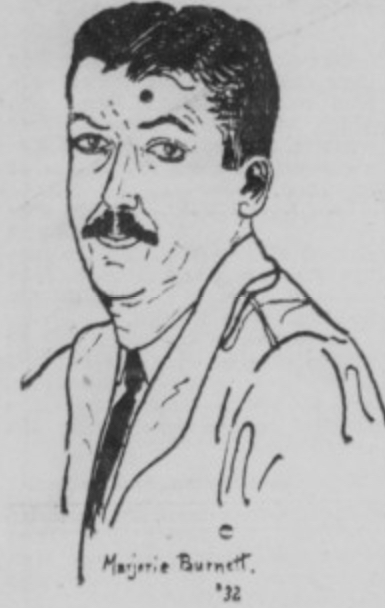
From May through August, DeKalb (IL) Public Library is hosting the free monthly program "The Golden Age of Film Noir and Its Novels," discussing key novels and showing clips from their film adaptations. Authors featured include Dashiell Hammett (May 27), James M. Cain, W. R. Burnett, and Cornell Woolrich.

Photos: (left) James M. Cain; (right) Dashiell Hammett, Yank, 30 Nov. 1945; (bottom, top) illustration of W. R. Burnett by his first wife, Marjorie Burnett, 1932; Cornell Woolrich.


Monday, April 04, 2022

Online exhibition, Teaching with Mass-Market Paperbacks.

The Phantom of the Opera by
Gaston Leroux, part of the
UNC Libraries exhibition
The UNC Libraries online exhibition "Teaching with Mass-Market Paperbacks" draws on the paperback collection of UNC Chapel Hill to assist instructors who wish to use such works in their classroom. Some sample lesson plans are provided. Mystery books include assorted works by Dashiell Hammett and Raymond Chandler; The Blue Geranium by Dolan Birkley (aka Dolores Hitchens); The Couch by Robert Bloch; Honeymoon in Hell by Fredric Brown; Cassidy's Girl by David Goodis; A Taste for Honey by H. F. Heard; I Married a Dead Man and other works by William Irish (aka Cornell Woolrich); and Sorry, Wrong Number by Allan Ullman and Lucille Fletcher (as the cover notes: "She Dialed .. D-E-A-T-H").

Tuesday, November 05, 2019

The Chase (1946).

Based on The Black Path of Fear by Cornell Woolrich, The Chase features Robert Cummings as a troubled World War II veteran who becomes chauffeur to gangster Steve Cochran and entangled with Cochran's wife (Michele Morgan). Peter Lorre costars.

Tuesday, January 08, 2019

"Lullaby" (1953).

In this 3 October 1953 episode of Revlon Mirror Theatre adapted from "The Hummingbird Comes Home" by Cornell Woolrich, a blind woman (Agnes Moorehead, in her TV debut) suspects her son (Tom Drake) of involvement in robbery and manslaughter. Lee Marvin costars.

Tuesday, November 13, 2018

The Guilty (1947).

Based on the story "He Looked Like Murder" (1941) by Cornell Woolrich, The Guilty features Bonita Granville as twins; a murder; and suspects that include the other twin, a veteran, and a lodger in the home of the women's mother.

Tuesday, May 01, 2018

Woolrich's Street of Chance (1942).

Claire Trevor, Sheldon Leonard, and
Burgess Meredith in Street of Chance (1942)
In Street of Chance, Burgess Meredith is accused of murder, but he has no memory of the crime or of his past. The film is based on The Black Curtain by Cornell Woolrich. Costars include Claire Trevor, Sheldon Leonard, and Jerome Cowan.

Tuesday, March 13, 2018

Phantom Lady (1944).

Ella Raines and
Thomas Gomez in
Phantom Lady
Directed by Robert Siodmak (The Spiral Staircase, etc.), this adaptation of Cornell Woolrich's book features Ella Raines turning sleuth to exonerate her boss, who is accused of killing his wife.

Monday, June 26, 2017

Pulp cover art exhibition in Florida.

Cover of 15 May 1937 Argosy included
in the "In the Shadows" exhibition. Note
contributors include Cornell Woolrich,
Lawrence G. Blochman, and Judson
Philips (aka Hugh Pentecost)
At Florida International University's Wolfsonian until July 9 is the student-curated exhibition "In the Shadows; American Pulp Cover Art." Included are covers from Argosy, Detective Fiction, Detective Novels Magazine, G-Men Detective, and Popular Detective. Wolfsonian chief librarian Frank Luca discusses the exhibition and the students' research aims here.

Monday, June 20, 2016

"The Artists Who Make Argosy."

4 Nov 1922 Argosy cover by
Stockton Mulford
In advance of July's PulpFest in Columbus, OH, Mike Chomko gives a preview of "The Artists Who Make Argosy," the upcoming session with David Saunders that will celebrate the contributing artists to the legendary pulp magazine launched in 1882. The magazine's contributing writers included Max Brand, Norbert Davis, Erle Stanley Gardner, Robert E. Howard, Mary Roberts Rinehart, and Cornell Woolrich. Saunders is the son of illustrator Norman Saunders.

Wednesday, November 12, 2014

New releases: Poe, Woolrich film scores.

Clues 26.4 (2008), w/Barbara Stanwyck
and John Lund from No Man of Her Own
Scott Bettancourt of Film Score Monthly highlights the following new releases:
  • Hugo Friedhofer's score for No Man of Her Own (film with Barbara Stanwyck based on I Married a Dead Man by William Irish, aka Cornell Woolrich)

Tuesday, June 24, 2014

Woolrich's "Post Mortem" (May 1949).

In this 1949 episode of Suspense based on Cornell Woolrich's "Post Mortem" (Black Mask, Apr. 1940) and directed by Robert Stevens (Alfred Hitchcock Presents, Twilight Zone), a woman marries a doctor who has a disturbing track record when it comes to life insurance.

Tuesday, June 03, 2014

Woolrich's "The Listener" (1956).

In this February 1956 episode of Four Star Playhouse based on Cornell Woolrich's "Eyes That Watch You," Ida Lupino has some dark plans in store for her husband—but are she and her accomplice the only ones who know? Playing her brother is Richard Lupino (a cousin to Ida Lupino and Buster Keaton).

Tuesday, February 04, 2014

Podcasts on mystery films, Warner Archive.

The latest episode of the Warner Archive Collection podcast discusses the release of Bill Elliott Detective Mysteries (1955–57), a DVD of films with Elliott as a detective working in the LA sheriff's office:

Calling Homicide (a police officer's death is connected to the murder of a head of a modeling school)

Chain of Evidence (man with amnesia faces murder charges)

Dial Red-O (disturbed veteran is accused of killing his wife)

Footsteps in the Night (Elliott on the trail of a strangler)

Sudden Danger (son seeks his father's murderer)

Other podcast episodes include:
  • Episode on Terror on a Train (1953, with Glenn Ford) and The Decks Ran Red (1958, with James Mason and Dorothy Dandridge)
  • Episode on The Mask of Dimitrios (1944, from the novel by Eric Ambler), A Dangerous Profession (1949), Duffy of San Quentin (1954), The Fall Guy (1947, from Cornell Woolrich's "Cocaine"/"C-Jag"), FBI Code 98 (1963), and Loophole (1954)
  • Episode on the Hildegarde Withers Mystery Collection that features the spinster detective created by Stuart Palmer and popularized by Edna May Oliver

Monday, April 15, 2013

Clues 31.1: Hitchcock and adaptation.


"Hitchcock and Adaptation" is the theme of Clues 31.1 (2013), guest edited by Loyola Univ Maryland's Mark Osteen (author of Nightmare Alley: Film Noir and the American Dream). The following is a summary of the contents (with links on the article titles). To order the issue or subscribe to Clues, visit this Web page or download the subscription flyer.

Introduction. MARK OSTEEN

Melancholy Elephants: Hitchcock and Ingenious Adaptation. KEN MOGG Alfred Hitchcock films such as Marnie and Young and Innocent represent a world that is equivocal. Highly ingenious and imaginative, they enable the spectator, much like the character Roger Thornhill in North by Northwest, to re-engage with that world and come “alive.”

"Inspiring Public Uneasiness": Hitchcock's Adaptation of Conrad's "Simple Tale." MATTHEW PAUL CARLSON (High Point Univ, NC) In Alfred Hitchcock’s Sabotage (1936; adapted from Joseph Conrad’s The Secret Agent, 1907), the director goes beyond mere use of the novel as a point of departure; he deeply engages its underlying anxieties about the artist’s relationship to his audience.

Reading Hitchcock/Reading Queer: Adaptation, Narrativity, and a Queer Mode of Address in Rope, Strangers on a Train, and Psycho. HEATH A. DIEHL (Bowling Green State Univ) Alfred Hitchcock’s Rope (1948) and Strangers on a Train (1951) reveal an interest in the odd; the peculiar; the “queer.” The author examines the narrative choices made in adaptation.

"Dear Miss Lonelyhearts": Voyeurism and the Spectacle of Human Suffering in Rear Window. NICHOLAS ANDREW MILLER (Loyola Univ Maryland) Rear Window offers a powerful meditation on the ethical implications of private voyeurism in the public sphere. The film draws thematic inspiration from Nathanael West’s Miss Lonelyhearts.

"The Proper Geography": Hitchcock's Adaptation of Daphne du Maurier's "The Birds." JOHN BRUNS (College of Charleston) Alfred Hitchcock’s adaptation of Daphne du Maurier’s “The Birds” illuminates the technical aspects of his process of adaptation, much-ignored similarities between du Maurier’s text and Hitchcock’s film, and the anxiogenics of spatial dislocation.

Hitchcock's Diegetic Imagination: Thornton Wilder, Shadow of a Doubt, and Hitchcock's Mise-en-Scene. DONNA KORNHABER (UT-Austin) The author considers the collaboration between Thornton Wilder and Alfred Hitchcock on Shadow of a Doubt (1943) and examines the influence of Wilder’s theories of theatrical abstraction and cinematic realism on Hitchcock’s developing sense of mise-en-scène.

The Second Look, the Second Death: W. G. Sebald's Orphic Adaptation of Hitchcock's Vertigo. R. J. A. KILBOURN (Wilfred Laurier Univ, Canada) This essay compares W. G. Sebald’s novel Vertigo (1991) and Hitchcock’s 1958 film Vertigo. The book extends key themes and formal strategies in the film, most notably Hitchcock’s famous “vertigo shot.”

Adapting Poe, Adapting Hitchcock: Robert Bloch in the Shadow of Hitchcock's Television Empire. DENNIS R. PERRY and CARL H. SEDERHOLM (both Brigham Young Univ) Alfred Hitchcock’s television programs challenged adaptors to transfer his style and persona to the small screen. Robert Bloch invoked his own and Hitchcock’s deep interest in Poe to create episodes that tended to be more dark, ironic, and psychologically edgy than others.

Extraordinary Renditions: DeLillo's Point Omega and Hitchcock's Psycho. MARK OSTEEN Tracing how Don DeLillo’s novella rings changes on the word rendition, the author unravels a skein of intertextual and metacinematic relations that stretches from Psycho to Douglas Gordon’s 24 Hour Psycho video installation, Robert Bloch’s original novel, and the many Psycho remakes.

REVIEWS
Susan M. Griffin and Alan Nadel, eds. The Men Who Knew Too Much: Henry James and Alfred Hitchcock. PAMELA BEDORE

R. Barton Palmer and David Boyd, eds. Hitchcock at the Source: The Auteur as Adaptor. JOHN TEEL

Tuesday, October 16, 2012

Woolrich's Fear in the Night (1947).


A man is uncertain if his dream of committing murder is just a dream—or reality. The film, based on "And So to Death" (1941, later repr. as "Nightmare") by Cornell Woolrich under the pseudonym of William Irish, stars Star Trek's DeForest Kelley.

Wednesday, November 17, 2010

The apartment in film noir and other genres.

Jimmy Stewart in
Rear Window
The Apartment Plot by Notre Dame's Pamela Robertson Wojcik analyzes the role of the urban apartment from 1945 to 1975 in film noir and other genres. The book includes discussion of Rear Window (dir. Alfred Hitchcock, writ. Cornell Woolrich and John Michael Hayes, 1954).

Monday, September 13, 2010

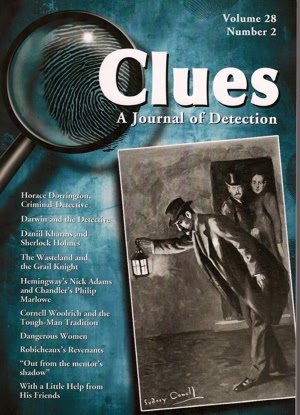
Clues 28.2: Cornell Woolrich, Vera Caspary, Arthur Conan Doyle, James Lee Burke, et al.

Volume 28, no. 2 of Clues: A Journal of Detection has been published, which offers among its highlights:

• Hilary A. Goldsmith on Darwinian echoes in Conan Doyle

• Clare Clarke on Arthur Morrison's Horace Dorrington, criminal-detective

• Christine Photinos on whether Cornell Woolrich can be considered a member of the US hard-boiled school

• Laura Vorachek on Vera Caspary's rewriting of Mary Elizabeth Braddon's Lady Audley's Secret (1862) in Bedelia (1945)

• Patricia Gaitely on the supernatural in James Lee Burke

A particularly interesting article is Lisanne Sauerwald's analysis of Russian absurdist writer Daniil Kharms (1905–42), who was so enamored of Sherlock Holmes that he dressed like an English gentleman and encoded Holmes's Russian name, Kholms, into his pseudonym, Kharms. Sauerwald also notes that Conan Doyle's name appeared on 1920s lists of censored authors in Russia. Some of the passages included in this article have been translated into English for the first time.

For the table of contents with article abstracts, go here. For online access and subscription information, go here. For indices from Clues vols 1 to 28, go here.

Thursday, January 21, 2010

Vera Caspary's Murder in the Stork Club.

Crippen & Landru has published The Murder in the Stork Club and Other Mysteries, an anthology of Vera Caspary's short stories. I played a small part in the book, as A. B. Emrys, who wrote the Clues 23.3 article "Laura, Vera, and Wilkie," mentioned that mystery stories, which had only been published in magazines, existed in the Caspary papers at the Wisconsin Center for Film and Theater Research; I suggested that she contact C&L's Doug Greene regarding a possible publication.

Emrys (University of Nebraska–Kearney) has done significant critical work on Caspary; in addition to her Clues article, she wrote afterwords to the new editions of Caspary's Laura and Bedelia published by Feminist Press. Her introduction to the collection connects Caspary's fiction, play, and film work with events in her life.

As Emrys notes (pp. 8, 15), Caspary was not a great mystery fan, although she admired the work of Wilkie Collins and Cornell Woolrich, as well as Before the Fact by Francis Iles (aka Anthony Berkeley Cox; filmed as Suspicion by Alfred Hitchcock). The stories continue Caspary's interest in sexual politics and racial issues, and further illuminate her role as a trailblazing writer and professional woman. The menace in her "Stranger in the House" (1943) recalls Charlotte Armstrong or Celia Fremlin. "The Murder in the Stork Club" offers a possible future scenario for the relationship between Laura's Mark McPherson and Laura Hunt, as it features a detective husband and his wife, a writer of radio programs (echoing the Ann Sothern character in A Letter to Three Wives, on which Caspary served as screenwriter). It also includes a Christie-like gathering of suspects at the glamorous club.

For my take on Caspary's wry autobiography, The Secrets of Grown-ups, go here.
... to my mind crime is sordid and inevitably associated with gangsters, frustrated choir singers in dusty suburban towns, and starving old ladies supposed to have hidden vast fortunes in the bedsprings.

—Vera Caspary, "Sugar and Spice." 1943.
The Murder in the Stork Club and Other Mysteries 60
About the photo: Vera Caspary, by Jane Rady. From The Secrets of Grown-ups.