Showing posts with label EQMM. Show all posts

Monday, June 15, 2026

My July-Aug 2026 EQMM column.


My new Jury Box column w/reviews of mystery short story collections and classic reprints is now posted at Ellery Queen's Mystery Magazine, featuring works that focus on the impossible crime (Elsa Barker, Christianna Brand, Charles Chadwick, Mary Collins, Celia Fremlin, Peter Lovesey, T.S. Stribling).

Monday, June 16, 2025

My July-Aug 2025 EQMM column.

My Jury Box column has been published in the July/August 2025 Ellery Queen Mystery Magazine, including reviews of short story collections and classic reprints by Ethel Lina White (of The Lady Vanishes and Some Must Watch fame), Sara Woods, the intriguing Madelon St. Denis, Miles Burton (aka Cecil John Charles Street), Dorothy Cameron Disney, and Mary Fortune (a 19th-century mystery pioneer who emigrated to Australia).

Monday, June 17, 2024

My July-Aug 2024 EQMM column.

My column, The Jury Box, appears in the July/Aug 2024 Ellery Queen Mystery Magazine. In it, I review recent classic reprints and short story collections that offer elements atypical in mystery fiction (like the unreliable narrator). Authors covered are Joan Cockin (aka Edith Joan Burbidge Macintosh), Sebastian Farr (aka Eric Walter Blom), Lorenz Heller, Edward D. Hoch, R. M. Laurenson, Helen Nielsen, Isabel Ostrander, and Florence Ryerson and Colin Clements.

Monday, June 26, 2023

A new Jury Box columnist for EQMM.

I debut in the July/Aug 2023 Ellery Queen Mystery Magazine as The Jury Box columnist (I am the first woman to write the column--I think I'll be writing one column per year). As someone who grew up reading Jon L. Breen's Jury Box reviews, it's a dream come true. I review classic reprints or short story collections by Anthony Berkeley [Cox], Eleanor A. Blake, J. Harvey Bond [Russell Robert Winterbotham], Mary Fitt [Kathleen Freeman], Elisabeth Sanxay Holding, E. C. R. Lorac [Edith Caroline Rivett], Ellery Queen & Josh Pachter, Jack Ritchie [John George Reitci], and Susan Scarlett [Noel Streatfeild].

Tuesday, June 27, 2017

Remembering James Yaffe:
"Dragon in the Den" (1963).

James Yaffe, right, with
Frederic Dannay, 1943.
Library of Congress, Prints
and Photographs Div.
James Yaffe, who sold his first story to EQMM at age 15 and was a longtime English professor at Colorado College, died on June 4 at age 90. One of his characters was Mom, who solves cases for her policeman son over dinner (she appears in A Nice Murder for Mom, Mom Meets Her Maker, and Mom Doth Murder Sleep, as well as in the Crippen and Landru collection My Mother, the Detective). Yaffe's other works include plays ("The Deadly Game"; "Cliffhanger"; "Dear Me, the Sky Is Falling") and screenplays for such TV series as Studio One, the U.S. Steel Hour, and the Alfred Hitchcock Hour. Another of his episodes was "Dragon in the Den" (1963) for the TV series Channing, which features William Shatner as a candidate for state attorney general who discovers there's no such thing as a clean campaign. Costarring are Henry Jones as Channing dean Fred Baker, Jason Evers as a Channing professor, and Denver Pyle as Shatner's campaign manager.

Wednesday, April 26, 2017

Foxwell on mystery reviewing, EQMM blog.

Today on the EQMM blog "Something Is About to Happen," I discuss "The Not-So-Simple Art of Mystery Reviewing," including a look back at some eminent reviewers (such as Walter R. Brooks, Dorothy L. Sayers, Dorothy B. Hughes, Howard Haycraft, and Anthony Boucher).

Tuesday, November 15, 2016

Simenon's "The Old Lady of Bayeux" (1952).

Georges Simenon, May 1965.
Fotocollectie Anefo,
Dutch National Archives
In this Sept. 1952 episode of Suspense directed and produced by Robert Stevens with lots of dramatic organ music, a wealthy widow dies, and a visiting Inspector Maigret (Luis Van Rooten) doubts that a heart attack was the cause of death. The episode is based on Georges Simenon's Aug. 1952 EQMM story of the same name (trans. of "La Vieille Dame de Bayeux," 1939).

Tuesday, September 22, 2015

"Age of Peril" (1952).

In this February 1952 episode of Tales of Tomorrow adapted from "Crisis 1999" (EQMM, Aug 1949) by mystery-sci fi author Fredric Brown, an agent (character actor Dennis Patrick) sets out to discover who is leaking classified defense secrets. Phyllis Kirk co-stars.

Monday, May 19, 2014

Whitman's story of murder.

Walt Whitman. NYPL.
In the "Story of the Week," Library of America features Walt Whitman's "One Wicked Impulse!," which deals with the ironic aftermath of the murder of a unscrupulous lawyer. The introduction to "Impulse" mentions that the story was first published in 1845 and reprinted in the January 1954 EQMM.

Tuesday, July 09, 2013

Cozzens's "Clerical Error" (1983).

In this April 1983 episode of Tales of the Unexpected, some shady booksellers attempt to extort a dead man's family—with unexpected results. Poirot's Hugh Fraser appears in this adaptation of James Gould Cozzens's "Foot in It" (Redbook Aug. 1935; repr. as "Clerical Error" in venues such as the June 1950 EQMM, Ellery Queen's The Literature of Crime, and Marcia Muller and Bill Pronzini's Chapter and Hearse). Cozzens (1903–78), author of the Haycraft-Queen Cornerstone novel The Just and the Unjust and the Pulitzer Prize winner Guard of Honor (admired by Raymond Chandler), was dubbed "the Garbo of U.S. letters" by Time magazine in 1957.

Monday, June 03, 2013

It came from the archives: Fitzgerald's ledger.

The Irvin Dept of Rare Books and Special Collections at the University of South Carolina has digitized F. Scott Fitzgerald's ledger in which he recorded his earnings from writing, as well as income by his wife, Zelda. Entries range from the listing of his first published short story ("Babes in the Woods," Smart Set, Sept. 1918) and notations on the income from his novels to the record of his appreciation of journalist and author Ring Lardner (New Republic, Oct. 1933) and the radio piece "Let's Go Out and Play" (1935).

F. Scott Fitzgerald.
Library of Congress,
Prints and Photographs Div. 
The ledger also includes an autobiographical timeline. Although many may not be interested in the fact that Fitzgerald had colic when he was a baby and find his references to being drunk or "tight" repetitive, he notes in the 1909 entries, "Wrote the Mystery of the Raymond Mortgage." (This flawed mystery tale, later reprinted in EQMM, is found in The Apprentice Fiction of F. Scott Fitzgerald, ed. John Kuehl; I discuss it in my 1999 piece for Mystery Scene, "F. Scott Fitzgerald: Mystery Writer?") There is a tantalizing notation on one of the "ten years old" pages, "He began a history of the U.S. and also a detective story about a necklace that was hidden in [sic] a trapdoor under the carpet," but the latter does not seem to have come to fruition (a trap door concealed by a carpet does appear in Fitzgerald's Pat Hobby story "No Harm Trying").

There are lively bits such as the reaction of his grade school classmates to him ("Will someone poison Scotty or find some means to shut his mouth") and sadder details such as "Zelda transferred to Sheppard [psychiatric facility in Maryland] in katatonic [sic] state."

Update. Princeton has digitized the corrected galleys to The Great Gatsby. (thanks, PhiloBiblos)

Friday, January 11, 2013

"The Grave Grass Quivers," by MacKinlay Kantor (1931).

I had the strange notion that Doctor George Martindale, after unloading the sad story of his youth, had taken two days in going deliberately and completely insane.
—MacKinlay Kantor, "The Grave Grass Quivers" (Omnibus 184)


In "The Grave Grass Quivers," a country doctor suspects that his father and brother were murdered years ago, but thinks he can finally prove it with the assistance of a younger colleague. The story resonates today as the doctor conveys the anguish of himself and his family in not knowing what has happened to their loved ones.

MacKinlay Kantor (1904–77) is probably best known for his Pulitzer Prize-winning Andersonville (1955) and Glory for Me (1945; the basis for the film The Best Years of Our Lives), but he also wrote pulp stories and the story and screenplay (the latter with Dalton Trumbo) for the film Gun Crazy (1950). "The Grave Grass Quivers" was first published in the Elks Magazine in 1931 (repr. The Third Omnibus of Crime, ed. Dorothy L. Sayers, 1935; EQMM, Mar 1949; and It's About Crime, 1960). 
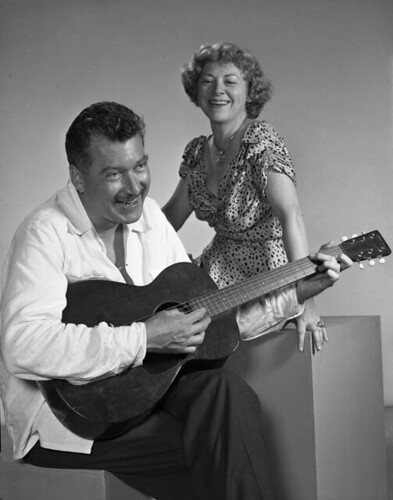
Novelist MacKinlay Kantor playing the guitar: Sarasota, Florida
MacKinlay Kantor plays the guitar.
July 1950. Photo: State Library
and Archives of Florida

Tuesday, July 31, 2012

Faulkner's "An Error in Chemistry," on screen.

"An Error in Chemistry" (1954) is an episode of Climax! adapted from a 1946 EQMM story by William Faulkner (one of his stories with lawyer Gavin Stevens collected in Knight's Gambit). Edmond O'Brien is a carnival huckster who readily confesses to killing his wife; also featured is Lon Chaney Jr.

Wednesday, September 14, 2011

AKA: Five pseudonymous female mystery authors.

M. C. Beaton. The lighthearted Beaton mysteries feature dour Scottish constable Hamish MacBeth (adapted for television) and the always-in-trouble Agatha Raisin (adapted for radio with Penelope Keith), but under Beaton's real name, Marion Chesney, other mysteries have appeared (such as the Edwardian-set Snobbery with Violence) as well as romance novels.


Italian ed. of David Frome's
The Hammersmith Murders
David Frome/Leslie Ford. Zenith Jones Brown began her mystery career with Murder of an Old Man (1929) under the pseudonym David Frome, followed by more than 15 Frome mysteries and more than 30 mysteries under the name Leslie Ford. Her sleuths include Mr. Pinkerton, Inspector Bull, Colonel Pickering, and Grace Latham. The bookstore Mystery Loves Company selected Ford's Girl from the Mimosa Club (1957) as one of the best mysteries of the 20th century.

Nina Foch in
My Name Is Julia Ross (1945),
based on Anthony Gilbert's
The Woman in Red (1943)
Anthony Gilbert. Lucy Beatrice Malleson, a relative of actor Miles Malleson (Kind Hearts and Coronets, etc.), wrote 32 books under the four pseudonyms of Anne Meredith, J. Kilmeny Keith, Sylvia Denys Hooke, and Lucy Egerton. However, vulgar lawyer Arthur Crook is the star of most of the 60 novels under Malleson's pen name of Anthony Gilbert. Crook debuted in Murder by Experts (1936); the final Gilbert book was A Nice Little Killing (1974). A Detection Club member, she was an Edgar nominee for "Door to a Different World" (EQMM Mar. 1970) and "Fifty Years After" (EQMM Mar. 1973).

Evelyn Piper. Merriam Modell, wife of a Cornell pharmacology professor, wrote stories for the New Yorker and the novel The Sound of Years (1946), but it was under the name Evelyn Piper that she published her most well-known work: Bunny Lake Is Missing (1957, film 1965). Other Piper books include the Edgar-nominated The Innocent (1949), the Haycraft-Queen Cornerstone work The Motive (1950; called by the New York Times "a fine study in the detection not of who, but of why"), The Plot (1951), The Lady and Her Doctor (1956), Hanno's Doll (1961), The Naked Murderer (1962), The Nanny (1964, film 1965), and The Stand-In (1970).

Peter Vaughan in
Die! Die! My Darling
(1965), based on
Anne Blaisdell's Edgar-
nominated Nightmare
Dell Shannon. Illinois-born author Elizabeth Linington wrote under the pseudonyms Anne Blaisdell, Egan O'Neill, and Leslie Egan, as well as her own name; her police procedurals under the name Dell Shannon feature the LAPD's Luis Mendoza, including the Edgar-nominated novels Case Pending (1960) and Knave of Hearts (1962).

Wednesday, August 24, 2011

Harry Miner, before EQMM.

Harold E. Miner,
from the 1932
UW-Madison yearbk
The spring 2011 Wisconsin Magazine of History has an article by Michael Edmonds on "The Federal Writers Project in Wisconsin 1935–42" that details the often rocky course of the project in the state, including a brush with HUAC and the various travel, folklore, and other publications produced. It extensively quotes Harold Miner (1910–80), who worked for the project in Madison. This is Harry Miner, who served with the OSS and inspected Hitler's bunker after the latter's suicide; he also wrote "Corpus Delicti" (EQMM Nov. 1951, part of EQMM's "Department of First Stories"; deals with postwar Germany) and "Due Process" (EQMM Nov. 1954; repr. Ellery Queen's Awards, 9th ser., 1956).

Friday, June 25, 2010

Edna St. Vincent Millay's home now open
to the public.

As the Albany Times-Union reports, Steepletop (the Austerlitz, NY, home of poet, Provincetown Players member, and Pulitzer Prize recipient Edna St. Vincent Millay) has been opened to the public.

As I noted in my spring 2003 article in Mystery Scene, "'Me and Eddie Poe': Edna St. Vincent Millay's Dips into Mystery," Millay had a short-lived flirtation with mystery stories, including one, "Murder in the Fishing Cat," that eventually was reprinted in EQMM.

About the image: Edna St. Vincent Millay, NYPL