Monday, November 14, 2016

A British mystery author's work with Holocaust survivors.

Charity Blackstock.
Photo by Mark Gerson
The Neglected Books blog highlights The Children (1966) by mystery writer Charity Blackstock (pseudonym of Ursula Torday, 1912–97; 1959 Edgar nominee for The Woman in the Woods). The Children are those traumatized by the Holocaust who came for a holiday in England, sponsored by a group headed by Torday (a Gentile). The New York Times called it a "moving and remarkable memoir."

Tuesday, November 08, 2016

Tourneur's "Into the Night" (1955).

Eddie Albert and Ruth Roman
in "Into the Night"
In this episode of GE Theater directed by Jacques Tourneur (Out of the Past, etc.) from a story by Charles Hoffman (The Blue Gardenia, Peter Gunn, Hawaiian Eye), a husband and wife (Eddie Albert and Ruth Roman) engage in a battle of wits with two carjackers (Dane Clark and Robert Armstrong) fleeing robbery and murder charges; Jerry Mathers appears briefly as their son. Chris Fujiwara's book on Tourneur notes the episode's parallels with Ida Lupino's The Hitch-Hiker (1953).

Monday, November 07, 2016

A silent film actor's mystery novel.

Silent film actor and author
James W. Morrison
in 1916
. . . suddenly the quiet was broken by the sharp report of a pistol, followed by the piercing sound of a police whistle.
—Woods Morrison, Road End 185
As the Daily Illini wrote on 18 June 1927, Charlie Chan creator Earl Derr Biggers stated, as the bookshelves were overflowing with mystery stories, "how pleasant it would be if all but three or four mystery novelists could be taken out and painlessly drowned. Only I can never decide as to the survivors . . . ."

However, the debut mystery of Woods Morrison, Road End (1927), had caused a rethink by Biggers. ". . . Whether I want to or not, I've got to welcome Woods Morrison. . . . [O]nce he gets going, he deals out thrills with the speed and nonchalance of a river gambler dealing cards" (4).

The first novel of Morrison (1888–1974)—a University of Chicago graduate who acted under the name James W. Morrison (including roles in the silent films Black Beauty, The Little Minister, and Captain Blood) and later taught drama at the Packer Collegiate Institute in New York—focuses on murder, the theft of a pearl necklace, strange wailing, and other mysterious occurrences at an elegant Long Island house, with a down-on-his-luck young man taking on the roles of chauffeur and sleuth. (The ending, however, is rather weak.) The book was serialized in the Philadelphia Inquirer in Feb.–May 1934 (note that some of the pages are faint, and the following are all the parts I could find):

• Chapters 1–2 
• Chapter 3
• Chapters 5–6
• Chapters 6–7
• Chapters 7–8
• Chapters 10–11 
• Chapters 12–13
• Chapters 14–15
• Chapters 16–17

Silent film scholar Anthony Slide paints a sad picture of Morrison later in life crippled by arthritis, living in a small Greenwich Village apartment, and considering his silent film career to be insubstantial (despite Slide's views to the contrary).

The following are other works by Morrison:

• April Luck (1932). "The moving story of a sensitive girl whom fate made into a glamorous adventuress"

• "Under Pressure" (Liberty magazine, 17 Dec. 1932)

•  "Alias Miss Williams" (Brooklyn Daily Eagle, 8 Oct. 1933)

Wednesday, November 02, 2016

Richard Atwater on detective novels, 1930.
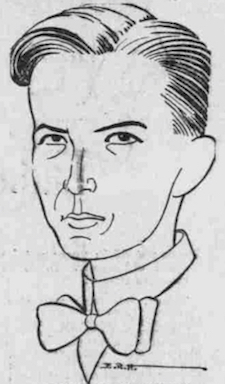
Illustration of Richard Atwater, frm
21 Oct 1922 Bisbee Daily Review
Richard Atwater (1892–1948) was coauthor of the Newbery Award-nominated Mr. Popper's Penguins, a classics professor at the University of Chicago, and a frequent contributor to Chicago newspapers. In a 7 Jun 1930 article in The Chicagoan, Atwater asserted that "there are only six detective novels in existence: the rest being a rewriting of the same plots" (15). The following were his picks for the two best detective novels partly because "neither . . . has a butler in it":
• G. K. Chesterton, The Man Who Was Thursday (1908). Chesterton's classic tale of unlikely agent Gabriel Syme infiltrating an anarchist group
• James Branch Cabell, The Cream of the Jest (1917). It is unusual to characterize this book as a detective work, as it is a satire—a fictional work with fantasy elements within a fictional work.
Tongue planted firmly in cheek, Atwater then floated his idea for a detective novel, in which a valet named Rudy offends because of his crooning (one suspects that Atwater was no fan of Rudy Vallee), and decorators "mistaking Rudy for the new wall paper, . . .  paste him to the wall of the master's study. As the master never studies, nobody discovers the error, and the crime is never known" (15).

Tuesday, November 01, 2016

The Moonstone (1934).

David Manners, who plays
Franklin Blake in
The Moonstone (1934)
There's a new BBC One version of Wilkie Collins's The Moonstone, which is the seventh adaptation for the screen of the tale about a stolen gem and its effect on a family. The third screen adaptation was in 1934, with Sergeant Cuff promoted to a Scotland Yard inspector.

Tuesday, October 25, 2016

"The Town that Slept w/the Lights On" (1958).

Edmond O'Brien,
ca. 1954
Edmond O'Brien directs this episode of Schlitz Playhouse as well as plays a hard-hitting New York reporter investigating two murders in a small town and doubting the Hispanic suspect fingered by vigilantes. The episode (which has a hardboiled-style voiceover and discussion of domestic violence) is written by Liam O'Brien, Edmond's screenwriter-producer brother (Police Story, Hawaii Five-0, Miami Vice).

Monday, October 24, 2016

A mystery parody by Harry Stephen Keeler?

Harry Stephen Keeler, from
his 1916 passport application
In the latest issue of Keeler News, the newsletter of the Harry Stephen Keeler Society, Morgan Wallace posits plausibly that mystery/sci-fi writer Keeler wrote a 1920 PI parody, "The Keenwit Case," for the Chicago Ledger under the pseudonym Lon Riggs to make a point about the types of material that could come over the transom at a periodical. "The Keenwit Case" is reproduced in the newsletter and features such immortal statements as "[t]hen he lighted a cigar, and smoked viciously. This indicated that his brain was very active, and that without a doubt the clever criminal would be in irons before the close of another day."

Of related interest:
• Link to cartoonist Al Hirschfeld's caricatures of Keeler
• "The Life and Death of Harry Stephen Keeler" by Vincent Starrett

Wednesday, October 19, 2016

Frances Chesterton, wife of G. K.

Stephanie A. Mann provides some insights on poet-playwright Frances Chesterton, wife of G. K. and niece of art historian Mary Margaret Heaton, and mentions the 2015 biography by Nancy Carpentier Brown, The Woman Who Was Chesterton. Brown blogs on Frances Chesterton here. Both writers paint a touching picture of a devoted couple. According to the 13 Dec. 1938 New York Times, G. K. regarded Frances as "in all ways a kindred spirit," and longtime G. K. friend E. C. Bentley (Trent's Last Case) called her G. K.'s "right-hand in all his dealings with the world" (qtd in Brown).

Of related interest: Frances Chesterton being mistaken for The Lodger author Marie Belloc Lowndes and her response: "I am quite willing to feel honored by [the] mistake, but they [Hilaire Belloc and Marie Belloc Lowndes] might feel aggrieved." Belloc (brother of Marie Belloc Lowndes) and G. K. Chesterton were close friends.

Monday, October 17, 2016

Paretsky companion published.

Just published is Sara Paretsky: A Companion to the Mystery Fiction (vol. 7 of the McFarland Companions to Mystery Fiction series) by MWA Raven recipient Margaret Kinsman. I edit the series. Goodies abound in this in-depth analysis of Paretsky's groundbreaking detective V. I. Warshawski and other subjects in the author's fiction and nonfiction works, including Margaret's discussion of Paretsky's first published piece (which she wrote at age 11).

Tuesday, October 11, 2016

Theodore Sturgeon's "No Answer" (1958).

A con man (Donald Cook) who targets wealthy widows seems to have an unshakeable alibi when one of his victims is murdered. Keenan Wynn stars as the police officer frustrated by his previous unsuccessful attempts to nab the man. This Dec. 1958 episode of Schlitz Playhouse is based on the story "Dead Dames Don't Dial" (1956; repr. in And Now the News...) by Theodore Sturgeon (1918–85, best known for science fiction) and is directed by Arthur Hiller (Alfred Hitchcock Presents, Naked City, Perry Mason, The Americanization of Emily, etc.).

Monday, October 10, 2016

At Yale: An illustration of Edgar Allan Poe.

The Room 26 Cabinet of Curiosities blog of Yale's Beinecke Library highlights its new acquisition: postcards that reproduce paintings by artist Peter Oresick. One of them is a portrait of Edgar Allan Poe.

Tuesday, October 04, 2016

Lady in the Death House (1944).

In Lady in the Death House, a woman (Jean Parker) is on death row for the murder of a blackmailer, although she claims she was framed for the crime. A criminologist (Lionel Atwill) looks into the case, seeking to save her from the electric chair. The film is based on "Meet the Executioner" by Frederick C. Davis.

Tuesday, September 27, 2016

Mrs. O'Malley and Mr. Malone (1950).

Based on "Once upon a Train, or the Loco Motive" (1950) by Stuart Palmer and Craig Rice, the comic Mrs. O'Malley and Mr. Malone features Marjorie Main as a radio contest winner and James Whitmore as a lawyer who stumble over constant corpses on their train to New York. Note the sleuths are handcuffed together a la Robert Donat and Madeleine Carroll in The 39 Steps.

Monday, September 26, 2016

Mapping Sherlock Holmes.

Violet Smith pursued in "The
Solitary Cyclist." Detail from
the Sherlock Holmes
Mystery Map (1987).
One of the treasures accessible online via Recollection Wisconsin is the "Sherlock Holmes Mystery Map" (1987) created by Jim Wolnick and Susan Lewis and published by Aaron Blake Publishers. Complete with a "Dancing Men" border, it provides a visual guide to 130 locales in the Holmes canon.

Tuesday, September 20, 2016

A 2001 flashback with Ed McBain.

WYSO's The Book Nook recently rebroadcast Vick Mickunas's 2001 interview with Ed McBain (aka Evan Hunter, 1926–2005) that coincided with the release of McBain's 87th Precinct novel Money, Money, Money. Mickunas describes it as one of his favorite interviews. In addition to Money, Money, Money, McBain discusses The Blackboard Jungle (the first Hunter novel), Cop Hater (the first McBain novel), The Chisholms (a Western), and Candyland (the innovative novel with the double byline of McBain and Hunter). He also talks about growing up in New York City, visiting the Apollo Theater, and working for the Scott Meredith Literary Agency (including editing P.G. Wodehouse).

Monday, September 19, 2016

Murder in song.

University of Kentucky law professor Richard H. Underwood looks at the real-life cases behind ballads featuring murder in Crime Song: True Crime Stories in Southern Murder Ballads. Individuals covered include Frankie Silver, Frankie Bailey (of Frankie and Johnny fame), Delia Green (of Delia's Gone), and Mary Phagan and Leo Frank (of The Ballad of Mary Phagan).  (Thanks to Law & Humanities blog)

Wednesday, September 14, 2016

John le Carre reads from The Pigeon Tunnel.

Via BBC Radio, you can listen to John le Carre reading from his new memoir The Pigeon Tunnel (including an explanation for the title and the intersections of his life between real-life espionage and fiction):

• Episode 1
• Episode 2
• Episode 3
• Episode 4
• Episode 5

Saturday, September 10, 2016

Happy 80th birthday, Peter Lovesey.

Peter Lovesey—story consultant for the TV mystery series Rosemary & Thyme as well as creator of Victorian detective Sergeant Cribb; present-day detective Peter Diamond; and hapless, would-be detective Bertie, Prince of Wales—turns 80 today. His latest novel is Another One Goes Tonight. He appears in this CBS Sunday Morning tribute to P. D. James.

Tuesday, September 06, 2016

Heartbeat (1946).

Adolphe Menjou and Ginger Rogers in Heartbeat (1946)
In Heartbeat (dir. Sam Wood), Ginger Rogers flees reform school for tutoring at Basil Rathbone's school for pickpockets. She is caught in mid-theft by Adolphe Menjou, who compels her to steal a watch from diplomat Jean-Pierre Aumont, as Menjou is suspicious of Aumont's relationship with his wife. Further complications ensue as Ginger is threatened with a return to the reformatory.

Monday, September 05, 2016

More on Conan Doyle and spiritualism.

Arthur Conan Doyle. Library of
Congress, Prints & Photos Div.
New in the journal ELT (English Literature in Transition, 1880–1920) is Angela Fowler's discussion of the post-World War I career of Arthur Conan Doyle, examining his works dealing with spiritualism (The New Revelation, the Professor Challenger novel The Land of Mist, and the horror novella The Parasite) as well as considering his belief in spiritualism in a global context.