Friday, June 30, 2006

In Praise of Purple Prose

Okay, I confess. I really love those 19th- and early 20th-century thrillers with their often overwrought prose. I'm a fan of Louisa May Alcott's work in this area, including A Long, Fatal Love Chase, in which the heroine disguises herself as a man, the man who falls in love with her is a priest, and Alcott, presciently, deals with stalking. Perhaps it's genetic; my sister confesses to an undying devotion for that epitome of villains, Sax Rohmer's Dr. Fu Manchu (insert hissing sounds here).

So imagine my delight when reading an upcoming article for the fall 06 issue of CLUES: A Journal of Detection on the mysteries of Arthur Machen (1863-1947), an inspiration for H.P. Lovecraft and a member of Oscar Wilde's set. Machen's villains are so evil that they dissolve into protoplasm; to wit, in "The White Powder":

"Upon the floor was a dark and putrid mass, seething with corruption and hideous rottenness, neither liquid nor solid, but melting and changing before our eyes, and bubbling with unctuous oily bubbles like boiling pitch. And out of the midst of it I saw two burning points like eyes. "

Now, how can anyone possibly resist that?

You can learn more about Machen at the Friends of Arthur Machen Web site. For etexts of his work, go here.

Monday, June 12, 2006

Happy Birthday, Dorothy L. Sayers

Dorothy L. Sayers was born on June 13, 1893. She could speak Latin, French, and German by the time she was sixteen; she broke new ground when she wrote a play about Jesus, "The Man Who Would Be King," for BBC broadcast (produced by Val Gielgud, John's brother); she was the translator on an acclaimed version of Dante's Divine Comedy. Oh, yeah, and she created aristocratic sleuth Lord Peter Wimsey.

Wimsey appearances on DVD with Ian Carmichael ("The Unpleasantness at the Bellona Club"; "The Nine Tailors"; "Murder Must Advertise"; "Five Red Herrings," "Clouds of Witness") and Edward Petherbridge ("Strong Poison," "Have His Carcase," "Gaudy Night") can be found here.

Sunday, June 04, 2006

On the Air.
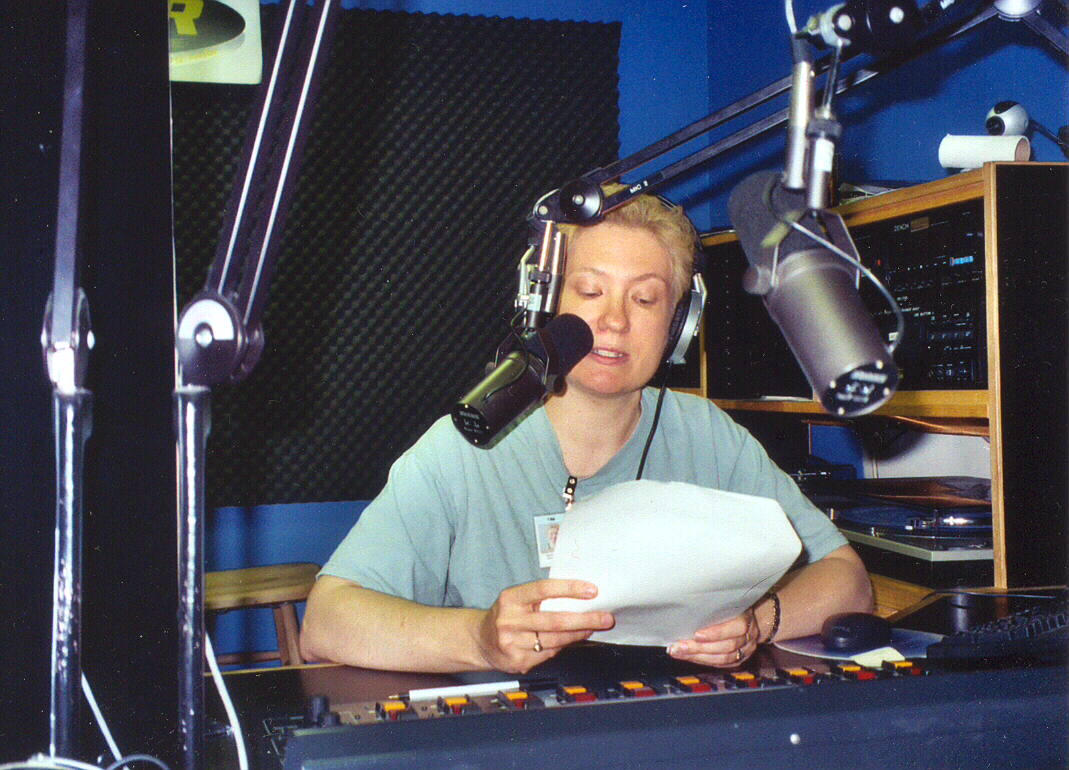
Here is a fetching photo of me in action on "It's a Mystery," my weekly show featuring interviews with mystery authors and others in the field, old-time radio mystery plays, and music from mystery TV shows and movies, on WEBR in Fairfax, VA. WEBR is broadcast on cable TV in Fairfax and Reston, VA and Webcast on Mondays at 11A ET here. J. Kingston Pierce gave the show a nice mention on his blog "The Rap Sheet" (see "Foyle'd Again" on my interview with Foyle's War creator Anthony Horowitz).

Using my previous experience as a newscaster on University of Maryland's WMUC (the oldest college radio station in the country), I created "It's a Mystery" because I was disturbed by the dearth of broadcast outlets for mystery authors unless their name was something like Clark, Patterson, or Grisham. I felt certain that readers wanted to hear about authors beyond the bestseller list, and I was concerned about the lack of knowledge out there about classic mystery writers such as Mary Roberts Rinehart, Charlotte Armstrong, and Edgar Wallace. I found written pearls of wisdom by now deceased writers such as A. A. Fair (aka Erle Stanley Gardner, the creator of Perry Mason) and thought, "Wouldn't it be wonderful to have an audio archive of mystery authors talking about their work before (God forbid) they leave us?" "It's a Mystery" is a small step in that direction.

WEBR is a noncommercial, public access station, where you can hear everything from early American rock 'n roll of "The Professor Rocks" and all Beatles music on "The Magical History Tour" to progressive rock, folk music, and talk shows such as the magazine format "American Odyssey"---all without paying for satellite radio. The producers are all volunteers.

To listen to the radio promo for "It's a Mystery," click here.
To listen to past author interviews, go here.

And you can listen here to a short excerpt from the theme from the 1968 TV show "Judd for the Defense," starring Carl Betz (playing a lawyer modeled on F. Lee Bailey). The theme was composed by Star Trek's Alexander Courage.

Monday, May 22, 2006

Spring 06 issue of CLUES.

The spring 2006 issue of CLUES: A Journal of Detection focuses on Hispanic detective fiction. This includes articles on UT-Austin's own Rolando Hinojosa (see photo at left), the mystery novel in Argentina, contemporary Central American neoliberal noir, the contemporary Spanish detective novel, and authors Carlos Gonzalez Reigosa and Javier Otaola. Further details here.

Monday, April 17, 2006

Dove Award.

Margaret Kinsman (the executive editor of Clues) and I were gobsmacked to receive the George N. Dove Award on April 14th. The award, sponsored by the Popular Culture Assn's Detective/Mystery Caucus, recognizes "outstanding contributions to the serious study of mystery and crime fiction"; past recipients include distinguished author-critic H.R.F. Keating and the late John M. Reilly (editor of Twentieth Century Crime and Mystery Writers).

Isn't the dove in the policeman's hat wonderfully fetching?

Sunday, April 09, 2006

Mark Salzman.

Some time has certainly passed since the last post (work, writing, and weekly radio show are the usual culprits).

I have a few authors on a select list where I will read anything they write, regardless of subject matter. The sadly late Laurie Colwin was one of these; the biographer A. Scott Berg is another (and if you look at the C-Span tape of Berg's 2001 appearance at the National Book Festival, you'll see me in the audience). It is because of the sterling quality of their prose.

Mark Salzman is another author in my personal pantheon. His particular strength is memoir, with his most well-known work as Iron and Silk, his narrative about teaching English and learning martial arts in China, and the hilarious Lost in Place: Growing Up Absurd in Suburbia, which includes an irresistible account of the young Salzman running around in white pajamas and a Kung Fu wig as an aspiring martial arts master in tony suburban Connecticut.

So there would seem to be a huge jump to his novel Lying Awake, about a cloistered nun, which might make the brow wrinkle a bit as to the potential for conflict. But Salzman pulls it off, featuring an intriguing look at the inner workings of a religious community and the grappling of the main character with a profound choice between her life and her relationship with God.

I've recently finished True Notebooks, Salzman's return to memoir with his account of teaching writing in juvenile detention in LA, where the violent crimes of his students include murder. I thought, "How will Salzman be able to make me understand such people?" But he does, through relating classroom conversations, showing the point of view of guards and volunteers within juvenile hall, and reprinting the often astonishingly eloquent pieces that the students produce. The reader sees the remorse of some perpetrators and the more hardened attitude of others. He squarely addresses the Norman Mailer-Jack Henry Abbott issue (Mailer mentored the writing of Abbott, a convicted murderer, who went on to kill again), displays his own stumbles in handling his students, and deals honestly with the brutality of their crimes. All in all, this is an eye-opening look at life behind bars for young people, told in Salzman's crystal-clear prose.

Monday, February 13, 2006

Brief Encounter (1945).
It seems appropriate for Valentine's Day to mention a great film, Brief Encounter, which was based on a short play by one of my favorite writers, Noel Coward, and is often considered one of the great British movies.

This film of thwarted love has it all: beautifully staged scenes by David Lean; wonderful performances by Celia Johnson and Trevor Howard; and a compelling honesty in its writing and approach. (Let's try to forget the attempt to rewrite it with a different ending, Falling in Love, starring Robert DeNiro and Meryl Streep [1984]. A huge disappointment.)

Go here for the British Film Institute's site on Brief Encounter. And here is an interesting site on Brief Encounter's train station locations.

Sunday, January 29, 2006

Winter '06 CLUES published.

Just out is the winter 2006 issue of CLUES: A Journal of Detection (the only US scholarly journal on mystery fiction; I am its managing editor). Its truly international lineup of articles focus on Irish mystery writer Ken Bruen, American mystery writer Barbara Wilson, British mystery author Minette Walters, the German noir film Happy Birthday, Turke!, and the French polar film. Further details here.

Saturday, January 21, 2006

Christianna Brand.

I've been reading with much pleasure Buffet for Unwelcome Guests: The Best Short Mysteries of Christianna Brand (ed. Francis M. Nevins Jr. and Martin H. Greenberg, 1983). Brand (1907?-1988) is probably best known for her superb WWII-era novel Green for Danger, which was made into a film in 1946 with Alastair Sim as Inspector Cockrill and Trevor Howard as Dr. Barnes (go here for the British Film Institute's site on Green for Danger). In addition, the upcoming movie Nanny McPhee with Emma Thompson is based on Brand's Nurse Matilda books for children, and she received a screenwriting credit on Secret People (1952), an early Audrey Hepburn film.

Brand's centenary is approaching (in 2007, although her friend and fellow scribe Robert Barnard says that she often fudged her birthdate and so her exact centenary may be a cause for doubt). The short stories in Buffet are terrific examples of Brand's razorlike prose and mastery of the twist ending and include a few with Inspector Cockrill. I was especially struck by "Murder Game," in which a man relates a case of mysterious death to someone who wants to figure out the culprit; Brand's numerous twists to the plot left me lost in admiration for her skill.

Brand once said, "[. . .C]rime novels are my real interest. I write them for no reason more pretentious than simply to entertain. I try to include, within the regulation puzzle form, good and interesting characterization, dialogue, and background [. . .]." The stories in Buffet more than amply fulfill these stated goals.

Wednesday, December 14, 2005

Happy Birthday, Shirley Jackson

Masterful modern gothic author Shirley Jackson ("The Lottery," The Haunting of Hill House, etc.) was born today in 1916. After her death in 1965, she received an Edgar Award in 1966 for her short story "The Possibility of Evil."

Monday, December 12, 2005

Lucy Maud Montgomery's Lawsuit

An interesting episode in the life of Anne of Green Gables author Lucy Maud Montgomery was her lawsuit against her original publisher, L. C. Page Co. of Boston, for its publication of Further Chronicles of Avonlea.

The suit is recounted in My Dear Mr. M, a collection of letters from Montgomery to her friend George MacMillan that was published by Oxford UP (1992), and it makes for fascinating reading.

Montgomery had changed publishers in 1916, whereupon Page withheld $1,000 of her royalties. With the assistance of the Authors League of America (which is now made up of the Authors Guild and the Dramatists Guild), Montgomery filed suit to collect her royalties and won. In March 1920, Page issued Further Chronicles that included stories that had been cut from an earlier volume, Chronicles of Avonlea. The cut stories had been returned to Montgomery, but she learned that the publisher had kept copies, and Montgomery was concerned because the cut stories contained descriptions and other elements that were now in Montgomery's books with Stokes, her new publisher.

Montgomery brought suit for an injunction against the book and damages. She testified in court for 3 weeks, which included one comical episode where she and legal counsel debated the precise color of Anne's hair. Page attempted to bring a libel suit against Montgomery that went all the way up to the Supreme Court where it was thrown out. In April 1923, a judge found in Montgomery's favor, with an injunction against the book and the profits from it awarded to her. The appeals by Page lasted until October 1928, when its last legal avenue was exhausted.

Summed up Montgomery in 1929: "They paid me $18,000 of profits and the thing was ended after nearly 9 years of worry and expense. The suit cost me $15,000. So I had for recompense $3,000, my injunction against the book---and the satisfaction of having rebuffed the Pages to a finish! The suit cost the Pages about $75,000 in all."

Translating the figures into 2003 dollars via the consumer price index, $3,000 in 1929 was equivalent to about $32,000 in 2003; $15,000 in 1929 was roughly $161,000 in 2003; and $75,000 in 1929 amounted to about $800,000 in 2003.

Sunday, December 04, 2005

Happy birthday, Cornell Woolrich.

Today marks what would have been noir master Cornell Woolrich's 102nd birthday (he died in 1968). Probably best known for "The Window" (that eventually became Alfred Hitchcock's Rear Window), Woolrich also wrote under the pseudonym William Irish, and his works under that name include I Married a Dead Man (that was adapted as the film Mrs. Winterbourne starring Shirley MacLaine and Ricki Lake). You can read a good sampling of his dark and often disturbing works in Darkness at Dawn, including a chilling short story that I have never forgotten, "Walls That Hear You." Some other Woolrich-inspired films include Black Angel (starring Dan Duryea as an alcoholic piano man trying to expose a murderer) and Francois Truffaut's The Bride Wore Black.

You can hear more about Woolrich's life and work tomorrow on my radio show, "It's a Mystery," at 11 am ET, when Mike Nevins, Woolrich's biographer, will speak about Woolrich's considerable contributions to the mystery. For more information on (and sound clips from) "It's a Mystery," click here.

Wednesday, November 30, 2005

Happy Birthday, Rex Stout
The creator of orchid-loving detective Nero Wolfe, Rex Stout was born on Dec 1, 1886. In addition to writing more than 50 Wolfian novels and other works (I was astonished to learn that he was "Anonymous" on a political thriller called The President Vanishes [1934]), Stout served as a yeoman aboard Theodore Roosevelt's yacht Mayflower, where he earned a lot more money playing whist with the crew than his Navy pay.

I remain an unrepentant fan of the William Conrad-Lee Horsley "Nero Wolfe" TV show of 1981.

Monday, November 28, 2005

Suggested Mystery Movies

For those looking for possible gifts for the mystery lover on their holiday shopping list, here are some suggested mystery movies that are available on DVD:
  • The Spiral Staircase, dir. Robert Siodmak (1946). In 1915, a serial killer menaces a New England town, a mute Dorothy McGuire, and a bedridden Ethel Barrymore. The film is based on Some Must Watch by Ethel Lina White, who also wrote The Lady Vanishes.
  • Force of Evil, dir. Abraham Polonsky, perf. John Garfield (1948). A shady attorney involved in the numbers racket struggles to save his brother from ruin and Mob retribution.
  • D.O.A., dir. Rudolph Maté, perf. Edmond O’Brien (1950). An accountant discovers that he has been given a slow-acting poison and races against time to find his killer.
  • Dead Again, dir. Kenneth Branagh (1991). Branagh makes an interesting attempt to marry a Hitchcockian-style film to a modern thriller in this tale of a past murder that echoes in the present. Memorable performances include Andy Garcia as a scruffy reporter and Robin Williams as an oddball psychiatrist turned grocery clerk.
  • Shattered, dir. Wolfgang Petersen (1991). A wealthy man, played by Tom Berenger, wakes up after a car accident with no memory as to who he is and the uneasy feeling that what he is told about himself is not the truth. Look for Bob Hoskins as a rumpled private investigator.
And look for these that are not available on DVD but perhaps may be on the late-night film fest near you:
  • On Dangerous Ground, dir. Nicholas Ray (1952). Disillusioned detective Robert Ryan on the trail of a killer falls in love with the killer's blind sister (played by Ida Lupino).
  • Twenty-Three Paces to Baker Street, dir. Henry Hathaway (1956). Van Johnson in a surprisingly adept turn as a blind playwright who overhears a kidnapping plot. From the novel by Philip MacDonald.

Sunday, November 20, 2005

Charlotte Armstrong, Pt 5.

The Case of the Weird Sisters
(1943; rpt 1992) is one of Armstrong's three novels that feature professor detective Macdougal Duff. His former student Alice Brennan has decided to marry her rich employer Innes Whitlock. Their visit to Whitlock's three half-sisters, who are handicapped in various ways (blind, deaf, missing an arm), results in various mishaps to Innes: an attempted poisoning, a narrow escape from a falling lamp, and a crack-up with the car after a sign indicating a detour is mysteriously removed. Or are they mishaps, as Innes is thinking about writing a new will?

The gothic elements of the three sisters may be a bit off-putting to some, but this is another of Armstrong's skillfully told tales of a warped household. Readers will like Fred, the stalwart chauffeur who reveals that he attended college on a football scholarship.

Wednesday, November 16, 2005

Lucy Maud Montgomery

"It is the most chilling thing in the world to say something to a person and be met by a blank wall of non-comprehension . . . So, as a rule, I am very careful to be shallow and conventional where depth and originality are wasted."
-- Letter from Lucy Maud Montgomery to G. B. MacMillan, Dec 3, 1905 (My Dear Mr. M, Oxford UP, 1992)


I was thinking, in the midst of the hoopla for the new Pride and Prejudice film, that there's another writer that I consider in the same terms as Austen, and that's Lucy Maud Montgomery (1874-1942). Like Austen, Montgomery knew her characters and society inside and out, and we know people just like the ones that she writes about. Also like Austen (and Louisa May Alcott), Montgomery had a marvelous sense of humor.

And I'm not just talking Anne of Green Gables and its numerous sequels. Emily Climbs (1925) deals with the main character's struggles to be a writer, including fighting her loved ones' misapprehensions about the level of a writer's income (sound familiar?). I'm singling out The Blue Castle (1926), which I ran across on a fabulous Web site, Stump the Bookseller, which focuses on long-lost and reprinted treasures in children's literature. It's the sort of site where you can say, "I read a book in 1910 with a green cover. Do you know what it's called?" This bookseller usually does.

In The Blue Castle, a young woman who has led a dreary life among her critical and colorless relatives and is constantly compared to her beautiful and selfish cousin finds herself wondering, "Is that all there is?" When her doctor gives her a year to live because of a heart condition, she runs off to the woods with the bad boy of the town, sending her relatives into apoplexy, and cares for an ill friend that the town has deemed an outcast.

Surely Montgomery's message here is "Carpe Diem," and it's told in The Blue Castle with wisdom, humor, and grace.

Monday, November 14, 2005

Charlotte Armstrong, Pt 4.

In The Turret Room (1965), a young woman hides the troubled ex-husband of her cousin, who is accused of attacking his former wife and mother-in-law. The young woman suspects, because he has been institutionalized, that he is being set up.

Once again, Armstrong provides taut suspense and a chilling view of a monster that can lurk behind a pretty face.

Sunday, November 13, 2005

Mystery Advice from the Masters

I came across a 1967 reprint of the 1945 Writing Detective and Mystery Fiction (ed. A. S. Burack), with a line-up of contributors to make any potential mystery writer drool. There's S. S. Van Dine's classic "Twenty Rules for Writing Detective Stories" (Rule #7: "There simply must be a corpse in a detective novel, and the deader the corpse the better."). There's Dorothy L. Sayers's lucid "Detective Fiction: Origins and Development" ("The art of self-tormenting is an ancient one, with a long and honourable literary tradition") and John Creasey (he of the 600-novel output after 743 rejection slips prior to his first sale) explaining that "[w]riting more, in nine cases out of ten, is only a question of wanting to write more." There's Mary Stewart on setting ("What a writer is doing is to open a gateway on someone else's imagination.")

In addition, A. A. Fair, aka Erle Stanley Gardner, discusses his approach to writing the mystery with a touching humility. Says Gardner, "Personally I like a story that is just a little short of the hard-boiled school. A mystery story that has an element of humor, a puzzling plot, and a style of narration that makes for swift action . . . That, of course, is the ideal toward which I strive, the goal I seek to attain. Probably better than anyone else, I realize how far I miss that goal."

This from the man whose novels once sold 26,000 copies per day.

This book demonstrates how in writing, there really is no new problem under the sun, and how much these seasoned practitioners can still teach us.

Friday, November 11, 2005

Max Perkins

Several times a year, I open one of my copies of Editor to Author: The Letters of Maxwell E. Perkins (1950; rpt 1979). Perkins (1884-1947) was the famed Scribner's editor of Taylor Caldwell, F. Scott Fitzgerald, Ernest Hemingway, Marjorie Kinnan Rawlings, S. S. Van Dine, and a host of others and (what I tell younger readers) grandfather of the actor Perry King.

It's always heartening, especially when writing may not be going well, to read the letters of a man "in love with words," as his biographer A. Scott Berg (Max Perkins: Editor of Genius) once put it.
  • Perkins to Rawlings: ". . .when I write to you in that do-as-it-seems-right-to-you way, it is because it has always been my conviction---and I do not see how anyone could dispute the rightness of it---that a book must be done according to the writer's conception of it, as nearly perfectly as possible, and that the publishing problems begin then. That is, the publisher must not try to get a writer to fit the book to the conditions of the trade, etc. It must be the other way around."
  • Perkins to Marcia Davenport: "I really think the great difficulty in bringing The Valley of Decision into final shape is the old one of not being able to see the forest for the trees. There are such a great number of trees. We must somehow bring the underlying scheme or pattern of the book into emphasis, so that the reader will be able to see the forest in spite of the many trees. And that will mean reducing the number of trees, if we can possibly manage it---though, so far, I haven't found that easy."
  • Perkins to Rawlings again: "...the sales department always want a novel. They want to turn everything into a novel. They would have turned the New Testament into one, if it had come to us for publication, and they could have."
  • Perkins to Fitzgerald: "Don't ever defer to my judgment. . .a writer of any account must speak solely for himself."
And I think the 12 Aug 1938 letter from Thomas Wolfe to Perkins (after Wolfe had left Scribner's) just before Wolfe died is one of the most touching and beautifully written pieces that one can ever read:

"... [I] wanted to write you and tell you, no matter what happens or has happened, I shall always think of you and feel about you the way it was that 4th of July day 3 yrs. ago when you met me at the boat, and we went out on the cafe on the river and had a drink and later went on top of the tall building and all the strangeness and the glory and the power of life and of the city was below---"

Monday, November 07, 2005

Charlotte Armstrong, Pt 3.

The Unsuspected (1946; rpt 1967, 1970) opens with a man and woman discussing their impending revenge on the person whom they blame for their relative's death. Was it suicide or murder? To find out, they will infiltrate the man's household and do not care who will be used in the process.

Audrey Totter and Michael North in The Unsuspected (1947)

Although this novel features one moment where the reader wishes to shake the heroine silly, it is a perceptive and disturbing look at how a twisted, charismatic personality can hold others in thrall. The Unsuspected was made into a movie (1947) starring Claude Rains, Constance Bennett, and Hurd Hatfield.