Shelly Dickson Carr provides insight on her blog about the life of her grandfather, locked room mystery master John Dickson Carr, on today's anniversary of his death (see below for the trailer to Dangerous Crossing [1953], based on Carr's radio play "Cabin B-13").
Wednesday, February 27, 2013

Monday, February 25, 2013
BBC Radio 4 Extra: The life of Mata Hari.
 |
| Mata Hari, NYPL |
Wednesday, February 20, 2013
Charlaine Harris on writing.
At the Mercantile Library's Center for Fiction, Charlaine Harris talked about her approach to writing fiction, particularly regarding True Blood's Sookie Stackhouse and the initial resistance to selling the first book in the series, Dead until Dark. On keeping a series fresh, Harris noted, "There should be a constant stream of . . . exposing layers of the character."
Sunday, February 17, 2013
Today in 1906:
Alice Roosevelt weds Nicholas Longworth.
 |
| Portraits of Nicholas Longworth and Alice Roosevelt in heart-shaped frames, Palestine [TX] Daily Herald Feb. 10, 1906 |
Friday, February 15, 2013
Fri Forgotten Books: The Mystery of
Central Park, by Nellie Bly (1889).
He was questioned why he used the definite article instead of the indefinite in answering the officer's question.In The Mystery of Central Park, lazy man-about-town Richard "Dick" Treadwell must prove his worth to prospective fiancee Penelope (and clear his name) by discovering who killed a young woman in Central Park. Dick finds that he is being followed as his investigation leads him into less savory areas of New York. Bly's interest in portraying the plight of the working class is evident in Dick's acquaintance with pretty factory worker Dido and her friends who are deprived of a living wage (a relationship not regarded with favor by Penelope).
—Nellie Bly, The Mystery of Central Park
 |
| "Penelope, with calm but serious face, kept close to the morgue-keeper." Illustration from The Mystery of Central Park by Nellie Bly. New York World, 19 July 1889 |
The modern reader will find it hard to give credence to Dick's chance discoveries of information that prove so crucial to the case, and those with even a passing acquaintance with forensics will loathe the fact that Dick is permitted to take the dead woman's clothes from the morgue (although his reason for doing so shows some logic). The portrait of the Pygmalion-like murderer has some elements of interest. The Mystery of Central Park should perhaps be regarded as a curiosity of a famed journalist's career and a continuation of her focus on progressive issues rather than as a significant contribution to the mystery literature.
 |
| Nellie Bly, ca. 1890. Library of Congress, Prints & Photos Div. |
There are only three copies in U.S. libraries of the book version of The Mystery of Central Park. I found the serialized version in the New York World and have uploaded the parts as a resource for readers:
Update, 6-11-13. The Library of Congress has digitized its copy of The Mystery of Central Park (available at the Internet Archive).
Wednesday, February 13, 2013
John Sayles and history.
At the AHA meeting in January, historians discussed the work of writer-director-actor John Sayles, including Matewan (1987) and Lone Star (1996); Sayles responded to their presentations about 1 hour into the session.
Monday, February 11, 2013
TV version of Spellbound (1962).
The Paley Center for Media remembers that today in 1962, a television version of Spellbound aired on Theatre 62 with Maureen O'Hara, Hugh O'Brian, and Oskar Homolka. The source material is The House of Dr. Edwardes by Francis Beeding (aka Hilary St. George Saunders and John Palmer) and the 1945 Hitchcock film.
Monday, February 04, 2013
Mystery reading by Justice Holmes and friends.
He had just discovered [E. Phillips] Oppenheim and had been revelling in the world of international intrigue into which Oppenheim had transplanted him.
—1932 research material on Oliver Wendell Holmes Jr. by Mark DeWolfe Howe
 |
| Oliver Wendell Holmes Jr., ca. 1924. Library of Congress, Prints and Photographs Div. |
Some of Holmes's friends were equally enthusiastic about mysteries. In one letter, his British Marxist-socialist friend Harold Laski notes Freeman Wills Crofts's Inspector French's Greatest Case (1925), "which I commend warmly to you if it comes your way" and later urges Holmes to read Crofts's The Cask (1920; both books are on the Haycraft-Queen list). In another letter, Laski expresses appreciation for Mary Davies and the Manor of Ebury by Charles T. Gatty; in yet another letter, he recommends Philip MacDonald's The White Crow (1928) and The Rasp (1924; the latter is on the Haycraft-Queen list).
Pollock sent Holmes a list of his recommended detective stories, with a note by the names of Sayers and Agatha Christie that stated, "anything by either of these writers may be presumed to be good." Pollock's list included Margery Allingham, G. D. H. Cole, R. Austin Freeman, Ronald A. Knox, Anthony Rolls, Henry Wade, and Victor L. Whitechurch. It appears that Holmes did not need Pollock's prompting regarding Christie, as evidenced by the following passage from Some Table Talk of Mr. Justice Holmes and the Mrs. (1935): "Mrs. Agatha Christie may be pleased some day to know that at this moment [May 1933] she was sharing his attention and his praise with Aristotle."
Thursday, January 31, 2013
New! Collected Foxwell short stories.
 |
| Cover by Karen Jackson |
Ebook platforms:
• Kindle
• Kobo
• Nook
Wednesday, January 30, 2013
French TV history: Les cinq dernieres minutes (The Five Last Minutes).
Les cinq dernières minutes (The Five Last Minutes) was a landmark police procedural series on French TV that starred Raymond Souplex as commissaire Antoine Bourrel and featured a jazzy score. It began as a game show, morphed into a drama, and ran from 1958–97.
Tuesday, January 29, 2013
Cain's Slightly Scarlet (1956).
Two sisters (Arlene Dahl and Rhonda Fleming) become entangled with a mobster (John Payne), political corruption, theft, and murder. The film is based on James M. Cain's Love's Lovely Counterfeit (1942) and directed by Allan Dwan, creator of the dolly shot.
Monday, January 28, 2013
Unlikely pals: Bram Stoker and Walt Whitman.
 |
| Walt Whitman, 1887. Library of Congress, Print and Photos Div. |
Also of interest: this TLS review of Bram Stoker and the Stage
Thursday, January 24, 2013
Capote's adaptation of Caspary's Laura, 1968.

Tuesday, January 22, 2013
Simenon's The Man on the Eiffel Tower (1949).
In The Man on the Eiffel Tower, impoverished medical student Franchot Tone is hired to kill a man's rich aunt. Also featured are Burgess Meredith, Charles Laughton (as Maigret), and Wilfred Hyde-White, with directing duties taken by Meredith, Laughton, and Irving Allen. The film is adapted from Georges Simenon's A Battle of Nerves (aka War of Nerves).
Monday, January 21, 2013
Exhibition:
The Cartoon in Wartime Propaganda.

Friday, January 18, 2013
BL exhibition: Murder in the Library.
 |
| Ad for Sax Rohmer's The Return of Fu Manchu New York Sun, Mar 11, 1916 The nefarious criminal is featured in the BL exhibition. |
• Real Crime, Real Fiction, January 21. With Barry Forshaw, Laura Wilson, and others. (Listen to the podcast here)
• The Story of Crime Fiction, February 8. With BBC Radio 4's Mark Lawson, P.D. James, and others.
• The Female Detective, March 8. Guests not yet announced.
Update: TLS review of the exhibition with images of some items from it.
Wednesday, January 16, 2013
Mystery on the Tube.
 |
| Ralph Richardson |
In honor of the London Underground's sesquicentennial, the British Film Institute highlights 10 films with a Tube setting; some mystery-related ones are included:
• Bulldog Jack (1935). A Bulldog Drummond adventure with Ralph Richardson and Fay Wray.
• Death Line (1972, aka Raw Meat). Subterranean dwellers feed on passengers (Donald Pleasence, what are you doing in this film?).
• Hidden City (1987). Charles Dance on the trail of a enigmatic film and a government conspiracy.
• Skyfall (2012). James Bond at Temple tube station.
Tuesday, January 15, 2013
Caspary's Three Husbands (1951).

In Three Husbands, a troublemaker's letters to three men claim that he has had affairs with their wives. If the plot sounds familiar, it is—A Letter to Three Wives (1949) with a gender flip and the same screenwriter: Vera Caspary, the author of Laura. With additional screenwriting assistance by songwriter Edward Eliscu, the film was produced by I. G. Goldsmith, Caspary's husband, and directed by Irving Reis (director of The Bachelor and the Bobby-Soxer; some of the Falcon films with George Sanders; Enchantment). Its stars include Eve Arden, Howard da Silva, Ruth Warrick, and Vanessa Brown.
(Hat tip to Caspary scholar A. B. Emrys for bringing this film to my attention)
Friday, January 11, 2013
"The Grave Grass Quivers," by MacKinlay Kantor (1931).
I had the strange notion that Doctor George Martindale, after unloading the sad story of his youth, had taken two days in going deliberately and completely insane.
—MacKinlay Kantor, "The Grave Grass Quivers" (Omnibus 184)

In "The Grave Grass Quivers," a country doctor suspects that his father and brother were murdered years ago, but thinks he can finally prove it with the assistance of a younger colleague. The story resonates today as the doctor conveys the anguish of himself and his family in not knowing what has happened to their loved ones.
MacKinlay Kantor (1904–77) is probably best known for his Pulitzer Prize-winning Andersonville (1955) and Glory for Me (1945; the basis for the film The Best Years of Our Lives), but he also wrote pulp stories and the story and screenplay (the latter with Dalton Trumbo) for the film Gun Crazy (1950). "The Grave Grass Quivers" was first published in the Elks Magazine in 1931 (repr. The Third Omnibus of Crime, ed. Dorothy L. Sayers, 1935; EQMM, Mar 1949; and It's About Crime, 1960).
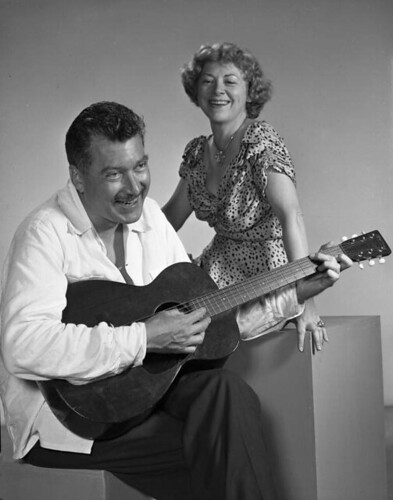 |
| MacKinlay Kantor plays the guitar. July 1950. Photo: State Library and Archives of Florida |
Wednesday, January 09, 2013
On Chinatown.
 |
| Jack Nicholson's J.J. Gittes being a "nosy fellow" in Chinatown |
Subscribe to:
Posts (Atom)