Showing posts with label E. W. Hornung. Show all posts

Monday, January 17, 2022

Hornung's John Dollar.

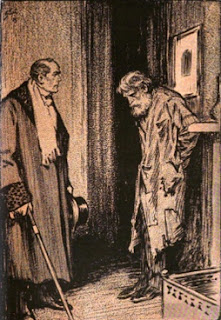
Illustration by Frederic Dorr Steele from "The Physician Who Healed Himself"
by E. W. Hornung. Everybody's Magazine, May 1913, p. 599.

On the Interesting Literature blog, Oliver Tearle (Loughborough University) discusses criminal psychologist John Dollar, created by Arthur Conan Doyle's brother-in-law E. W. Hornung. The Dollar stories can be read here.

Monday, June 22, 2020

The gentleman thief, annotated.

Kyrle Bellew as A. J. Raffles in
the play "Raffles, the Amateur
Cracksman" by E. W. Hornung
and Eugene W. Presbrey.
Ca. 1903. NYPL.
This Web site offers annotations and original illustrations for stories featuring A. J. Raffles, the gentleman thief created by E. W. Hornung, brother-in-law of Arthur Conan Doyle.

Monday, April 15, 2019

Championing Asimov's mysteries.

Isaac Asimov. LOC,
Prints & Photos Div.
On April 18 at 11:30 am, I'm delivering the paper "'A Necessary Clue': The Mysteries of Isaac Asimov" at the Popular Culture Assn conference in Washington, DC, which attempts to refute the perception of Asimov as merely a purveyor of gimmicks in his mysteries and stumps for his neglected mainstream mystery debut, The Death Dealers (aka A Whiff of Death, 1958).  (This new piece on Sherlock Holmes and SF mentions Asimov, who was a Baker Street Irregular.)

My fellow presenters are Kim Sherwood (University of the West of England and author of Testament), Elizabeth Cuddy (Hampton University), and Christine A. Jackson (Nova Southeastern University).  Read the conference program (guest passes can be purchased onsite for $50 per day for those who would like to attend for a day or two).


Tuesday, April 05, 2016

Symons's "The Mystique of the Detective Story" (1981).

In March 1981 author-critic (Mortal Consequences/Bloody Murder, etc.) and then-Detection Club president Julian Symons (1912–94) delivered a lecture on "The Mystique of the Detective Story" at the Vancouver Institute, contrasting modern works with those of the Golden Age. He gave a humorous precis of a typical English country-house mystery and emphasized "the power of reason" in Golden Age mysteries. Symons discussed the work of Patricia Highsmith, noting, "Ripley is the horrific modern counterpart of [E. W. Hornung's] Raffles." He also dealt with the mysteries of P.D. James and Ruth Rendell as well as his own books. "Whatever its merits may be, [the crime story] does begin and end as sensational literature," he stated. He mentioned his admiration for George V. Higgins, as well as Maj Sjowall and Per Wahloo, and critiqued John Creasey. Symons considered Nicholas Blake (aka Cecil Day-Lewis) as one writer who bridged Golden Age and modern mysteries.

Monday, June 30, 2014

E. W. Hornung's unpublished diary.

Libraries are always so interesting: a man's bookcase is something more interesting than the man himself, sometimes the one existing portrait of his mind.
—E. W. Hornung, The Crime Doctor

E. W. Hornung. NYPL
In English Literature in Transition, Edmund G. C. King (Open Univ) discusses the reading experience of British and Scottish soldiers in WWI, with particular attention to the wartime activities of E.W. Hornung (creator of Raffles, gentleman thief).

Sadly, Oscar—the only child of Hornung and Constance, Arthur Conan Doyle's sister—was killed in action at Ypres in July 1915. Seeking solace, Hornung served as a YMCA volunteer during the war—working in a canteen; maintaining a wartime library for soldiers in Arras, France, and a postwar one in the vicinity of Cologne, Germany; looking for friends of Oscar; and hoping to encounter Conan Doyle's serviceman son, Kingsley (who died of flu in 1918). His Notes of a Camp Follower on the Western Front (1919) tells about his war experiences and provides insight into what servicemen were reading (popular authors included Mary Elizabeth Braddon, Edward Bulwer Lytton, Marie Corelli, Anthony Hope, and E. Phillips Oppenheim). Interestingly, he reports only one reader for Wilkie Collins's The Woman in White. Pertaining to the works of his brother-in-law, he wrote, "Messrs. Holmes and Watson were the most flourishing of old firms, and Gerard the only Brigadier taken seriously at my counter" (Notes 141). His own output was not ignored:
"When I was up the line," said one of my friends, bubbling over with a compliment, "a chap said to me, 'You know that old—that—that elderly man who runs the Rest Hut? He's the author of Raffles.'"
Adds Hornung in mock outrage, "Elderly! One would as lief be labelled Virtuous or Discreet" (Notes 144–45). Hornung died of pneumonia in 1921 at 54, hardly an advanced age.

King relates that Hornung kept a diary between December 1917 and March 1918 that took the format of letters to his wife. He drew on this diary to write Notes, but King indicates that the diary reveals more about Hornung's reasons for war service than Notes does. Hornung's friend Shane Chichester preserved a typescript of the diary, which is now in the University of Birmingham's Cadbury Research Library along with other papers. King also provides a heart-warming glimpse of Hornung at work via the World War I memoir of Carlos Paton Blacker, Oscar's Eton classmate who became a noted psychiatrist.

King's article follows "The A. J. Raffles Stories Reconsidered: Fall of the Gentleman Ideal" by Jeremy Larance from the first 2014 issue of English Literature in Transition.
Monday, December 30, 2013

Somerset Maugham's "The Criminal" (1904).

Somerset Maugham, NYPL
In English Literature in Transition 57.1 (2014), Daniel Blackburn and Alexander Arsov discuss "The Criminal," an early short story by Somerset Maugham that has not been reprinted—until now, in the journal. The style may seem a bit stilted to modern readers, but those interested in Maugham's crime-related work (such as "The Letter") may find intriguing elements in this ironic tale (based on a true incident) of a woman accused of theft and the barrister who represented her (or so she believes).

The issue also includes Jeremy Larance's discussion of E. W. Hornung's Raffles as an "ungentlemanly gentleman" refuting the English code of conduct, yet enjoying tremendous popularity.

Tuesday, June 22, 2010

Graham Greene's picks, neglected books.

The Neglected Books blog discusses Graham Greene's 1940s picks of neglected literary works, which include Arthur Conan Doyle's Professor Challenger adventure The Poison Belt; Roy Horniman's Israel Rank: The Autobiography of a Criminal (aka the Alec Guinness film Kind Hearts and Coronets); Conan Doyle brother-in-law E. W. Hornung's Raffles, The Amateur Cracksman; William Babington Maxwell's The Case of Bevan Yorke (Maxwell was the son of Mary Elizabeth Braddon); Arthur Morrison's The Hole in the Wall (Morrison is best known for Martin Hewitt: Investigator and A Child of the Jago); and Anthony Hope's The King's Mirror (Hope is best known for The Prisoner of Zenda).

Thursday, March 18, 2010

Orwell on Hornung and Chase.

This C-Span podcast on the George Orwell essay collection All Art Is Propaganda (featuring George Packer and Christopher Hitchens) has a small section on "Raffles and Miss Blandish," Orwell's 1944 piece comparing E. W. Hornung's Raffles works to James Hadley Chase's No Orchids for Miss Blandish (1939). Says Orwell, "[Raffles and Bunny] think of themselves not as sinners but as renegades, or simply outcasts."

You can read further here.

Wednesday, April 29, 2009

More on Raffles, the Amateur Cracksman.

Over on the Guardian Books blog, Stuart Evers examines the morals of E. W. Hornung's A. J. Raffles—cricket player, man about town, and gentleman thief—and credits Hornung—Conan Doyle's brother-in-law—with considerable foresight. He writes, "Hornung, I believe, saw a new kind of crime story on the horizon: those of the hardboiled pulp novelists, and of the more psychologically acute writers such as Patricia Highsmith."

Evers points out that Atlantic Books has republished Raffles as part of its Classic Crime series (along with Sapper's Bulldog Drummond and Charles Dickens's Bleak House). Jim French Productions has been doing audio productions of Raffles for quite some time.

Monday, March 02, 2009

The debut of the Amateur Cracksman.

George Simmers on the Great War blog looks at the 1898 debut of A. J. Raffles, cricket player, gentleman burglar, and—according to Anthony Hope, author of The Prisoner of Zenda—a "low scoundrel" (qtd. by Richard Lancelyn Green in Raffles: The Amateur Cracksman, p. xlii). Raffles was created by E. W. Hornung (1866–1921), the brother-in-law of Arthur Conan Doyle. I was always very fond of Bunny Manders, Raffles's put-upon sidekick, and liked not only the Hornung stories but also the versions by Barry Perowne (aka Philip Atkey).

A list of Raffles-Holmes meetings outside of the Hornung-Conan Doyle oeuvre can be found here, including "The Problem of the Sore Bridge—among Others" by the recently departed Philip Jose Farmer.

Saturday, June 07, 2008

Happy birthday, E. W. Hornung.

E. W. Hornung, Conan Doyle brother-in-law and creator of Raffles, the gentleman thief, was born today in 1866. He was dubbed by George Orwell "a very conscientious and on his level a very able writer" ("Raffles and Miss Blandish" 212).

Wednesday, June 06, 2007

Happy birthday, E. W. Hornung.

E. W. Hornung, creator of gentleman thief Raffles and the brother-in-law of Arthur Conan Doyle, was born on June 7, 1866. He died in 1921. Conan Doyle called him "a Dr. Johnson without the learning but with a finer wit" (Memories and Adventures 252). Hornung punned that "[...t]hough he might be more humble, there is no police like Holmes" (ibid.).

After Hornung's death, Barry Perowne continued the Raffles series, and Graham Greene wrote a play, The Return of A. J. Raffles, that starred Denholm Elliott. On film, both Ronald Colman (1930) and David Niven (1939) played the amateur cracksman, but the photo above shows Anthony Valentine in a 1975 British production now on DVD. There are also new Raffles radio programs available from Jim French Productions.

I was always terribly fond of Bunny Manders, Raffles's loyal if sometimes hapless sidekick.