 |
| Frank Launder in 1947. |
Tuesday, December 27, 2016
Two Thousand Women (1944).

Monday, December 26, 2016
Listen to Chester Himes in 1969.
 |
| Chester Himes in 1967. Fotocollectie Anefo, Dutch National Archives |
Tuesday, December 20, 2016
See Conan Doyle in 1918 and 1922.

And here he is with his family in 1922.
Monday, December 19, 2016
The art of Dell design.
For those who love Dell paperbacks, two selections from the Thomas Fisher Rare Book Library at the University of Toronto:
 |
| Philip Ketchum, from U-Denver's 1925 Kynewisbok |
Tuesday, December 13, 2016
The Glass Alibi (1946).

Monday, December 12, 2016
Dick Tracy's Chester Gould at Northwestern.
 |
| Chester Gould, left, with producer Henry Saperstein of the Dick Tracy TV series in 1961 |
Friday, December 09, 2016
Happy centenary, Kirk Douglas.
 |
| Kirk Douglas and Jan Sterling in Billy Wilder's Ace in the Hole (1951) |
Tuesday, December 06, 2016
Strange Impersonation
(dir. Anthony Mann, 1946).

 |
| Mindret Lord (born Loeb) in 1923 |
Tuesday, November 29, 2016
For GivingTuesday: Consider mystery collections.
 |
| Phoebe Atwood Taylor. From Barnard College's Mortarboard, 1930 |
Libraries and archives need support to acquire, preserve, catalog, and digitize their collections as well as to present exhibitions or other programs involving their holdings. Consider contributing to your alma mater's library or one of the following collections with significant mystery elements:
• Ray and Pat Browne Popular Culture Library, Bowling Green State University
• Center for Southwest Research, University of New Mexico (home of the papers of Tony Hillerman)
• Howard Gotlieb Archival Research Center, Boston University (home of manuscripts of many authors such as Harry Kemelman, Jane Langton, Elizabeth Linington, Phoebe Atwood Taylor, Hillary Waugh, and Donald Westlake)
• Lilly Library, Indiana University Bloomington (home of the papers of author-critic Anthony Boucher and Mystery Writers of America)
• Harry Ransom Center, University of Texas at Austin (home of Erle Stanley Gardner's "plot wheel")
• Rose Library, Emory University (home of one of the largest collections of Victorian yellowbacks)
• Special Collections, University of California Irvine (home of the papers of Kenneth Millar, aka Ross Macdonald, and Margaret Millar)
• Special Collections, University of South Carolina (home of the papers of James Ellroy, George V. Higgins, and John Jakes. An ongoing and major project of the USC libraries is the preservation and digitization of 2000 Fox Movietone newsreels.)
• Wisconsin Center for Film and Television Research (home of the papers of Vera Caspary, Kirk Douglas, and Dalton Trumbo. The center has recently established a portal at the Internet Archive that includes a home movie of theater legends Alfred Lunt and Lynn Fontanne.)
The Library of Congress offers several options for supporting its work (don't forget that it houses the papers of luminaries such as James M. Cain), including the National Book Festival.
Monday, November 28, 2016
Leopold and Loeb exhibition.

 |
| Nathan Leopold (top) and Richard Loeb in 1924. |
Tuesday, November 22, 2016
Rex Stout/Bertrand Russell on civil liberties.

 |
| Top: Bertrand Russell, ca. 1936. NYPL. Bottom: Mitch Miller, Edward Whitehead, and Rex Stout compare beards in Feb. 1957. Ogdensburg [NY] Journal |
Monday, November 21, 2016
The crossroads of German detective fiction.

Related: Campbell discusses German detective fiction on the radio program With Good Reason.
In addition, watch Campbell's Oct. 2016 W&M Tack Faculty Lecture on "The Detective Is (Not) a Nazi: German Pulp Fiction." In his lecture, Campbell discusses detective fiction, culture, and memory in Germany, and recommends some authors in English translation (such as Friedrich Duerenmatt, Friedrich Glauser, and Doris Gercke). He also points out that a German detective novel (Adolf Muellner's Der Kaliber) was published in 1828, well before Edgar Allan Poe's 1841 "The Murders in the Rue Morgue," and that the longest-running TV series in the world is the German Scene of the Crime (aka Tatort).
Tuesday, November 15, 2016
Simenon's "The Old Lady of Bayeux" (1952).
 |
| Georges Simenon, May 1965. Fotocollectie Anefo, Dutch National Archives |
Monday, November 14, 2016
A British mystery author's work with Holocaust survivors.
 |
| Charity Blackstock. Photo by Mark Gerson |
Tuesday, November 08, 2016
Tourneur's "Into the Night" (1955).
 |
| Eddie Albert and Ruth Roman in "Into the Night" |
Monday, November 07, 2016
A silent film actor's mystery novel.
 |
| Silent film actor and author James W. Morrison in 1916 |
. . . suddenly the quiet was broken by the sharp report of a pistol, followed by the piercing sound of a police whistle.As the Daily Illini wrote on 18 June 1927, Charlie Chan creator Earl Derr Biggers stated, as the bookshelves were overflowing with mystery stories, "how pleasant it would be if all but three or four mystery novelists could be taken out and painlessly drowned. Only I can never decide as to the survivors . . . ."
—Woods Morrison, Road End 185
However, the debut mystery of Woods Morrison, Road End (1927), had caused a rethink by Biggers. ". . . Whether I want to or not, I've got to welcome Woods Morrison. . . . [O]nce he gets going, he deals out thrills with the speed and nonchalance of a river gambler dealing cards" (4).
The first novel of Morrison (1888–1974)—a University of Chicago graduate who acted under the name James W. Morrison (including roles in the silent films Black Beauty, The Little Minister, and Captain Blood) and later taught drama at the Packer Collegiate Institute in New York—focuses on murder, the theft of a pearl necklace, strange wailing, and other mysterious occurrences at an elegant Long Island house, with a down-on-his-luck young man taking on the roles of chauffeur and sleuth. (The ending, however, is rather weak.) The book was serialized in the Philadelphia Inquirer in Feb.–May 1934 (note that some of the pages are faint, and the following are all the parts I could find):
• Chapters 1–2
• Chapter 3
• Chapters 5–6
• Chapters 6–7
• Chapters 7–8
• Chapters 10–11
• Chapters 12–13
• Chapters 14–15
• Chapters 16–17
Silent film scholar Anthony Slide paints a sad picture of Morrison later in life crippled by arthritis, living in a small Greenwich Village apartment, and considering his silent film career to be insubstantial (despite Slide's views to the contrary).
The following are other works by Morrison:
• April Luck (1932). "The moving story of a sensitive girl whom fate made into a glamorous adventuress"
• "Under Pressure" (Liberty magazine, 17 Dec. 1932)
• "Alias Miss Williams" (Brooklyn Daily Eagle, 8 Oct. 1933)
Wednesday, November 02, 2016
Richard Atwater on detective novels, 1930.
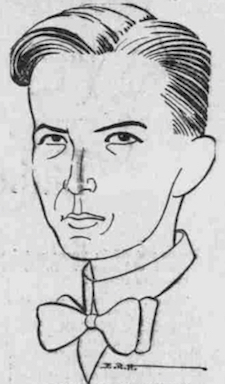 |
| Illustration of Richard Atwater, frm 21 Oct 1922 Bisbee Daily Review |
• G. K. Chesterton, The Man Who Was Thursday (1908). Chesterton's classic tale of unlikely agent Gabriel Syme infiltrating an anarchist group
• James Branch Cabell, The Cream of the Jest (1917). It is unusual to characterize this book as a detective work, as it is a satire—a fictional work with fantasy elements within a fictional work.Tongue planted firmly in cheek, Atwater then floated his idea for a detective novel, in which a valet named Rudy offends because of his crooning (one suspects that Atwater was no fan of Rudy Vallee), and decorators "mistaking Rudy for the new wall paper, . . . paste him to the wall of the master's study. As the master never studies, nobody discovers the error, and the crime is never known" (15).
Tuesday, November 01, 2016
The Moonstone (1934).
 |
| David Manners, who plays Franklin Blake in The Moonstone (1934) |
Tuesday, October 25, 2016
"The Town that Slept w/the Lights On" (1958).
 |
| Edmond O'Brien, ca. 1954 |
Monday, October 24, 2016
A mystery parody by Harry Stephen Keeler?
 |
| Harry Stephen Keeler, from his 1916 passport application |
Of related interest:
• Link to cartoonist Al Hirschfeld's caricatures of Keeler
• "The Life and Death of Harry Stephen Keeler" by Vincent Starrett
Subscribe to:
Posts (Atom)