Wednesday, May 29, 2013

Chesterton, Sayers articles of interest.

Illustration of Chesterton from
Hearst's International (Nov 1921)
Appropriate for today (the birthday of G. K. Chesterton), VII: An Anglo-American Literary Review has posted the following articles online:

• "Two Essays on George MacDonald by G. K. Chesterton" introd. Daniel Gabelman (Scottish novelist MacDonald, best known for At the Back of the North Wind [1871], was the grandfather of mystery author-screenwriter Philip MacDonald). In one essay, Chesterton calls George MacDonald "one of the most remarkable men of our time."

 • "Dorothy L. Sayers's Writings about Work, the Economy and Social Conditions: An Annotated Bibliography" by Christine M. Fletcher

Caroline Barta's "'That Precarious Balance': Harmonizing Temperance in Dorothy L. Sayers's Gaudy Night" is not yet posted from the 2012 issue.

Tuesday, May 28, 2013

"Dark Stranger" (1955).

In "Dark Stranger" (the first episode of the TV anthology series The Star and the Story), writer Edmond O'Brien finds that the murder plot in his novel has come to life. Costarring are Joanne Woodward, Evelyn Ankers, and Dan Tobin.

Wednesday, May 22, 2013

It came from the archives: G. K. Chesterton.

G. K. Chesterton, NYPL
Displaying distinctive penmanship, G. K. Chesterton wrote this gracious letter to the Barcelona club Ateneu Barcelones in May 1926 (found in the Manuscrits de la Bibloteca de l'Ateneu Barcelones). Ian Ker's biography of Chesterton indicates that PEN's Catalan branch had invited Chesterton to Barcelona; his engagements included a speech on "England Seen from the Outside" at Barcelona University.

Tuesday, May 21, 2013

The Long Arm (aka The Third Key, 1956).

In The Long Arm, Jack Hawkins stars as Scotland Yard superintendent Tom Halliday, who is on the trail of a safecracker and murderer. The film is directed by The Cruel Sea's Charles Frend, with story and screenplay by journalist-producer Robert Barr.

Monday, May 20, 2013

Product of the Day: Clues T-shirt.

Show your support for the study of mystery/detective fiction with this stylish Clues T-shirt. A portion of the proceeds goes to Bowling Green State University's Ray and Pat Browne Popular Culture Library to assist the library in buying mystery materials and maintaining its collections (Pat was the founding editor of Clues). The T-shirt and other Clues items are available at Zazzle's Clues store.

Wednesday, May 15, 2013

Return of Revelations of a Lady Detective (1864).

Just out in paperback from University of Chicago Press is the British Library's reissue of Revelations of a Lady Detective (1864, attrib. William Stephens Hayward). This is an important early work featuring a female detective. This edition is only for sale in North and South America; UK residents can buy it from the British Library here.

Tuesday, May 14, 2013

Triple Cross (1966).

In Triple Cross, Christopher Plummer stars as roguish ex-safecracker Eddie Chapman (the subject of Ben Macintyre's Agent Zigzag), who agrees to spy for the Germans—and the British—during World War II.

Monday, May 13, 2013

Today in 1965: The Defenders' final episode.

E. G. Marshall in
The Defenders
The Paley Center for Media remembers that today in 1965, the legal drama The Defenders (with E. G. Marshall) broadcast its final episode (which featured Robert Duvall).

Monday, May 06, 2013

Take a (virtual) bite of vampire fiction study.

Jeremy Brett in Dracula (1978)
NYPL
Edge Hill University in the United Kingdom will conduct a MOOC (Massive Open Online Course) on "Vampire Fictions" that will trace the genre from its 19th-century beginnings to the present. It will start September 3, 2013, and run for 12 weeks. MOOCs, a fairly recent method of online learning, are free to those who do not wish to earn course credit—those who do are required to complete assignments and pay a fee. (Hat tip to Minna Vuohelainen)

Thursday, May 02, 2013

Great Lives: Conan Doyle.

Arthur Conan Doyle.
NYPL
The latest subject in the BBC Radio 4 series Great Lives is Arthur Conan Doyle, selected by author Gyles Brandreth, who calls the creator of Sherlock Holmes "the champion of the good." Also commenting is Conan Doyle biographer Andrew Lycett.

Wednesday, May 01, 2013

Mike Hammer, anticommunist.

Ralph Meeker as Mike Hammer
in Kiss Me Deadly (1955)
Over on the International Spy Museum's blog, historian Mark Stout and author Michael Barson discuss books published since the 1950s that have dealt with the Soviet threat to the United States, including Mickey Spillane's One Lonely Night (1951).

Tuesday, April 30, 2013

Walk East on Beacon (1952).

Poster for Walk East on Beacon (1952)
Before he became a Republican senator from California, George Murphy hunted communist spies in Boston in Walk East on Beacon (dir. Alfred L. Werker, based on an article by J. Edgar Hoover).

Monday, April 29, 2013

McGerr's Selena Mead: An almost-series.

Illustration by Coby Whitmore
of Selena Mead from
"Campaign Fever," 1964.
Television Obscurities discusses the abortive effort to feature Patricia McGerr's spy Selena Mead in a TV series, including interest by Polly Bergen and Shirley MacLaine's then-husband Steve Parker.
Readers can become acquainted with Mead in the Nov. 1964 story "Campaign Fever."

More work of McGerr (1917–85) is on display in the May 1983 episode "Where's Your Sense of Humour?" from Tales of the Unexpected (based on a McGerr story).

Thursday, April 25, 2013

Reddy receives 2013 Dove Award.

Maureen Reddy (Rhode Island College) is this year's recipient of the George N. Dove Award from the Detective/Mystery Caucus of the Popular Culture Association for contributions to the serious study of mystery/crime fiction. Reddy is the author of Traces, Codes, and Clues: Reading Race in Crime Fiction and Sisters in Crime: Feminism and the Crime Novel, among other works. Past recipients of the Dove Award include Frankie Y. Bailey, Douglas G. Greene, the late H. R. F. Keating, P. D. James, Catherine Ross Nickerson, and yours truly.

Wednesday, April 24, 2013

Evelyn Waugh: Perry Mason fan.

A few interesting tidbits posted on the Web site of the Royal Society of Literature:

Erle Stanley Gardner
• A piece by Linda Kelly on detective fiction that discusses Evelyn Waugh's fondness for Perry Mason, his letter to Mason creator Erle Stanley Gardner, and Gardner's reply. (See also Alfred Borrello's article "Evelyn Waugh and Erle Stanley Gardner" from the winter 1970 Evelyn Waugh Newsletter.) In the web of relationships, Waugh was a cousin of mystery novelist Sarah Caudwell.

• P. D. James and Ruth Rendell on mystery writing after Agatha Christie. Among other topics, James discusses the road to publication for Cover Her Face, indicating that it started with meeting actor-writer Miles Malleson (a cousin of Lucy Beatrice Malleson, aka mystery author Anthony Gilbert).

•  A discussion (on audio) with Daphne Park (MI6 operative and principal of Somerville College, Oxford), including readings from Ian Fleming's work by Lucy Fleming (his niece).

Tuesday, April 23, 2013

MacInnes's Venetian Affair (1967).

Robert Vaughn (still playing Napoleon Solo on Man from U.N.C.L.E. at the time) tries to figure out why a US diplomat detonated a bomb at a peace conference in this adaptation of Helen MacInnes's spy novel (Kirkus review here). The film costars Boris Karloff, Elke Sommer, and Felicia Farr.

Monday, April 22, 2013

Artist Charles Dana Gibson on female jurors.

Detail from "When Women Are Jurors"
by Charles Dana Gibson (1902). LOC.
Included in the Library of Congress exhibition "The Gibson Girl's America: Drawings by Charles Dana Gibson" (on view until August 17, 2013, but some images are online) are Gibson's illustrations for Life, "When Women Are Jurors" (1902) and "Called for Jury Duty" (1927). One of the most popular posts on The Bunburyist is the one on female juries, which perhaps indicates keen interest in this topic.

Friday, April 19, 2013

Celebrating 50 years of The Birds.

On March 30, the History Show of RTE (Ireland) marked the 50th anniversary of the premiere of Alfred Hitchcock's film The Birds. Below, The Birds' screenwriter, Evan Hunter, talks about the original ending of the film.

Tuesday, April 16, 2013

de la Torre's "The Older Sister" (1956).

A female reporter pursues an interview with the reluctant sister of Lizzie Borden in the Alfred Hitchcock Presents episode "The Older Sister." Carmen Mathews plays Lizzie, and Patricia Hitchcock (daughter of Alfred) plays the servant Margaret. The episode is adapted from the play Goodbye, Miss Lizzie Borden (Suspense radio version, 1955) by Haycraft-Queen author and Edgar nominee Lillian de la Torre McCue (1902–93), who was known for her portrayal of Dr. Samuel Johnson as a master sleuth.

Monday, April 15, 2013

Clues 31.1: Hitchcock and adaptation.


"Hitchcock and Adaptation" is the theme of Clues 31.1 (2013), guest edited by Loyola Univ Maryland's Mark Osteen (author of Nightmare Alley: Film Noir and the American Dream). The following is a summary of the contents (with links on the article titles). To order the issue or subscribe to Clues, visit this Web page or download the subscription flyer.

Introduction. MARK OSTEEN

Melancholy Elephants: Hitchcock and Ingenious Adaptation. KEN MOGG Alfred Hitchcock films such as Marnie and Young and Innocent represent a world that is equivocal. Highly ingenious and imaginative, they enable the spectator, much like the character Roger Thornhill in North by Northwest, to re-engage with that world and come “alive.”

"Inspiring Public Uneasiness": Hitchcock's Adaptation of Conrad's "Simple Tale." MATTHEW PAUL CARLSON (High Point Univ, NC) In Alfred Hitchcock’s Sabotage (1936; adapted from Joseph Conrad’s The Secret Agent, 1907), the director goes beyond mere use of the novel as a point of departure; he deeply engages its underlying anxieties about the artist’s relationship to his audience.

Reading Hitchcock/Reading Queer: Adaptation, Narrativity, and a Queer Mode of Address in Rope, Strangers on a Train, and Psycho. HEATH A. DIEHL (Bowling Green State Univ) Alfred Hitchcock’s Rope (1948) and Strangers on a Train (1951) reveal an interest in the odd; the peculiar; the “queer.” The author examines the narrative choices made in adaptation.

"Dear Miss Lonelyhearts": Voyeurism and the Spectacle of Human Suffering in Rear Window. NICHOLAS ANDREW MILLER (Loyola Univ Maryland) Rear Window offers a powerful meditation on the ethical implications of private voyeurism in the public sphere. The film draws thematic inspiration from Nathanael West’s Miss Lonelyhearts.

"The Proper Geography": Hitchcock's Adaptation of Daphne du Maurier's "The Birds." JOHN BRUNS (College of Charleston) Alfred Hitchcock’s adaptation of Daphne du Maurier’s “The Birds” illuminates the technical aspects of his process of adaptation, much-ignored similarities between du Maurier’s text and Hitchcock’s film, and the anxiogenics of spatial dislocation.

Hitchcock's Diegetic Imagination: Thornton Wilder, Shadow of a Doubt, and Hitchcock's Mise-en-Scene. DONNA KORNHABER (UT-Austin) The author considers the collaboration between Thornton Wilder and Alfred Hitchcock on Shadow of a Doubt (1943) and examines the influence of Wilder’s theories of theatrical abstraction and cinematic realism on Hitchcock’s developing sense of mise-en-scène.

The Second Look, the Second Death: W. G. Sebald's Orphic Adaptation of Hitchcock's Vertigo. R. J. A. KILBOURN (Wilfred Laurier Univ, Canada) This essay compares W. G. Sebald’s novel Vertigo (1991) and Hitchcock’s 1958 film Vertigo. The book extends key themes and formal strategies in the film, most notably Hitchcock’s famous “vertigo shot.”

Adapting Poe, Adapting Hitchcock: Robert Bloch in the Shadow of Hitchcock's Television Empire. DENNIS R. PERRY and CARL H. SEDERHOLM (both Brigham Young Univ) Alfred Hitchcock’s television programs challenged adaptors to transfer his style and persona to the small screen. Robert Bloch invoked his own and Hitchcock’s deep interest in Poe to create episodes that tended to be more dark, ironic, and psychologically edgy than others.

Extraordinary Renditions: DeLillo's Point Omega and Hitchcock's Psycho. MARK OSTEEN Tracing how Don DeLillo’s novella rings changes on the word rendition, the author unravels a skein of intertextual and metacinematic relations that stretches from Psycho to Douglas Gordon’s 24 Hour Psycho video installation, Robert Bloch’s original novel, and the many Psycho remakes.

REVIEWS
Susan M. Griffin and Alan Nadel, eds. The Men Who Knew Too Much: Henry James and Alfred Hitchcock. PAMELA BEDORE

R. Barton Palmer and David Boyd, eds. Hitchcock at the Source: The Auteur as Adaptor. JOHN TEEL

Wednesday, April 10, 2013

BackStory: Deception in America.

The episode "Bridge for Sale: Deception in America" (mostly on confidence men) of the history radio program BackStory featured a few mystery elements during the discussion of the lie detector. In addition to covering Wonder Woman's golden lasso, the program included an excerpt from the mystery novel The Yellow Circle (1909) that posited the creation of a lie detector device; the author is Charles Edmonds Walk (1875–1943), who also wrote The Paternoster Ruby (1910). "Bridge for Sale" also mentioned the film Call Northside 777 (1948, dir. Henry Hathaway), in which reporter Jimmy Stewart attempts to exonerate an accused cop killer; a real-life developer of the polygraph, Leonarde Keeler, appears in the film as, appropriately enough, a polygraph examiner.

Tuesday, April 09, 2013

The Man Who Cheated Himself (1950).

Jane Wyatt and Lee J. Cobb in The Man Who Cheated Himself (1950)

In The Man Who Cheated Himself, a veteran homicide detective (Lee J. Cobb) faces the prospect of helping a wealthy woman (Jane Wyatt) cover up the murder of her husband as his brother (John Dall) takes charge of the case. The film was directed by Felix E. Feist (Tomorrow Is Another Day, Donovan's Brain, Voyage to the Bottom of the Sea), and the screenplay was cowritten by Haycraft-Queen author Philip MacDonald (The List of Adrian Messenger, Warrant for X, etc.)

Monday, April 08, 2013

British comics exhibition (incl Holmes spoof).

Cover of Jack Yeats
by Bruce Arnold
Among the fascinating images in the University of Oldenburg library's online exhibition "Wonderfully Vulgar: British Comics 1873–1939" are two pages from Arthur Conan Doyle's "The Adventure of the Greek Interpreter" in the Strand (illus. Sidney Paget) and the 1897 spoof The Funny Wonder featuring "Chubblock Homes" drawn by Jack Butler Yeats (the artist brother of W. B. Yeats; see also Chubblock's appearance in drag). There's also an excerpt from a 1936 sea serial starring James Cagney.

Wednesday, April 03, 2013

British Lib podcast: The Female Detective.

The British Library has just posted the podcast from the panel that discussed the female detective from the debut of "Miss G" in Andrew Forrester's The Female Detective in 1864. Held in conjunction with the exhibition "Murder in the Library," the event featured Lindsey Davis, Natasha Cooper, The Killing producer Piv Bernth, and former Clues executive editor Margaret Kinsman.

Tuesday, April 02, 2013

Christie's Love from a Stranger (1937).

Agatha Christie's "Philomel Cottage," in which a wife suspects her new husband of sinister intentions, has been adapted several times. These include a 1937 film (also known as A Night of Terror; see below) with Ann Harding and Basil Rathbone and a 1947 film with stars John Hodiak, Sylvia Sidney, and John Howard, and a screenplay by Philip MacDonald (The List of Adrian Messenger, etc.). Other versions include a play by Frank Vosper and the October 1943 Suspense episode with Orson Welles and Geraldine Fitzgerald.

Thursday, March 28, 2013

Today in 1967: Raymond Burr as Ironside.

The Paley Center for Media recalls that today in 1967 Raymond Burr debuted as San Francisco detective Robert Ironside, left a paraplegic after a murder attempt. Writers for the series included Stephen J. Cannell, Davis Dresser (aka Brett Halliday), and Christopher Trumbo (son of blacklisted screenwriter Dalton Trumbo).

Tuesday, March 26, 2013

Heyer's The Reluctant Widow (1950).

A former governess encounters spies employed by Napoleon in this adaptation of Georgette Heyer's novel (alternate film title: The Inheritance). Kathleen Byron (best known for Black Narcissus) is featured.

Monday, March 25, 2013

The life of the creator of Goodnight Moon.

With Good Reason radio program discusses the short life of Margaret Wise Brown, who wrote the children's classic Goodnight Moon (1947) and died at age 42 after an appendectomy.

Friday, March 22, 2013

Jacques Barzun, editor.

Those who miss Jacques Barzun (of the Barzun-Taylor Classic Crime Novels list) since his death at age 104 in October 2012 can now read Helen Hazen's delightful reminiscence in the American Scholar regarding his (sometimes painful) editing of her book during his time with Scribner. According to Hazen, Barzun once wrote, "I go through your pages like an angry bull."

Thursday, March 21, 2013

More on Patrick Hamilton: Hangover Square.

Coinciding with Patrick Hamilton's birthday on March 17, BBC Radio 4's A Good Read program discusses Hamilton's Hangover Square (1941). Although noting that it often is not the most comfortable book to read, the commentators admire Hamilton's insights into psychology and obsession. (Below: The trailer to Hangover Square [1945], with Laird Cregar, Linda Darnell, and George Sanders).

Wednesday, March 20, 2013

Conan Doyle to editor.

Arthur Conan Doyle, NYPL
The online slideshow of materials from Toronto Public Library's special collections includes some items from its noted Arthur Conan Doyle collection and sheds light on the author's relationship with Strand editor Herbert Greenhough Smith. One letter from Conan Doyle states, "I must say that I cannot agree with your estimate of the 'Norwood Builder.' I read it to a roomful of people and I was never more conscious of holding an audience absolutely spellbound." Another letter indicates that he wants a higher limit than 50,000 words for The Hound of the Baskervilles. Other items include covers from the Strand and a figurine of Professor Moriarty.

Sunday, March 17, 2013

Happy birthday, Patrick Hamilton.

Playwright and author Patrick Hamilton was born today in Hassocks, Sussex, United Kingdom, in 1904. He died in 1962. In mysterydom, he is best known for his plays Rope, with certain parallels to the Leopold and Loeb case (1929; filmed by Alfred Hitchcock, 1948) and Gaslight (1939, aka Angel Street; films 1940, 1944, 1947, and several TV adaptations). He also wrote the novel Hangover Square (1941; filmed by John Brahm, 1945). The TV series The Charmer, with Nigel Havers as con artist Ralph Gorse, was based on Hamilton's Mr. Stimpson and Mr. Gorse (1953). Faber Finds has reissued his Twopence Coloured (1928) and Impromptu in Moribundia (1939).

Friday, March 15, 2013

Want to back a Veronica Mars film?

Annoy, tiny blonde. Annoy like the wind.
—Logan Echolls to Veronica Mars

Veronica Mars TV series creator Rob Thomas is attempting to finance a film featuring the savvy investigator via Kickstarter. There seems to be quite a bit of enthusiasm for the venture, for the level of funding has already exceeded its $2 million goal. Donations will be accepted until April 12. The Clues 2008 theme issue on the girl sleuth had Kristen Bell on the cover and featured Alaine Martaus's article, "'You Get Tough. You Get Even': Rape, Anger, Cynicism, and the Vigilante Girl Detective in Veronica Mars." (Hat tip to Maryelizabeth Hart, Mysterious Galaxy Bookstore)

Wednesday, March 13, 2013

Conference on weird fiction scheduled.

Algernon Blackwood, NYPL
The conference "The Weird: Fugitive Fictions/Hybrid Genres" will be held at the University of London on November 8, 2013. A keynote speaker is S. T. Joshi (who has done much work on H. P. Lovecraft). The conference call for papers mentions interest in papers on Lovecraft and similar writers (probably including Algernon Blackwood, Lord Dunsany, M. R. James, Arthur Machen, and Robert Louis Stevenson), but also indicates the intent to cover topics such as "modernism and the weird."

Tuesday, March 12, 2013

Fletcher's Night Watch (1973).

Elizabeth Taylor and Laurence Harvey reunite after Butterfield 8 in this tale of a woman who has experienced a nervous breakdown and believes a murder has occurred next door. Directed by actor-director Brian G. Hutton (Where Eagles Dare, Kelly's Heroes, High Road to China), Night Watch is based on the play of the same name by Lucille Fletcher (Sorry, Wrong Number; The Hitchhiker).

Monday, March 11, 2013

Book cover design: Tiny men, women's backs.

Jack Higgins cover illustrating
the "tiny man" scenario
The Times Literary Supplement blog builds on J. Kingston Pierce's earlier blog posts (such as here and here) on book cover designs that contain similar elements. I had not noticed the "women with their backs to the reader" and "tiny men walking into the distance" trends, but the evidence seems clear. Also noted: Web sites with bad book cover designs (one of which poses the immortal question, "Whose head is she wearing?").

Wednesday, March 06, 2013

The return of John Blackburn.

British mystery-horror writer John Blackburn (1923–93) returns with Valancourt Books' reissue of Broken Boy (1959), in which a dead body in a river connects to ancient evil. Valancourt's reprints of Blackburn's Bury Him Darkly (1969) and Nothing But the Night (1968; film with Christopher Lee and Peter Cushing, 1973) are scheduled for release this month, and more Blackburn reissues are planned by the publisher.

Blackburn may be best known for A Scent of New-Mown Hay (1958). The nonfiction author Julia Blackburn is his niece (she's the daughter of poet Thomas Blackburn, who wrote the vampire novel The Feast of the Wolf, 1971).

Tuesday, March 05, 2013

Lizzie (1957).

Five months before the appearance of The Three Faces of Eve was the release of Lizzie (1957), in which a bewildered Elizabeth Richmond (played by Eleanor Parker) receives threatening letters from a stranger named Lizzie. The film (also starring Richard Boone and Joan Blondell, as well as Johnny Mathis singing "It's Not for Me to Say") was based on The Bird's Nest (1954) by Shirley Jackson (The Haunting of Hill House, "The Lottery," etc.).

Monday, March 04, 2013

Coming Soon: Crime and Detective Fiction

Crime and Detective Fiction, part of the Salem Press series Critical Insights, is scheduled for release in April. I wrote an essay for this volume—"'Your Sin Will Find You Out': Critical Perceptions of Mystery Fiction"—which examines the response to Anna Katharine Green's The Leavenworth Case, James M. Cain's Double Indemnity, Margery Allingham's The Tiger in the Smoke, and Nicholas Meyer's The Seven Per-Cent Solution. Another essay, written by Kerstin Bergman (Lund University), is on Stieg Larsson's work. The editor of the volume is Rebecca Martin (Pace University).

Friday, March 01, 2013

Today in 1971: Columbo pilot debuts.

The Paley Center for Media recalls today's debut in 1971 of "Ransom for a Dead Man," the pilot for Columbo starring Peter Falk and Lee Grant.

Wednesday, February 27, 2013

Today in 1977: The death of John Dickson Carr.

Shelly Dickson Carr provides insight on her blog about the life of her grandfather, locked room mystery master John Dickson Carr, on today's anniversary of his death (see below for the trailer to Dangerous Crossing [1953], based on Carr's radio play "Cabin B-13").

Monday, February 25, 2013

BBC Radio 4 Extra: The life of Mata Hari.

Mata Hari, NYPL
This week on BBC Radio 4 Extra, Juliet Stevenson reads Femme Fatale, which explores the life of Mata Hari, the notorious female spy executed in France during World War I. Episodes usually may be heard online for up to a week after broadcast.

Wednesday, February 20, 2013

Charlaine Harris on writing.

At the Mercantile Library's Center for Fiction, Charlaine Harris talked about her approach to writing fiction, particularly regarding True Blood's Sookie Stackhouse and the initial resistance to selling the first book in the series, Dead until Dark. On keeping a series fresh, Harris noted, "There should be a constant stream of . . . exposing layers of the character."

Sunday, February 17, 2013

Today in 1906:
Alice Roosevelt weds Nicholas Longworth.

Portraits of Nicholas Longworth and Alice Roosevelt
in heart-shaped frames, Palestine [TX] Daily Herald
Feb. 10, 1906
Today in 1906, presidential daughter Alice Roosevelt married congressman Nicholas Longworth (R–OH) in, according to the New York Tribune, "the most brilliant nuptials ever celebrated at the White House or in the nation's capital." It was not exactly a serene union—Alice contemplated divorce and had an affair with Sen. William Borah (R–ID) that produced a child, Paulina, and Longworth acquired a reputation as a serial philanderer. He, however, was a devoted father to Paulina and died in 1931; Alice lived to age 96. My new ebook collection, No Man's Land and Other Stories, includes three stories with Alice as sleuth.

Friday, February 15, 2013

Fri Forgotten Books: The Mystery of
Central Park
, by Nellie Bly (1889).

He was questioned why he used the definite article instead of the indefinite in answering the officer's question.
—Nellie Bly, The Mystery of Central Park
In The Mystery of Central Park, lazy man-about-town Richard "Dick" Treadwell must prove his worth to prospective fiancee Penelope (and clear his name) by discovering who killed a young woman in Central Park. Dick finds that he is being followed as his investigation leads him into less savory areas of New York. Bly's interest in portraying the plight of the working class is evident in Dick's acquaintance with pretty factory worker Dido and her friends who are deprived of a living wage (a relationship not regarded with favor by Penelope).

"Penelope, with calm but serious face, kept close to the
morgue-keeper." Illustration from The Mystery of
Central Park by Nellie Bly. New York World,
19 July 1889

The modern reader will find it hard to give credence to Dick's chance discoveries of information that prove so crucial to the case, and those with even a passing acquaintance with forensics will loathe the fact that Dick is permitted to take the dead woman's clothes from the morgue (although his reason for doing so shows some logic). The portrait of the Pygmalion-like murderer has some elements of interest. The Mystery of Central Park should perhaps be regarded as a curiosity of a famed journalist's career and a continuation of her focus on progressive issues rather than as a significant contribution to the mystery literature.

Nellie Bly, ca. 1890.
Library of Congress,
Prints & Photos Div.
The intrepid Nellie Bly (aka Elizabeth Cochrane Seaman, 1864–1922) became a reporter at age 16 and made her name as a "stunt" journalist, accomplishing a celebrated around-the-world journey in 72 days (meeting Jules Verne along the way and beating the 80 days of his character Phileas Fogg) and arranging her commitment to a mental asylum so she could write about the treatment of the mentally ill (see Ten Days in a Mad-House, 1887). The Mystery of Central Park was her sole mystery novel.

There are only three copies in U.S. libraries of the book version of The Mystery of Central Park. I found the serialized version in the New York World and have uploaded the parts as a resource for readers:
Update, 6-11-13. The Library of Congress has digitized its copy of The Mystery of Central Park (available at the Internet Archive). 

Wednesday, February 13, 2013

John Sayles and history.

At the AHA meeting in January, historians discussed the work of writer-director-actor John Sayles, including Matewan (1987) and Lone Star (1996); Sayles responded to their presentations about 1 hour into the session.

Monday, February 11, 2013

TV version of Spellbound (1962).

The Paley Center for Media remembers that today in 1962, a television version of Spellbound aired on Theatre 62 with Maureen O'Hara, Hugh O'Brian, and Oskar Homolka. The source material is The House of Dr. Edwardes by Francis Beeding (aka Hilary St. George Saunders and John Palmer) and the 1945 Hitchcock film.

Monday, February 04, 2013

Mystery reading by Justice Holmes and friends.

He had just discovered [E. Phillips] Oppenheim and had been revelling in the world of international intrigue into which Oppenheim had transplanted him.

—1932 research material on Oliver Wendell Holmes Jr. by Mark DeWolfe Howe
Oliver Wendell Holmes Jr.,
ca. 1924. Library of Congress,
Prints and Photographs Div.
Justice Sonia Sotomayer and Justice Ruth Bader Ginsburg's fondness for Nancy Drew has precedence on the Supreme Court. Harvard Law School Library's impressive digital project on Supreme Court Justice Oliver Wendell Holmes Jr. sheds further light on his mystery reading (Holmes once confessed his "ignoble liking" for detective stories to British jurist Sir Frederick Pollock). In one letter, he states, "I like what I have read of John Dickson Carr—(author of The Lost Gallows)" [1931]. An inventory of Holmes's library after his death in 1935 lists John Buchan's Greenmantle (1916) and The Three Hostages (1924), Dashiell Hammett's Red Harvest (1929), Oppenheim's A Prince of Sinners (1903) and Prodigals of Monte Carlo (1926), Dorothy L. Sayers's Have His Carcase (1932), and Edgar Wallace's The Man at the Carlton (1931). He also had a copy of Anna Katharine Green's The Leavenworth Case (1878, part of the Haycraft-Queen list of essential mysteries) with the following inscription by the author: "To Justice Oliver Wendell Holmes with birthday congratulations from Anna Katharine Green Rohlfs. Buffalo, March, 1926."

Some of Holmes's friends were equally enthusiastic about mysteries. In one letter, his British Marxist-socialist friend Harold Laski notes Freeman Wills Crofts's Inspector French's Greatest Case (1925), "which I commend warmly to you if it comes your way" and later urges Holmes to read Crofts's The Cask (1920; both books are on the Haycraft-Queen list). In another letter, Laski expresses appreciation for Mary Davies and the Manor of Ebury by Charles T. Gatty; in yet another letter, he recommends Philip MacDonald's The White Crow (1928) and The Rasp (1924; the latter is on the Haycraft-Queen list).

Pollock sent Holmes a list of his recommended detective stories, with a note by the names of Sayers and Agatha Christie that stated, "anything by either of these writers may be presumed to be good." Pollock's list included Margery Allingham, G. D. H. Cole, R. Austin Freeman, Ronald A. Knox, Anthony Rolls, Henry Wade, and Victor L. Whitechurch. It appears that Holmes did not need Pollock's prompting regarding Christie, as evidenced by the following passage from Some Table Talk of Mr. Justice Holmes and the Mrs. (1935): "Mrs. Agatha Christie may be pleased some day to know that at this moment [May 1933] she was sharing his attention and his praise with Aristotle."

Thursday, January 31, 2013

New! Collected Foxwell short stories.


Cover by Karen Jackson
Just out from Oconee Spirit Press (which has reissued the popular Sigrid Harald novels by Margaret Maron and early rarities by Carolyn Hart) is No Man's Land & Other Stories, an ebook collection of 12 of my (mostly historical) short stories. It includes two award winners ("No Man's Land" with WWI female ambulance drivers; "Keeper of the Flame" with a 19th-century lighthouse keeper); a story set on the Titanic ("Unsinkable"); three stories with Alice Roosevelt Longworth and her snide comments about her cousin, Franklin ("Come Flit by Me," "Alice and the Agent of the Hun," "Artistic License"); two stories inspired by Oscar Wilde ("A Roman of No Importance"; "Lady Windermere's Flan"); and some previously unpublished works (such as "Death in Blue and Gray," a Civil War story set in Washington, DC; and "An Epidemic Proportion," set during the 1918 flu pandemic). I provide an introduction that explains the background of the stories.

Ebook platforms:
• Kindle 
• Kobo
• Nook

Wednesday, January 30, 2013

French TV history: Les cinq dernieres minutes (The Five Last Minutes).

Les cinq dernières minutes (The Five Last Minutes) was a landmark police procedural series on French TV that starred Raymond Souplex as commissaire Antoine Bourrel and featured a jazzy score. It began as a game show, morphed into a drama, and ran from 1958–97.

Tuesday, January 29, 2013

Cain's Slightly Scarlet (1956).

Two sisters (Arlene Dahl and Rhonda Fleming) become entangled with a mobster (John Payne), political corruption, theft, and murder. The film is based on James M. Cain's Love's Lovely Counterfeit (1942) and directed by Allan Dwan, creator of the dolly shot.

Monday, January 28, 2013

Unlikely pals: Bram Stoker and Walt Whitman.

Walt Whitman, 1887.
Library of Congress,
Print and Photos Div.
In "When Bram Met Walt" (Humanities Nov/Dec 2012), Meredith Hindley discusses the friendship between Bram Stoker and Walt Whitman (with a cameo appearance by Sir Henry Irving; Stoker served as Irving's manager at the time).

Also of interest: this TLS review of Bram Stoker and the Stage

Thursday, January 24, 2013

Capote's adaptation of Caspary's Laura, 1968.

The Paley Center for Media remembers the TV adaptation of Vera Caspary's Laura, which debuted today in 1968. Scripted by Truman Capote, it starred Capote friend Lee Radziwill (as Laura Hunt), Arlene Francis (as Ann Treadwell), Farley Granger (as Shelby Carpenter), Robert Stack (as Mark McPherson), and George Sanders (as Waldo Lydecker). Reviews were not that kind (see this example from the Milwaukee Journal).

Tuesday, January 22, 2013

Simenon's The Man on the Eiffel Tower (1949).


In The Man on the Eiffel Tower, impoverished medical student Franchot Tone is hired to kill a man's rich aunt. Also featured are Burgess Meredith, Charles Laughton (as Maigret), and Wilfred Hyde-White, with directing duties taken by Meredith, Laughton, and Irving Allen. The film is adapted from Georges Simenon's A Battle of Nerves (aka War of Nerves).

Monday, January 21, 2013

Exhibition:
The Cartoon in Wartime Propaganda.

The online exhibition "The Cartoon in Wartime Propaganda" at King's College London mentions Minute for Murder (1947) by Nicholas Blake (aka the Irish-born poet laureate Cecil Day-Lewis), who worked for Britain's Ministry of Information during World War II.

Friday, January 18, 2013

BL exhibition: Murder in the Library.

Ad for Sax Rohmer's
The Return of Fu Manchu
New York Sun, Mar 11, 1916
The nefarious criminal is
featured in the BL exhibition.
Opening today at the British Library's Folio Society Gallery is the exhibition "Murder in the Library: An A-Z of Crime Fiction," which looks at the history of the genre and runs to May 12. There also will be some events in conjunction with the exhibition:

• Real Crime, Real Fiction, January 21. With Barry Forshaw, Laura Wilson, and others. (Listen to the podcast here)

• The Story of Crime Fiction, February 8. With BBC Radio 4's Mark Lawson, P.D. James, and others.

• The Female Detective, March 8. Guests not yet announced.

Update: TLS review of the exhibition with images of some items from it.

Wednesday, January 16, 2013

Mystery on the Tube.

Ralph Richardson

In honor of the London Underground's sesquicentennial, the British Film Institute highlights 10 films with a Tube setting; some mystery-related ones are included:

• Bulldog Jack (1935). A Bulldog Drummond adventure with Ralph Richardson and Fay Wray.

• Death Line (1972, aka Raw Meat). Subterranean dwellers feed on passengers (Donald Pleasence, what are you doing in this film?).

• Hidden City (1987). Charles Dance on the trail of a enigmatic film and a government conspiracy.

• Skyfall (2012). James Bond at Temple tube station.


Tuesday, January 15, 2013

Caspary's Three Husbands (1951).


In Three Husbands, a troublemaker's letters to three men claim that he has had affairs with their wives. If the plot sounds familiar, it is—A Letter to Three Wives (1949) with a gender flip and the same screenwriter: Vera Caspary, the author of Laura. With additional screenwriting assistance by songwriter Edward Eliscu, the film was produced by I. G. Goldsmith, Caspary's husband, and directed by Irving Reis (director of The Bachelor and the Bobby-Soxer; some of the Falcon films with George Sanders; Enchantment). Its stars include Eve Arden, Howard da Silva, Ruth Warrick, and Vanessa Brown.
(Hat tip to Caspary scholar A. B. Emrys for bringing this film to my attention)


Friday, January 11, 2013

"The Grave Grass Quivers," by MacKinlay Kantor (1931).

I had the strange notion that Doctor George Martindale, after unloading the sad story of his youth, had taken two days in going deliberately and completely insane.
—MacKinlay Kantor, "The Grave Grass Quivers" (Omnibus 184)


In "The Grave Grass Quivers," a country doctor suspects that his father and brother were murdered years ago, but thinks he can finally prove it with the assistance of a younger colleague. The story resonates today as the doctor conveys the anguish of himself and his family in not knowing what has happened to their loved ones.

MacKinlay Kantor (1904–77) is probably best known for his Pulitzer Prize-winning Andersonville (1955) and Glory for Me (1945; the basis for the film The Best Years of Our Lives), but he also wrote pulp stories and the story and screenplay (the latter with Dalton Trumbo) for the film Gun Crazy (1950). "The Grave Grass Quivers" was first published in the Elks Magazine in 1931 (repr. The Third Omnibus of Crime, ed. Dorothy L. Sayers, 1935; EQMM, Mar 1949; and It's About Crime, 1960). 

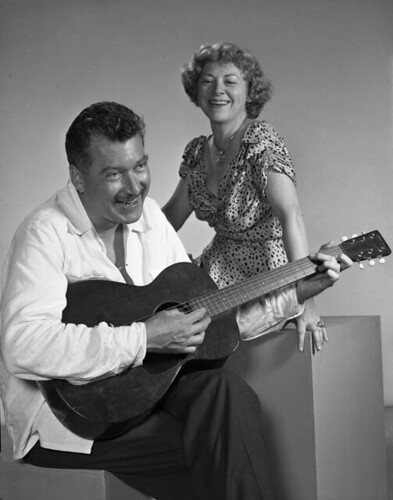
Novelist MacKinlay Kantor playing the guitar: Sarasota, Florida
MacKinlay Kantor plays the guitar.
July 1950. Photo: State Library
and Archives of Florida

Wednesday, January 09, 2013

On Chinatown.

Jack Nicholson's J.J. Gittes being 
a "nosy fellow" in Chinatown
Over on the British Film Institute Web site, Geoff Andrew reflects on Chinatown (1974, dir. Roman Polanski) and the talented individuals brought together for the film.

Tuesday, January 08, 2013

He Walked by Night (1948).

In He Walked by Night, the police pursue a suspected cop killer and robber (Richard Basehart). Actor-screenwriter-director Crane Wilbur, a cousin of Tyrone Power, wrote the film's story and screenplay.

Monday, January 07, 2013

"You're going to jail, sir."

Michael Moriarty as exec ADA
Ben Stone, Law & Order
The Overthinking It blog compiles the results from the 20 seasons of Law & Order into a handy chart and reveals, among other findings, that a not-guilty verdict occurred in less than 10 percent of the cases.
(Hat tip to the Law & Humanities blog)

Friday, January 04, 2013

James Caan in Naked City (1961).

The Paley Center for Media remembers today's television debut of James Caan on Naked City in 1961 (also note Dick York in the clip).

Tuesday, January 01, 2013

The Limping Man (1953).

In The Limping Man, a World War II veteran (Lloyd Bridges) encounters spies in postwar London.