Sunday, February 07, 2010

Fowler on Ambler, Shute.

Christopher Fowler's latest in his Forgotten Authors series for The Independent focuses on Nevil Shute and Eric Ambler, although he does acknowledge that they still have a presence in today's literary world. One aspect of Shute's oeuvre he fails to mention: aeronautical engineer Shute's No Highway (1948; filmed as No Highway in the Sky, 1951), which sounded a prophetic warning against the dangers of metal fatigue in planes.

About the image: Jimmy Stewart in No Highway in the Sky, 1951, dir. Henry Koster

Friday, February 05, 2010

Literally living at the library.

On the NYPL blog, Sachiko Clayton discusses the superintendents who resided at various branches of the New York Public Library, including one man whose child was born in one library.

Thursday, February 04, 2010

"I Know Poe" exhibition.

Last year's "I Know Poe" exhibition sponsored by the Library of Virginia and the Poe Museum of Richmond is now online here.

About the image: Poe's room at the University of Virginia, NYPL. Go here to read about Poe's time at the university.

Wednesday, February 03, 2010

Illustrators try their hand at mystery characters.

On Steve Gettis's Web site, various illustrators provide their interpretations of their favorite literary figures. Roger Langridge's Jeeves & Wooster are charming. Mystery-related subjects include Earl Derr Biggers's Charlie Chan, Raymond Chandler, Arthur Conan Doyle, Len Deighton, Erle Stanley Gardner, Dashiell Hammett, Chester Himes's Coffin Ed Johnson and Grave Digger Jones, Ed McBain's Carella and Meyer, and Edgar Allan Poe.

(Hat tip to Quill & Quire)

Tuesday, February 02, 2010

BBC Radio 3: More on The Woman in White.

This BBC Radio 3 Arts and Ideas podcast includes a discussion of Wilkie Collins's The Woman in White on its 150th anniversary.

About the photo: Wilkie Collins, bet. 1880 and 1890. Library of Congress, Prints and Photographs Division)

Monday, February 01, 2010

Comic books: The Hulk, Martin Luther King.

For those interested in comic books:

• A comic book on the Montgomery bus boycott of 1956 that was influential in the civil rights movement

• The Hulk, featured in Northern Illinois University's "Heroes, Villains, and the American Zeitgeist" exhibition

(About the image: The Hulk, from the 1966 cartoon version of Marvel Comics' superhero. Hat tips to librarian.net, Confessions of a Curator)

Friday, January 29, 2010

1891: Galton's fingerprint classification system.

The online exhibition "Trailblazing: Three and a Half Centuries of Royal Society Publishing" includes "1891: The Proof That Fingerprints Are Unique," which discusses the still-used classification system for fingerprints developed by Sir Francis Galton, a cousin of Charles Darwin.

About the image: Galton's fingerprints, from the cover of his book Finger Prints (1892)

Thursday, January 28, 2010

Policing in Australia exhibition.

The exhibition "Policing in Australia since 1788" includes:
• a carte de visite of detective John Christie, dubbed "the Sherlock Holmes of Victoria police"

• an image of the posse that captured outlaw Ned Kelly

• an account of the first Australian policeman killed in the line of duty (in 1803)

• an image of the police escort for British aviator Amy Johnson

• an image of a mobile forensic van of the Victoria police, ca. 1960
About the image: Detective John Christie in disguise as a tinker. Museum Victoria

Wednesday, January 27, 2010

Valancourt reissues Bulwer Lytton's
Eugene Aram (1832).

Valancourt Books has republished Edward Bulwer Lytton's Eugene Aram (1832); as Lucy Sussex discussed in this article for Clues 26.1, Bulwer Lytton (friend of Dickens and Collins) made important contributions to the mystery genre with Eugene Aram, Paul Clifford (1830), and Night and Morning (1841; go here to read Edgar Allan Poe's review of this book) .

About the image: Edward Bulwer Lytton. Courtesy of Knebworth House.

Tuesday, January 26, 2010

G. K. Chesterton and Notre Dame.

The exhibition "The Story of Notre Dame" includes a section on G. K. Chesterton, including:
• an account of his lectures there in fall 1930: "... there was the man himself, nearly three hundred pounds of him, who, thinking of some delicious aside, would start to chuckle and so convulse the audience before he had said what he had to say, that they were in a constant state of good nature. "

• a faculty admission card to Chesterton's Notre Dame lectures, which reveals that he spoke on history on Tuesdays, Thursdays, and Fridays; and on literature on Mondays, Wednesdays, and Fridays.

• online text of the 1912 Chesterton Day by Day, which features Chesterton quotes organized by days of the year. For example, the entry for January 31 is from The Defendant: "The Iliad is only great because all life is a battle, the Odyssey because all life is a journey, the Book of Job because all life is a riddle."

• online text of Greybeards at Play: Literature and Art for Old Gentlemen, written and illustrated by Chesterton (note the dedication to "E.C.B.," who is Chesterton's old friend, mystery writer E. C. Bentley)

About the image: Cigarette card of G. K. Chesterton, NYPL

Monday, January 25, 2010

New book on "The Man Who Never Was."

In the Guardian Euan Ferguson reviews Operation Mincemeat by Ben Macintyre (author of Agent Zigzag, about World War II secret agent and con man Eddie Chapman). The book details the successful British effort to misdirect the Nazis about the invasion of Sicily during WWII.

Go here to see the UK National Archives program on The Man Who Never Was; go here to see Bloomsbury Publishing's trailer on the book, which mentions the involvement of Ian Fleming in the operation)

About the image: Gloria Grahame in The Man Who Never Was (dir. Ronald Neame, 1956)

Friday, January 22, 2010

BPL: "Cool and Collected" exhibition.

Among the items of the Boston Public Library's "Cool and Collected" exhibition that you can see online at Flickr:

• Scrapbook of Houdini memorabilia: see pages here, here, here, and here

• 1895 ad for Houghton Mifflin

• 1916 season pass, Boston Red Sox

About the image: Houdini poster, ca. 1909. Library of Congress, Prints and Photographs Division.

Thursday, January 21, 2010

Vera Caspary's Murder in the Stork Club.

Crippen & Landru has published The Murder in the Stork Club and Other Mysteries, an anthology of Vera Caspary's short stories. I played a small part in the book, as A. B. Emrys, who wrote the Clues 23.3 article "Laura, Vera, and Wilkie," mentioned that mystery stories, which had only been published in magazines, existed in the Caspary papers at the Wisconsin Center for Film and Theater Research; I suggested that she contact C&L's Doug Greene regarding a possible publication.

Emrys (University of Nebraska–Kearney) has done significant critical work on Caspary; in addition to her Clues article, she wrote afterwords to the new editions of Caspary's Laura and Bedelia published by Feminist Press. Her introduction to the collection connects Caspary's fiction, play, and film work with events in her life.

As Emrys notes (pp. 8, 15), Caspary was not a great mystery fan, although she admired the work of Wilkie Collins and Cornell Woolrich, as well as Before the Fact by Francis Iles (aka Anthony Berkeley Cox; filmed as Suspicion by Alfred Hitchcock). The stories continue Caspary's interest in sexual politics and racial issues, and further illuminate her role as a trailblazing writer and professional woman. The menace in her "Stranger in the House" (1943) recalls Charlotte Armstrong or Celia Fremlin. "The Murder in the Stork Club" offers a possible future scenario for the relationship between Laura's Mark McPherson and Laura Hunt, as it features a detective husband and his wife, a writer of radio programs (echoing the Ann Sothern character in A Letter to Three Wives, on which Caspary served as screenwriter). It also includes a Christie-like gathering of suspects at the glamorous club.

For my take on Caspary's wry autobiography, The Secrets of Grown-ups, go here.
... to my mind crime is sordid and inevitably associated with gangsters, frustrated choir singers in dusty suburban towns, and starving old ladies supposed to have hidden vast fortunes in the bedsprings.

—Vera Caspary, "Sugar and Spice." 1943.
The Murder in the Stork Club and Other Mysteries 60
About the photo: Vera Caspary, by Jane Rady. From The Secrets of Grown-ups.

Wednesday, January 20, 2010

Robert B. Parker, 1932–2010.

It is indeed sad to think of a world with no new entertaining adventures with the smart-mouthed Spenser and the staunch, frankly terrifying Hawk.

Despite the fact that I coauthored The Robert B. Parker Companion, I only met Parker once, as the photo below shows. I interviewed him in 2006 for a Bryant Park program just outside the New York Public Library (go here to listen to the interview). He was jovial, unsurprisingly snide about Hollywood, and, after he'd said he wasn't a short story writer, touchingly pleased when I disagreed and mentioned "Surrogate" (1982; rpt. in New Crimes 3, ed. Maxim Jakubowski, 1991). Most of all, I was impressed by his serious commitment to taking care of his family.

If we wanted to name favorite Parker novels, I'd have to mention Promised Land (1976), in which Parker discusses Cape Cod as an unfulfilled ideal of paradise, and A Catskill Eagle (1985). I also really like Potshot (2001), in which Parker marries the mystery and the western, following up on his 1970 doctoral dissertation for Boston University where he discussed the evolution of the hard-boiled detective from the western lawman ("The Violent Hero, Wilderness Heritage, and Urban Reality: A Study of the Private Eye in the Novels of Dashiell Hammett, Raymond Chandler, and Ross Macdonald").

About the photo: Elizabeth Foxwell and Robert B. Parker, spring 2006. Photo by Glenn Curry.

Tuesday, January 19, 2010

WCFTR: Kirk Douglas's suspense-related and other work.

Among the small number of collections featured online at the Wisconsin Center for Film and Theater Research is one on Kirk Douglas:
• Documents and a still from Seven Days in May (1964; dir. John Frankenheimer, writ. Rod Serling), including suggestions by Stanley Kubrick
• Annotated script from "Never Steal a Butcher's Wife" (Suspense, 1950). You can listen to the episode here.

• Various materials on Spartacus (1960)

About the image
: Kirk Douglas in Detective Story (1951, dir. William Wyler)

Monday, January 18, 2010

Patrick Hamilton redux:
Mr. Stimpson and Mr. Gorse.

George Simmers on the Great War Fiction blog has another look at the presence of WWI in Patrick Hamilton's work after Rope—this time in Mr. Stimpson and Mr. Gorse (1953) and Unknown Assailant (1955), part of Hamilton's Gorse trilogy. Mr. Stimpson and Mr. Gorse was adapted for television as The Charmer (1987) starring Nigel Havers as con man Ralph Gorse, and one of the blog commenters notes that Gorse is believed to be based on murderer Neville Heath.

About the image: Nigel Havers in The Charmer (dir. Alan Gibson)

Friday, January 15, 2010

Helping Haiti: AmeriCares.

If you're looking at options in contributing toward the Haiti relief effort, consider AmeriCares. The nonprofit AmeriCares provides medical and other supplies for disaster relief efforts around the world and has a commitment to accountability that I find admirable. Only minuscule amounts of donations are applied to overhead; go here to see the pie chart for the breakdown.

Thursday, January 14, 2010

Happy birthday, Thomas Tryon.

Actor-writer and Yale alumnus Thomas Tryon was born today in Hartford in 1926. His best-known films are probably I Married a Monster from Outer Space (1958), The Cardinal (1962), The Longest Day (1962), and In Harm's Way (1965). His highly successful books include The Other (1971), Crowned Heads (1976; adapted as the Billy Wilder film Fedora, 1978), and All That Glitters (1986). He died of cancer in 1991.

About the image: Tom Tryon in Three Violent People (1956, dir. Rudolph Maté)

Wednesday, January 13, 2010

Bookplate design.

The online exhibition "Here Today, Here Tomorrow: Varieties of Medical Ephemera" from the National Library of Medicine's History of Medicine division includes bookplates with medically related subjects. Go here to see sample bookplates from individuals such as Danish actor-book collector Jean Hersholt and physician-writer Oliver Wendell Holmes Sr.

About the image: Jean Hersholt, NYPL.

Tuesday, January 12, 2010

A bully reader: TR's favorite books.

The following is information I've gleaned on some of the favorite books of Theodore Roosevelt from various sources (according to his autobiography [18], he was not allowed to read dime novels when he was a child, which apparently did not thwart him from obtaining a few. He was forbidden to read Ouida's Under Two Flags but did so anyway):
  • Louisa May Alcott, Little Women, Little Men, and An Old-Fashioned Girl (according to TR's autobiography)
  • Dante's Divine Comedy (according to J. A. Zahm—see below for source)
  • Inazo Nitobe, Bushido (according to Donald Keene's Emperor of Japan)
  • William Makepeace Thackeray, Vanity Fair (according to TR's autobiography)
  • H. G. Wells, The Time Machine (reported by Wells after his 1906 White House visit)
What TR didn't like to read:
  • Hamlet
  • Jane Austen
Roosevelt's concentration of mind when reading was quite as remarkable as his ability to read at any and all times and under the most unfavorable circumstances without inconvenience or annoyance. When interested in a book, he seemed to be absolutely dead, for the time being, to all the rest of the world. Noise did not affect him in the least. He could sit in the midst of a talking, shouting crowd and be totally oblivious of and insensible to everything but the contents of the volume in his hands.
— J. A. Zahm, C.S.C., "Theodore Roosevelt as a Hunter-Naturalist,"
The Outlook 121 (March 1919): 435
About the image: TR reads, ca. 1904. Library of Congress, Prints and Photographs Division

Monday, January 11, 2010

BBC Open Book: US gangster fiction.

Michael Carlson on BBC Radio 4's Open Book addresses a question on US gangster fiction in this podcast, recommending Dashiell Hammett's Red Harvest, Raoul Whitfield, and Elmore Leonard, among other authors.

About the image: William Powell in Private Detective 62 (1933, dir. Michael Curtiz, from a story by Raoul Whitfield)

Friday, January 08, 2010

The return of Lady Molly of Scotland Yard and a classic Jack the Ripper tale.

It's nice to see that, courtesy of Academy Chicago Publishers, two mystery classics by female authors will be back in print: Marie Belloc Lowndes's The Lodger (1914; Hitchcock film 1927), where an elderly couple begin to think the unthinkable about their mysterious tenant (out in March); and Baroness Emmuska Orczy's Lady Molly of Scotland Yard (1910), where Lady Molly and her maid, Mary Granard, put "the test of feminine investigation" to unsolved crimes (out in May).

Lowndes (1868–1947), author of more than 50 books and sister of poet Hilaire Belloc, also created vain French detective Hercules Popeau. Several of her books are based on real cases or are true crime studies; go here to read her 1912 McClure's article on poisoner Marie Lafarge. Orczy (1865–1947), best known for The Scarlet Pimpernel, also wrote some of the earliest armchair detective stories with the "Old Man in the Corner," who related his tales of deduction to an eager lady journalist in a teashop.

About the image: George Sanders in The Lodger (1944, dir. John Brahm)

Thursday, January 07, 2010

Ed McBain's "Improvisation" on Selected Shorts.

In the Symphony Space series Selected Shorts: A Celebration of the Short Story, Isaiah Sheffer reads Ed McBain's "Improvisation" (2005) in which a pickup in a bar has distinct consequences. Go here for information on the program.

Wednesday, January 06, 2010

BFI Screenonline: Edward Woodward;
Robert Siodmak; Our Man in Havana.

Recent additions to BFI Screenonline: A look at The Wicker Man (1973), a rather odd thriller featuring recently departed actor Edward Woodward as a police sergeant; the 1959 noirish adaptation of Robin Maugham's The Rough and the Smooth by The Killers and The Spiral Staircase director Robert Siodmak; and Carol Reed's 1959 adaptation of Graham Greene's Our Man in Havana.

About the image: Edward Woodward in The Wicker Man (dir. Robin Hardy)

Tuesday, January 05, 2010

Book bindings exhibition:
Mason, Edwards, Stockton, et al.

The online "Beauty for Commerce" exhibition at the University of Rochester features some beautiful book cover and spine designs from the nineteenth and early-twentieth centuries. Some examples include:

• Amelia B. Edwards, Untrodden Peaks and Unfrequented Valleys (1890). Bestselling novelist and explorer Edwards was one of the inspirations for Elizabeth Peters's Amelia Peabody Emerson.

• A. E. W. Mason and Andrew Lang, Parson Kelly (1899). Liberal Member of Parliament Mason is well remembered for the novels The Four Feathers (1902) and Fire Over England (1936), but he also created Inspector Hanaud (At the Villa Rose, etc.). Writer-critic Lang is best known for his various volumes of fairy tales.

• Frank R. Stockton, Afield and Afloat (1900) and Mrs. Clift's Yacht (1896). Stockton is probably best known for the short story "The Lady or the Tiger?" (1882).

About the image: Amelia B. Edwards, NYPL

Monday, January 04, 2010

The Dude abides:
The Big Lebowski and The Big Sleep.

There's been a flurry of recent publicity for The Year in Lebowski Studies that features essays on the Coen Brothers' 1998 film The Big Lebowski, which has distinct parallels to Raymond Chandler's The Big Sleep. To wit:
  • Michael Dirda's Washington Post review here.
  • Indiana University's piece on the coeditor, IU English professor Ed Comentale, here.
  • University of Louisville piece on its contributors here.
  • New York Times blog post here.
  • WFIU Artworks piece here.
We at Clues previously got into the act in issue 26.3 with Anthony Hoefer's "'Like tumbleweed drifting across a vacant lot': The Mythic Landscape of Los Angeles in Chandler's The Big Sleep and the Coen Brothers' The Big Lebowski." In addition, Kate Camp on Radio New Zealand discusses Chandler's book here in the program Kate's Klassics.

Friday, January 01, 2010

UK vs. US bestsellers, a century ago.

Annabel Wynne on the Guardian books blog, in the inevitable summing-up that occurs at the end of a decade, looks back at the popular UK writers of a century ago: Beatrix Potter, E. M. Forster, and, most of all, H. G. Wells.

I was curious about their U.S. equivalents, so I looked at the Publishers Weekly bestseller lists for 1909 and 1910, and found mostly names that are not prominent on today's literary landscape. The possible exception, and the only mystery writer to appear on these lists—Mary Roberts Rinehart, for The Man in Lower Ten (1909) and for The Window at the White Cat and When a Man Marries (both 1910). Irish novelist Katherine Cecil Thurston does appear on the 1910 list for Max, but she's best known for the thriller John Chilcote (1904), which was the basis for The Masquerader (1933) starring Ronald Colman.

Modern readers might be bemused to see A Modern Chronicle by one Winston Churchill on the 1910 list, but this is the American novelist Churchill, not the budding politician. The Canadian retired clergyman Basil King shows up both in 1909 (for The Inner Shrine) and 1910 (for The Wild Olive). The sentimental The Trail of the Lonesome Pine by Theodore Roosevelt friend John Fox Jr. appears on both the 1908 and 1909 PW lists. Hoosier George Barr McCutcheon appears on the PW lists from 1904 to 1909 (the latter for Truxton King), but he is perhaps best known for Brewster's Millions (1902) and also wrote Anderson Crow, Detective (1920). Britons Charles Norris Williamson and Alice Muriel Williamson appear on the 1910 list for Lord Loveland Discovers America; Alice wrote the mystery A Woman in Grey (1898).

So does this somewhat depressing litany beg the questions: What names will still be known a century from now? Whose books will still be read?

About the images: Mary Roberts Rinehart, ca. 1920, LOC; John Fox Jr., NYPL

Thursday, December 31, 2009

Happy birthday, Helen Eustis.

Helen Eustis—author of the Edgar-winning The Horizontal Man (1946) and The Fool Killer (1954), friend of Carson McCullers, and ex-wife of Smith poet-professor Alfred Young Fisher—turns 92 today in New York City.

About the image: Anthony Perkins in The Fool Killer (1965, dir. Servando Gonzalez)

Wednesday, December 30, 2009

Poe's "The Raven" online at LOC.

Courtesy of the Center for the Book at the Library of Congress, the 1884 edition of Edgar Allan Poe's "The Raven" (with illustrations by Gustave Doré) has been digitized, as well as an 1875 French translation of the poem by Stéphane Mallarmé (with illustrations by famed painter and Mallarmé friend Edouard Manet).

About the image: Illustration by Gustave Doré from Poe's "The Raven" (New York: Harper, 1884)

Tuesday, December 29, 2009

Patrick Hamilton's Rope and World War I.

On the Great War Fiction blog, George Simmers discusses the World War I background to Patrick Hamilton's Rope, the 1929 play based on the Leopold and Loeb case, which was later filmed by Alfred Hitchcock. The play is on stage again at London's Almeida Theater.

About the image: John Dall and Farley Granger in Rope (dir. Alfred Hitchcock, 1948).

Monday, December 28, 2009

"The footprints of a gigantic hound"
this week on BBC Radio 7.

This week, BBC Radio 7 features Sir Arthur Conan Doyle's The Hound of the Baskervilles starring Roger Rees. Go here for the schedule or to listen.

About the image: Cigarette card of the Hound of the Baskervilles, part of a series featuring Conan Doyle's characters, NYPL.

Friday, December 25, 2009

Rod Serling's "Night of the Meek."

For today, Rod Serling's 85th birthday as well as Christmas Day, let's remember the episode he wrote for The Twilight Zone, "Night of the Meek," starring Art Carney as an alcoholic department store Santa. Go here to watch it.

Thursday, December 24, 2009

R. Austin Freeman's first detective work sold at auction.

At the December 17th Sotheby's auction, a first edition of R. Austin Freeman's first detective work The Adventures of Romney Pringle (1902, written with James Pitcairn under the pseudonym Clifford Ashdown), sold for £1875 (approx. US$3030). Freeman is the creator of Dr. John Thorndyke and a pioneer in the Columbo school of storytelling (i.e., the reader knows the identity of the criminal at the outset of the narrative and follows the detective's investigation).

Other results include the following:
  • R. Austin Freeman, The Red Thumb Mark (1907), 1st ed. copy owned by Ellery Queen, £3250 (approx. US$5252)
  • Dashiell Hammett, 1st ed. of The Thin Man (1934), £1375 (approx. US$2222)
(Hat tip to PhiloBiblos)

Wednesday, December 23, 2009

Doug Cushman's Dirk Bones.

The latest mystery for beginning readers from author-illustrator Doug Cushman is Dirk Bones and the Mystery of the Missing Books, in which the intrepid reporter Dirk (I suspect a nod to Clive Cussler's Dirk Pitt) investigates why the books by famous author Edgar Bleek are going missing.

I really like Cushman's works (such as the Aunt Eater series and those featuring wombat detective Seymour Sleuth) with their engaging drawings.

Tuesday, December 22, 2009

The Art of the Bookstore.

The Art of the Bookstore features paintings by Gibbs M. Smith of—what else—bookshops. The usual suspects seem to be covered—for example, Laurence Ferlinghetti's City Lights in San Francisco, Powell's in Portland, Shakespeare & Co. in Paris—and it is also good to see icons such as Tattered Cover in Denver and Prairie Lights in Iowa, as well as one of my favorites, Green Apple, represented. But it is sad to see those that are no more—Cody's in Berkeley, CA; Chapters in Washington, DC (although Chapters may eventually reopen; go here for details).

About the image: Inside the Strand Bookstore, NYC. Go here for a tour of the store.

Monday, December 21, 2009

Russell Thorndike this week on BBC Radio 7.

This week on BBC Radio 7, Dr. Syn, Russell Thorndike's swashbuckling vicar, is back in The Further Adventures of Dr. Syn (1936), read by Rufus Sewell (Cold Comfort Farm, John Adams). Go here for the schedule or to listen.

About the image: Patrick McGoohan as Dr. Syn in The Scarecrow of Romney Marsh (dir. James Neilson, 1963)

Saturday, December 19, 2009

Marcia Muller on favorite books received from Santa.

Marcia Muller discusses the past books she has received as Christmas gifts on Bookreporter.com.

Friday, December 18, 2009

Early zombie work reissued.

Long before Pride and Prejudice and Zombies was Richard Marsh's A Spoiler of Men (1905), dubbed by the Morning Leader as "thoroughly gruesome and effective." Now republished by Valancourt Books, it joins Valancourt's other Marsh reprints such as The Beetle (1897) and The Seen and the Unseen (1900).

Thursday, December 17, 2009

Happy birthday, Penelope Fitzgerald.

British author Penelope Fitzgerald (The Bookshop, Offshore, etc.) was born today in Lincoln in 1916. She died in 2000. Fitzgerald was the niece of Golden Age mystery writer Monsignor Ronald Knox (see Fitzgerald's book The Knox Brothers [1977] for her take on her uncle and her father, Punch editor Edmund Knox).

Wednesday, December 16, 2009

New Poe exhibition in Boston.

As noted by PhiloBiblos, "The Raven in the Frog Pond: Edgar Allan Poe and the City of Boston" opens at the Boston Public Library on December 17th. The festivities kick off with the latest chapter of the Great Poe Debate as to what city can claim the tortured writer as its own.

About the image: Edgar Allan Poe, NYPL

Tuesday, December 15, 2009

Spy novelists continue to attract interest at auction.

At Bloomsbury's December 10th auction, spy novelists continued to garner buyer interest. Below are pertinent mystery-related results.
  • Agatha Christie, first editions of A Murder Is Announced (1950); Destination Unknown (1954); Hickory, Dickory Dock (1955); and four other unspecified novels, £480 (approx. US$781).
  • Arthur Conan Doyle, 2nd ed. of The Sign of Four (1892), £120 (approx. US$195); 1st ed., The Memoirs of Sherlock Holmes (1894), £110 (approx. US$179); 1st ed., The Hound of the Baskervilles (1902), £320 (approx. US$520); 1st ed., The Return of Sherlock Holmes (1905), £460 (approx. US$748); 2nd issue, The Lost World (1914, which includes photos of Conan Doyle disguised as Professor Challenger), £260 (approx. US$423).
  • Ian Fleming, first editions of You Only Live Twice (1964), The Man with the Golden Gun (1965), and Octopussy (1966), £380 (approx. US$618).
  • Graham Greene, 2nd issue of Stamboul Train (1932), with two other works, £240 (approx. US$390); 1st ed., The Third Man and The Fallen Idol (1950), £190 (approx. US$309); 1st ed., The Spy's Bedside Book: An Anthology (1957, ed. Graham Greene and Hugh Greene), £10 (approx. US$16).
  • John le Carre, 1st ed., The Looking Glass War (1965), with 13 other books, £140 (approx. US$228).
Sadly, Edgar Wallace's Captain Tatham of Tatham Island (1909), est. between £200–250, went unsold.

(Hat tip to PhiloBiblos.)

Monday, December 14, 2009

Collins, Cadfael, and more this week on
BBC Radio 7.

This week on BBC Radio 7: The program The Lady Detectives features Wilkie Collins's The Law and the Lady (1874–75), in which a wife attempts to clear her husband of the charge of murdering his first spouse; and detective Florence Cusack looks into "Mr. Bovey's Unexpected Will" (1899) by L. T. Meade [Elizabeth Thomasina Meade Smith] and Robert Eustace [Dr. Eustace Robert Barton]. Also airing this week is Ellis Peters's Brother Cadfael in The Virgin in the Ice. Go here for the schedule or to listen.

About the image
: L. T. Meade, NYPL.

Friday, December 11, 2009

The Folio Club debuts.

The Folio Club, which gets its name from a Poe story, is a new biannual literary magazine edited and published by an old friend of mine, Robert Pranzatelli, who is a publicist for Yale University Press. Indie cartoonist Onsmith designed the cover; contributors include Blondie songwriter Romy Ashby and poet Mark Saba.

Thursday, December 10, 2009

Happy birthday, George MacDonald.

Scottish writer-poet George MacDonald, primarily known for fantasy works including "The Light Princess" (1864), "The Golden Key" (1867), and At the Back of the North Wind (1871), was born today in Aberdeenshire in 1824. For his influence on C. S. Lewis, go here; for his friendship with Mark Twain, go here. MacDonald, who died in 1905, was the grandfather of Philip MacDonald, screenwriter and author of mysteries such as The Rasp (1924), Warrant for X (1938; filmed as 23 Paces to Baker Street, 1956), and The List of Adrian Messenger (1959; film 1963).

About the image: George MacDonald, NYPL.

Wednesday, December 09, 2009

Conan Doyle, Milne, Washington score big at Christie's auction.

Christie's December 4th auction of fine printed books and manuscripts reaped the following results:
  • George Washington, letter to his nephew Bushrod Washington (1787), $3.2 million
  • Oscar Wilde, Poems (1892), $12,500 (estimated at $4000–6000)
(Hat tip to PhiloBiblos)

Tuesday, December 08, 2009

Happy birthday, Leslie Ford.

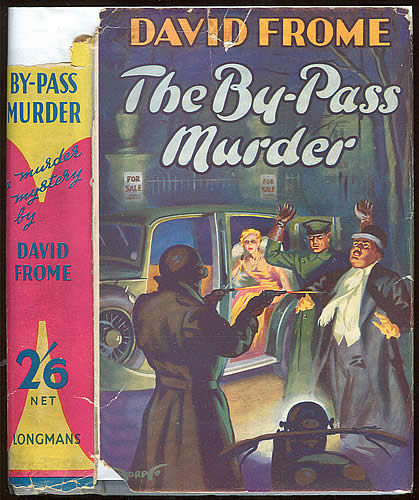
Zenith Jones Brown—aka Leslie Ford, David Frome, and Brenda Conrad and a descendant of the illustrious Calvert family of Maryland—was born today in Smith River, CA, in 1898. Her numerous mystery works include The By-Pass Murder (1932), The Strangled Witness (1934), Ill Met by Moonlight (1937), The Simple Way of Poison (1937), Three Bright Pebbles (1938), and The Girl from the Mimosa Club (1957, selected as one of Mystery Loves Company's Best Mysteries of the Century). She died in Baltimore in 1983.

Monday, December 07, 2009

BBC Film Programme: Eric Ambler.

In this December 4th broadcast of BBC Radio 4's Film Programme, Adrian Wootten discusses the "profound influence" of espionage master Eric Ambler on film and points out that 2009 marks Ambler's centenary.

About the image: Orson Welles (foreground) and Joseph Cotten in Eric Ambler's Journey into Fear (dir. Norman Foster, 1943).

Friday, December 04, 2009

Hawthorne meets the blow dryer.

The Harvard University Press blog discusses its new covers for works by Nathaniel Hawthorne that feature various renderings of the author, but they tend to appear as if Hawthorne has discovered the blow dryer (see sample at left).

Thursday, December 03, 2009

Erle Stanley Gardner's correspondence with Nathan Leopold.

On the blog American Fiction Notes, Mark Athitakis discusses the correspondence of author-lawyer Erle Stanley Gardner with convicted murderer Nathan Leopold (of Leopold and Loeb infamy). A few more details can be gleaned here from UT-Austin's Ransom Center; other mystery writers mentioned on this page include Rupert Croft-Cooke (aka Leo Bruce) and Beverley Nichols.

(Hat tip to the Guardian books blog)

Wednesday, December 02, 2009

"Why I Still Love Encyclopedia Brown."

Kate Sutherland of Kate's Book Blog pays tribute to Donald J. Sobol's super sleuth, Encyclopedia Brown, who debuted in 1963: "...I'm a lawyer and a law professor. Much is made of the mystical process by which students learn in first year law school how to 'think like a lawyer.' On reflection it occurs to me, with apologies to my first year law professors, that I may in fact have received my earliest lessons in how to think like a lawyer from Encyclopedia Brown."

Tuesday, December 01, 2009

Latest auction results.

At Christie's November 23rd auction, a letter from Arthur Conan Doyle regarding the Oscar Slater case (one occasion where Conan Doyle acted as a real-life detective) fetched £1500 (approx. US$2500); and a first edition of Ian Fleming's From Russia with Love (1957) with three other Fleming first editions went for £1250 (approx. US$2081).

(Hat tip to PhiloBiblos)