 |
| Portraits of Nicholas Longworth and Alice Roosevelt in heart-shaped frames, Palestine [TX] Daily Herald Feb. 10, 1906 |
Sunday, February 17, 2013
Today in 1906:
Alice Roosevelt weds Nicholas Longworth.

Friday, February 15, 2013
Fri Forgotten Books: The Mystery of
Central Park, by Nellie Bly (1889).
He was questioned why he used the definite article instead of the indefinite in answering the officer's question.In The Mystery of Central Park, lazy man-about-town Richard "Dick" Treadwell must prove his worth to prospective fiancee Penelope (and clear his name) by discovering who killed a young woman in Central Park. Dick finds that he is being followed as his investigation leads him into less savory areas of New York. Bly's interest in portraying the plight of the working class is evident in Dick's acquaintance with pretty factory worker Dido and her friends who are deprived of a living wage (a relationship not regarded with favor by Penelope).
—Nellie Bly, The Mystery of Central Park
 |
| "Penelope, with calm but serious face, kept close to the morgue-keeper." Illustration from The Mystery of Central Park by Nellie Bly. New York World, 19 July 1889 |
The modern reader will find it hard to give credence to Dick's chance discoveries of information that prove so crucial to the case, and those with even a passing acquaintance with forensics will loathe the fact that Dick is permitted to take the dead woman's clothes from the morgue (although his reason for doing so shows some logic). The portrait of the Pygmalion-like murderer has some elements of interest. The Mystery of Central Park should perhaps be regarded as a curiosity of a famed journalist's career and a continuation of her focus on progressive issues rather than as a significant contribution to the mystery literature.
 |
| Nellie Bly, ca. 1890. Library of Congress, Prints & Photos Div. |
There are only three copies in U.S. libraries of the book version of The Mystery of Central Park. I found the serialized version in the New York World and have uploaded the parts as a resource for readers:
Update, 6-11-13. The Library of Congress has digitized its copy of The Mystery of Central Park (available at the Internet Archive).
Wednesday, February 13, 2013
John Sayles and history.
At the AHA meeting in January, historians discussed the work of writer-director-actor John Sayles, including Matewan (1987) and Lone Star (1996); Sayles responded to their presentations about 1 hour into the session.
Monday, February 11, 2013
TV version of Spellbound (1962).
The Paley Center for Media remembers that today in 1962, a television version of Spellbound aired on Theatre 62 with Maureen O'Hara, Hugh O'Brian, and Oskar Homolka. The source material is The House of Dr. Edwardes by Francis Beeding (aka Hilary St. George Saunders and John Palmer) and the 1945 Hitchcock film.
Monday, February 04, 2013
Mystery reading by Justice Holmes and friends.
He had just discovered [E. Phillips] Oppenheim and had been revelling in the world of international intrigue into which Oppenheim had transplanted him.
—1932 research material on Oliver Wendell Holmes Jr. by Mark DeWolfe Howe
 |
| Oliver Wendell Holmes Jr., ca. 1924. Library of Congress, Prints and Photographs Div. |
Some of Holmes's friends were equally enthusiastic about mysteries. In one letter, his British Marxist-socialist friend Harold Laski notes Freeman Wills Crofts's Inspector French's Greatest Case (1925), "which I commend warmly to you if it comes your way" and later urges Holmes to read Crofts's The Cask (1920; both books are on the Haycraft-Queen list). In another letter, Laski expresses appreciation for Mary Davies and the Manor of Ebury by Charles T. Gatty; in yet another letter, he recommends Philip MacDonald's The White Crow (1928) and The Rasp (1924; the latter is on the Haycraft-Queen list).
Pollock sent Holmes a list of his recommended detective stories, with a note by the names of Sayers and Agatha Christie that stated, "anything by either of these writers may be presumed to be good." Pollock's list included Margery Allingham, G. D. H. Cole, R. Austin Freeman, Ronald A. Knox, Anthony Rolls, Henry Wade, and Victor L. Whitechurch. It appears that Holmes did not need Pollock's prompting regarding Christie, as evidenced by the following passage from Some Table Talk of Mr. Justice Holmes and the Mrs. (1935): "Mrs. Agatha Christie may be pleased some day to know that at this moment [May 1933] she was sharing his attention and his praise with Aristotle."
Thursday, January 31, 2013
New! Collected Foxwell short stories.
 |
| Cover by Karen Jackson |
Ebook platforms:
• Kindle
• Kobo
• Nook
Wednesday, January 30, 2013
French TV history: Les cinq dernieres minutes (The Five Last Minutes).
Les cinq dernières minutes (The Five Last Minutes) was a landmark police procedural series on French TV that starred Raymond Souplex as commissaire Antoine Bourrel and featured a jazzy score. It began as a game show, morphed into a drama, and ran from 1958–97.
Tuesday, January 29, 2013
Cain's Slightly Scarlet (1956).
Two sisters (Arlene Dahl and Rhonda Fleming) become entangled with a mobster (John Payne), political corruption, theft, and murder. The film is based on James M. Cain's Love's Lovely Counterfeit (1942) and directed by Allan Dwan, creator of the dolly shot.
Monday, January 28, 2013
Unlikely pals: Bram Stoker and Walt Whitman.
 |
| Walt Whitman, 1887. Library of Congress, Print and Photos Div. |
Also of interest: this TLS review of Bram Stoker and the Stage
Thursday, January 24, 2013
Capote's adaptation of Caspary's Laura, 1968.

Tuesday, January 22, 2013
Simenon's The Man on the Eiffel Tower (1949).
In The Man on the Eiffel Tower, impoverished medical student Franchot Tone is hired to kill a man's rich aunt. Also featured are Burgess Meredith, Charles Laughton (as Maigret), and Wilfred Hyde-White, with directing duties taken by Meredith, Laughton, and Irving Allen. The film is adapted from Georges Simenon's A Battle of Nerves (aka War of Nerves).
Monday, January 21, 2013
Exhibition:
The Cartoon in Wartime Propaganda.

Friday, January 18, 2013
BL exhibition: Murder in the Library.
 |
| Ad for Sax Rohmer's The Return of Fu Manchu New York Sun, Mar 11, 1916 The nefarious criminal is featured in the BL exhibition. |
• Real Crime, Real Fiction, January 21. With Barry Forshaw, Laura Wilson, and others. (Listen to the podcast here)
• The Story of Crime Fiction, February 8. With BBC Radio 4's Mark Lawson, P.D. James, and others.
• The Female Detective, March 8. Guests not yet announced.
Update: TLS review of the exhibition with images of some items from it.
Wednesday, January 16, 2013
Mystery on the Tube.
 |
| Ralph Richardson |
In honor of the London Underground's sesquicentennial, the British Film Institute highlights 10 films with a Tube setting; some mystery-related ones are included:
• Bulldog Jack (1935). A Bulldog Drummond adventure with Ralph Richardson and Fay Wray.
• Death Line (1972, aka Raw Meat). Subterranean dwellers feed on passengers (Donald Pleasence, what are you doing in this film?).
• Hidden City (1987). Charles Dance on the trail of a enigmatic film and a government conspiracy.
• Skyfall (2012). James Bond at Temple tube station.
Tuesday, January 15, 2013
Caspary's Three Husbands (1951).

In Three Husbands, a troublemaker's letters to three men claim that he has had affairs with their wives. If the plot sounds familiar, it is—A Letter to Three Wives (1949) with a gender flip and the same screenwriter: Vera Caspary, the author of Laura. With additional screenwriting assistance by songwriter Edward Eliscu, the film was produced by I. G. Goldsmith, Caspary's husband, and directed by Irving Reis (director of The Bachelor and the Bobby-Soxer; some of the Falcon films with George Sanders; Enchantment). Its stars include Eve Arden, Howard da Silva, Ruth Warrick, and Vanessa Brown.
(Hat tip to Caspary scholar A. B. Emrys for bringing this film to my attention)
Friday, January 11, 2013
"The Grave Grass Quivers," by MacKinlay Kantor (1931).
I had the strange notion that Doctor George Martindale, after unloading the sad story of his youth, had taken two days in going deliberately and completely insane.
—MacKinlay Kantor, "The Grave Grass Quivers" (Omnibus 184)

In "The Grave Grass Quivers," a country doctor suspects that his father and brother were murdered years ago, but thinks he can finally prove it with the assistance of a younger colleague. The story resonates today as the doctor conveys the anguish of himself and his family in not knowing what has happened to their loved ones.
MacKinlay Kantor (1904–77) is probably best known for his Pulitzer Prize-winning Andersonville (1955) and Glory for Me (1945; the basis for the film The Best Years of Our Lives), but he also wrote pulp stories and the story and screenplay (the latter with Dalton Trumbo) for the film Gun Crazy (1950). "The Grave Grass Quivers" was first published in the Elks Magazine in 1931 (repr. The Third Omnibus of Crime, ed. Dorothy L. Sayers, 1935; EQMM, Mar 1949; and It's About Crime, 1960).
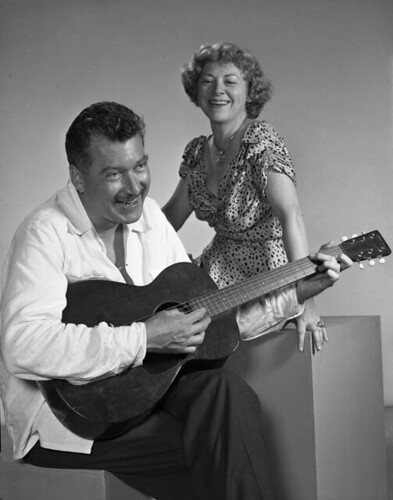 |
| MacKinlay Kantor plays the guitar. July 1950. Photo: State Library and Archives of Florida |
Wednesday, January 09, 2013
On Chinatown.
 |
| Jack Nicholson's J.J. Gittes being a "nosy fellow" in Chinatown |
Tuesday, January 08, 2013
He Walked by Night (1948).
In He Walked by Night, the police pursue a suspected cop killer and robber (Richard Basehart). Actor-screenwriter-director Crane Wilbur, a cousin of Tyrone Power, wrote the film's story and screenplay.
Monday, January 07, 2013
"You're going to jail, sir."
 |
| Michael Moriarty as exec ADA Ben Stone, Law & Order |
(Hat tip to the Law & Humanities blog)
Friday, January 04, 2013
James Caan in Naked City (1961).
The Paley Center for Media remembers today's television debut of James Caan on Naked City in 1961 (also note Dick York in the clip).
Tuesday, January 01, 2013
The Limping Man (1953).
In The Limping Man, a World War II veteran (Lloyd Bridges) encounters spies in postwar London.
Monday, December 31, 2012
Dick Francis on BBC's Great Lives.

Friday, December 28, 2012
Fri Forgotten Books:
Crime Hound, by Mary Semple Scott (1940).
I'm just an ordinary fellow with sharp ears and eyes who can sometimes do a problem in mental arithmetic.
—Mary Semple Scott, Crime Hound 50
 |
| Jacket by Carl Cobbledick |
Mary Semple Scott (1873–1968) was a granddaughter of Illinois senator James Semple; her brothers Ashley and Semple Scott made the first electric bus in St. Louis. She was active in the woman's suffrage movement, was the editor of the suffrage magazine The Missouri Woman, and was a friend of American novelist Winston Churchill (not to be confused with the British prime minister of the same name). Crime Hound was her only mystery novel.
 |
| Mary Semple Scott, from Mar 1904 St. Louis Republic |
 |
| Mary Semple Scott, at left, plays the Democratic donkey in a skit at the 1920 Nat Amer Woman Suffrage Assn meeting. Library of Congress, Prints and Photos Division. |
Tuesday, December 25, 2012
The Miracle on 34th Street (1955).
This 1955 TV version of The Miracle on 34th Street features Thomas Mitchell as Kris Kringle, MacDonald Carey as lawyer Fred, and Teresa Wright as Doris (the Maureen O'Hara part). Carey and Wright had appeared earlier together in Hitchcock's Shadow of a Doubt (1943).
Monday, December 24, 2012
From OSS to a winery.
After The Bunburyist featured the TV movie Deadly Harvest, in which a vintner finds Soviet agents on his trail, is it any wonder to find that truth is stranger than fiction? In this podcast, Peter Earnest of the Intl Spy Museum talks to Peter Sichel, who worked for the OSS, the CIA, and Blue Nun Wines. In the clip below, Sichel discusses his work in the wine business and mentions his intelligence background.
Update. Part 2 of the discussion with Sichel here.
Update. Part 2 of the discussion with Sichel here.
Friday, December 21, 2012
Ardai on rediscovered Cain, From the Bookshelf.

Wednesday, December 19, 2012
MacDonald on McBain/Hunter, David's Bk Talk.
 |
| Evan Hunter, NYPL |
Tuesday, December 18, 2012
Please Murder Me (1956).
In Please Murder Me (1956), a lawyer (a pre–Perry Mason Raymond Burr) successfully defends his client (Angela Lansbury) against a murder charge, but all may not be well. The film is directed by Peter Godfrey (Christmas in Connecticut, The Two Mrs. Carrolls).
Monday, December 17, 2012
Chester Himes this week on BBC Radio 4 Extra.
 |
| Clues 28.1, 2010 (theme issue on Chester Himes) |
Monday, December 10, 2012
A vicar detects this week on BBC Radio 4 Extra.

Saturday, December 08, 2012
Today in 1963: Sinatra Jr kidnapping.
British Pathe recalls the kidnapping of Frank Sinatra Jr. that occurred December 8, 1963. Sinatra Jr. discusses the kidnapping in this recent Guardian piece.

FBI CRACKS SINATRA KIDNAPPING CASE
Wednesday, December 05, 2012
Spies in fiction on SpyCast.
 |
| William Le Queux, NYPL |
Monday, December 03, 2012
Edwardian sleuth Thorpe Hazell this week on BBC Radio 4 Extra.

Friday, November 30, 2012
Happy centenary, Gordon Parks.
Today marks the centenary of Shaft director and photographer Gordon Parks, who was born today in Fort Scott, KS, in 1912. He died in 2006. The Gordon Parks Foundation has a rundown of various events and exhibitions this year in honor of Parks.
Wednesday, November 28, 2012
Censoring Evan Hunter.
 |
| Evan Hunter, NYPL |
Tuesday, November 27, 2012
Household's Deadly Harvest (1972).
In this 1972 TV movie, a California vintner (Richard Boone) learns that he is the target of Soviet agents. It is adapted (not very faithfully) from Watcher in the Shadows by the Detection Club's Geoffrey Household (best known for Rogue Male).
Monday, November 26, 2012
Haycraft-Queen: More titles back in print.
Welcome developments in reprints of titles on the Haycraft-Queen Cornerstone list (those mysteries deemed essential by Howard Haycraft and Ellery Queen):
 • Arcturus Crime Classics has reprinted Helen McCloy's Through a Glass, Darkly and Francis Iles's Before the Fact
• Bello (an imprint of Macmillan) has reissued Roy Vickers's The Department of Dead Ends
• Felony & Mayhem has reprinted Edmund Crispin's The Moving Toyshop
• Ramble House has an edition of Harvey J. O'Higgins's Detective Duff Unravels It
• Titan Books has reissued Sax Rohmer's The Mystery of Dr. Fu Manchu
• There are new ebook versions of Charlotte Armstrong's The Unsuspected (1947 film available on DVD as well) and Clayton Rawson's Death from a Top Hat
Note that there was a 2011 edition of Helen Eustis's The Horizontal Man in ImPress's Best Mysteries of All Time series, but this is an abridged version, and I believe this series is available only by subscription.
And to recap previous HQ reissues:
• Rue Morgue Press's new editions of Manning Coles's Pray Silence (US title: A Toast to Tomorrow) and John Dickson Carr's The Judas Window and The Crooked Hinge
• Blue Dolphin Publishing's reissue of H. F. Heard's A Taste for Honey
Haycraft-Queen Out-of-Print Titles in the United States (compiled and revised by Elizabeth Foxwell)
Anderson Frederick Irving - The Book of Murder - 1930
Bailey H. C. - The Red Castle - 1932
Benson G. R. - Tracks in the Snow - 1906
Charteris Leslie [Leslie Charles Bowyer Yin] - Meet the Tiger - 1928
Coates Robert M. - Wisteria Cottage - 1948
Cole G. D. H. [G. D. H. Cole and Margaret Cole] - The Brooklyn Murders - 1923
Dane Clemence [Winifred Ashton] and Helen Simpson - Re-enter Sir John - 1932
Davis Dorothy Salisbury - A Gentle Murderer - 1951
De la Torre Lillian [Lillian McCue] - Dr. Sam Johnson, Detector - 1946
Dickson Carter [John Dickson Carr] - Lord of the Sorcerers - 1946
Dunsany Lord - The Little Tales of Smethers - 1952
Eberhart Mignon G. - The Patient in Room 18 - 1929
Ellin Stanley - Dreadful Summit - 1948
Eustis Helen - The Horizontal Man - 1946
Frome David [Zenith Jones Brown] - The Hammersmith Murders - 1930
Gardner Erle Stanley - The Case of the Sulky Girl - 1933
Halsey Harlan Page - Old Sleuth, the Detective - 1872
Hammett Dashiell - The Adventures of Sam Spade - 1944
Hart Frances Noyes - The Bellamy Trial - 1927
Hughes Dorothy B. - The So Blue Marble - 1940
King Rufus - Murder by the Clock - 1929
Lawrence Hilda - Blood Upon the Snow - 1944
Lipsky Eleazar - The People Against O’Hara - 1950
Lockridge Frances and Richard Lockridge - The Norths Meet Murder - 1940
Lustgarten Edgar - A Case to Answer - 1947
MacDonald Philip - The Rasp - 1924
MacDonald Philip - The Nursemaid Who Disappeared [aka Warrant for X] - 1938
MacHarg William and Edwin Balmer - The Achievements of Luther Trant - 1910
Marquand John P. - No Hero - 1935
Paul Elliot - The Mysterious Mickey Finn - 1939
Piper Evelyn [Merriam Modell] - The Motive - 1950
Rhode John - The Murders in Praed Street - 1928
Rhode John - The Paddington Mystery - 1925
Rice Craig - Trial by Fury - 1941
Ross Barnaby [Ellery Queen] - The Tragedy of Y - 1932
Seeley Mabel - The Listening House - 1938
Stribling T. S. - Clues of the Caribbees - 1929
Trevor Glen [James Hilton] - Murder at School [aka Was It Murder?] - 1931
Van Dine S. S. [Willard Huntington Wright] - The Benson Murder Case - 1926
Walling R. A. J. - The Fatal Five Minutes - 1932
Walsh Thomas - Nightmare in Manhattan - 1950
Waters [William Russell] - Recollections of a Detective Police Officer - 1856
Wells Carolyn - The Clue - 1909
• Bello (an imprint of Macmillan) has reissued Roy Vickers's The Department of Dead Ends
• Felony & Mayhem has reprinted Edmund Crispin's The Moving Toyshop
• Ramble House has an edition of Harvey J. O'Higgins's Detective Duff Unravels It
• Titan Books has reissued Sax Rohmer's The Mystery of Dr. Fu Manchu
• There are new ebook versions of Charlotte Armstrong's The Unsuspected (1947 film available on DVD as well) and Clayton Rawson's Death from a Top Hat
Note that there was a 2011 edition of Helen Eustis's The Horizontal Man in ImPress's Best Mysteries of All Time series, but this is an abridged version, and I believe this series is available only by subscription.
And to recap previous HQ reissues:
• Rue Morgue Press's new editions of Manning Coles's Pray Silence (US title: A Toast to Tomorrow) and John Dickson Carr's The Judas Window and The Crooked Hinge
• Blue Dolphin Publishing's reissue of H. F. Heard's A Taste for Honey
Haycraft-Queen Out-of-Print Titles in the United States (compiled and revised by Elizabeth Foxwell)
Anderson Frederick Irving - The Book of Murder - 1930
Bailey H. C. - The Red Castle - 1932
Benson G. R. - Tracks in the Snow - 1906
Charteris Leslie [Leslie Charles Bowyer Yin] - Meet the Tiger - 1928
Coates Robert M. - Wisteria Cottage - 1948
Cole G. D. H. [G. D. H. Cole and Margaret Cole] - The Brooklyn Murders - 1923
Dane Clemence [Winifred Ashton] and Helen Simpson - Re-enter Sir John - 1932
Davis Dorothy Salisbury - A Gentle Murderer - 1951
De la Torre Lillian [Lillian McCue] - Dr. Sam Johnson, Detector - 1946
Dickson Carter [John Dickson Carr] - Lord of the Sorcerers - 1946
Dunsany Lord - The Little Tales of Smethers - 1952
Eberhart Mignon G. - The Patient in Room 18 - 1929
Ellin Stanley - Dreadful Summit - 1948
Eustis Helen - The Horizontal Man - 1946
Frome David [Zenith Jones Brown] - The Hammersmith Murders - 1930
Gardner Erle Stanley - The Case of the Sulky Girl - 1933
Halsey Harlan Page - Old Sleuth, the Detective - 1872
Hammett Dashiell - The Adventures of Sam Spade - 1944
Hart Frances Noyes - The Bellamy Trial - 1927
Hughes Dorothy B. - The So Blue Marble - 1940
King Rufus - Murder by the Clock - 1929
Lawrence Hilda - Blood Upon the Snow - 1944
Lipsky Eleazar - The People Against O’Hara - 1950
Lockridge Frances and Richard Lockridge - The Norths Meet Murder - 1940
Lustgarten Edgar - A Case to Answer - 1947
MacDonald Philip - The Rasp - 1924
MacDonald Philip - The Nursemaid Who Disappeared [aka Warrant for X] - 1938
MacHarg William and Edwin Balmer - The Achievements of Luther Trant - 1910
Marquand John P. - No Hero - 1935
Paul Elliot - The Mysterious Mickey Finn - 1939
Piper Evelyn [Merriam Modell] - The Motive - 1950
Rhode John - The Murders in Praed Street - 1928
Rhode John - The Paddington Mystery - 1925
Rice Craig - Trial by Fury - 1941
Ross Barnaby [Ellery Queen] - The Tragedy of Y - 1932
Seeley Mabel - The Listening House - 1938
Stribling T. S. - Clues of the Caribbees - 1929
Trevor Glen [James Hilton] - Murder at School [aka Was It Murder?] - 1931
Van Dine S. S. [Willard Huntington Wright] - The Benson Murder Case - 1926
Walling R. A. J. - The Fatal Five Minutes - 1932
Walsh Thomas - Nightmare in Manhattan - 1950
Waters [William Russell] - Recollections of a Detective Police Officer - 1856
Wells Carolyn - The Clue - 1909
Tuesday, November 20, 2012
Popeye, PI.
In Private Eye Popeye (1954), the spinach-loving shamus is on the trail of Olive Oyl's stolen gem.
Monday, November 19, 2012
Winifred Holtby's "Why Herbert Killed His Mother."
. . . among the things a Fella does, correct grammar is not necessarily included.
—Winifred Holtby, "Why Herbert Killed His Mother"

Wednesday, November 14, 2012
Pulp magazines in "Thrill Seekers" exhibition.

Monday, November 12, 2012
And away we go: Gleason and the paranormal.
 |
| Gleason-designed bookplate from U-Miami's Jackie Gleason Collection |
Wednesday, November 07, 2012
Glimpses of royalty from Marie Belloc Lowndes.
 |
| Marie Belloc Lowndes, from the Evening Public Ledger, Apr 7, 1917 |
Tuesday, November 06, 2012
Lawrence Treat's "The Debt" (1952).
In "The Debt," a May 1952 episode of Suspense, a drifter confronts murder. The episode, which features Conrad Janis and Brian Keith, is adapted from "Twenty-Dollar Debt" by Lawrence Treat—MWA cofounder, Edgar winner, and an important figure in the development of the police procedural.
Monday, November 05, 2012
"... I have been prepared to be shot."
 |
| Theodore Roosevelt, NYPL |
Thursday, November 01, 2012
BBC Radio 4 program on European detectives.

Wednesday, October 31, 2012
Tune up the zither: Third Man Museum.
In the Washington Post, David Stewart White writes about the devoted collector who has opened a Vienna museum dedicated to the Carol Reed film of Graham Greene's novella. Film costar Joseph Cotten talks about the production and remeeting some of his castmates years later in his autobiography, Vanity Will Get You Somewhere.
Tuesday, October 30, 2012
Whispering City (1947).
In Whispering City (1947), Lifeboat's Mary Anderson is a reporter who learns that the death of an actress's fiance was no accident and may involve a smooth and calculating lawyer (Paul Lukas), who is busily blackmailing a composer (Helmut Dantine, best known for Mrs. Miniver and Casablanca). Set in Quebec, the film features Canadian composer Andre Mathieu's evocative "Quebec Concerto."
Monday, October 29, 2012
New TV version of Mystery of a Hansom Cab.
Burberry Entertainment just produced for the Australian Broadcasting Co. a new adaptation of The Mystery of a Hansom Cab, the major mystery success of 1886–87 in Australia and the United Kingdom that was penned by British-born Fergusson Wright Hume (aka Fergus Hume). John Waters stars. Christopher Pittard discussed the novel in this 2007 Clues article. (Hat tip to Lucy Sussex)
Saturday, October 27, 2012
Clues 30.2: Paranormal mysteries.
Just in time for Halloween, Clues 30.2 has been published—a theme issue on paranormal mysteries guest edited by Agatha and Macavity nominee A. B. Emrys. A quick rundown of the content appears below; I'll insert links once the articles are uploaded to the McFarland Metapress Web site. Go here for details on ordering the issue or subscribing. The cover features Kevin Bacon in Stir of Echoes.
 Introduction: From Psychical Investigation to Paranormal Detective A. B. EMRYS (emerita, University of Nebraska-Kearney). The guest editor of this Clues theme issue on paranormal mysteries introduces the issue, outlining the themes of the contributor essays and mentioning authors such as Alice and Claude Askew, Wilkie Collins, Arthur Conan Doyle, Hamlin Garland, Hüseyin Rahmi Gürpinar, Fitz-James O’Brien, Sandra West Prowell, and Ian Rankin.
What Are They? The Pseudo-Mystery Stories of Fitz-James O’Brien PETE ORFORD The works of Fitz-James O’Brien are largely forgotten. The author considers how two of O’Brien’s works resemble early detective fiction and assesses how the stories’ hero, Harry Escott, both conforms to and subverts the figure of the detective as presented by the bookending icons of C. Auguste Dupin and Sherlock Holmes.
Literature for the People: The Paranormal Mysteries of Hüseyin Rahmi Gürpınar ÖZGÜR ÇIÇEK (Binghamton University, SUNY) and IRMA KERTUNA-HOWISON (Beykent University, Istanbul). The authors examine Hüseyin Rahmi Gürpınar’s paranormal mysteries in the context of the modernization of the late Ottoman Empire. His popular style, distinctive from other Westernizing movements at the time, as well as his incorporation of traditional narrative techniques, reveal how Gürpınar hybridizes the Western genre of paranormal mystery in early Turkish literature.
CSΨ: Occult Detectives of the Fin de Siècle and the Interpretation of Evidence SARAH CROFTON (King's College, London). Early occult-detective fiction aped the familiar detective formula, playfully substituting its basis in criminalistics for psychical research. In disrupting the archetype, it draws attention to a gap traditionally elided in detective fiction but at the heart of occultism: that between proof in its absolute sense and the persuasive proof of a convincing story.
Aylmer Vance and the Paradox of the Paranormal OLIVER TEARLE (Loughborough University, UK). How can the ever-mysterious world of the supernatural be successfully joined with the detective story, a genre that thrives on tying up loose ends in the narrative? Through a comparison of some of the best-known fictional psychical detectives and investigators, this article seeks to explore the important issues surrounding this hybrid genre.
Beyond the Border: The Author as Occult Detective in Hamlin Garland’s The Mystery of the Buried Crosses TIM PRCHAL (Oklahoma State University). Occult detectives probe fictional mysteries rooted in the supernatural. In The Mystery of the Buried Crosses (1939), Hamlin Garland recounts his investigation into a real-life mystery involving spiritualism. Like the fictional detectives, Garland urges readers to ponder the borders of their physical world but offers no definitive stance on supernatural intrusions.
Montana Gothic: Sandra West Prowell’s Phoebe Siegel Mysteries RACHEL SCHAFFER (Montana State University Billings). Montana author Sandra West Prowell blends gothic and paranormal elements, including mysterious mansions, ghostly sightings, and prophetic dreams, as she examines issues of social justice, particularly for women and Native Americans, and highlights Native American spirituality, all from the irreverent point of view of private investigator Phoebe Siegel.
Ghosts and Skeletons: Metaphors of Guilty History in Ian Rankin’s Rebus Series ERIN E. MacDONALD (Fanshawe College, Canada). The author examines Ian Rankin’s use of the gothic convention of the ghost in Black and Blue, Dead Souls, Set in Darkness, and “The Very Last Drop.” In these works, ghosts and skeletons are used as metaphors for Detective Inspector John Rebus’s guilt over past mistakes and for the dark past of his home city, Edinburgh.
Ghost-Seeing and Detection in Stir of Echoes MURRAY LEEDER (Carleton University, Canada). The author explores the links between the ghost story and the classical detective story, using as a case study the 1999 film adaptation of Richard Matheson’s Stir of Echoes (1959). The author explores the relationship of the restless dead to the living as well as the investment of the detective with powers to see a secret world hidden from everyday human vision.
The Mystifying Rationale of Psychic Detection EDEN LEONE (Bowling Green State University, OH). Through an examination of the USA Network series Psych (2006–), the author discusses how the psychic detective subverts the model of rational detection as exemplified by Sherlock Holmes.
ESSAY
Homicide and Home-icide: Exhuming Ireland’s Past in the Detective Novels of Tana French SHIRLEY PETERSON (Daemen College, NY). Tana French’s Dublin Murder Squad series features police procedurals in which homicide investigations act as a social critique of “home-cide” in the “new” Ireland spawned by the economic boom known as the Celtic Tiger. Dublin is a crime scene in which victims of its inconvenient past refuse to stay buried until justice is served.
BOOK REVIEWS
Stephen Knight. The Mysteries of the Cities: Urban Crime Fiction in the Nineteenth Century. DANIEL STEIN
Christine A. Jackson. The Tell-Tale Art: Poe in Modern Popular Culture and Paul Meehan. Horror Noir: Where Cinema’s Dark Sisters Meet JIM MANCALL
A Land Down Under: Recent Crime Fiction and Nonfiction from Australia STEPHEN KNIGHT
What Are They? The Pseudo-Mystery Stories of Fitz-James O’Brien PETE ORFORD The works of Fitz-James O’Brien are largely forgotten. The author considers how two of O’Brien’s works resemble early detective fiction and assesses how the stories’ hero, Harry Escott, both conforms to and subverts the figure of the detective as presented by the bookending icons of C. Auguste Dupin and Sherlock Holmes.
Literature for the People: The Paranormal Mysteries of Hüseyin Rahmi Gürpınar ÖZGÜR ÇIÇEK (Binghamton University, SUNY) and IRMA KERTUNA-HOWISON (Beykent University, Istanbul). The authors examine Hüseyin Rahmi Gürpınar’s paranormal mysteries in the context of the modernization of the late Ottoman Empire. His popular style, distinctive from other Westernizing movements at the time, as well as his incorporation of traditional narrative techniques, reveal how Gürpınar hybridizes the Western genre of paranormal mystery in early Turkish literature.
CSΨ: Occult Detectives of the Fin de Siècle and the Interpretation of Evidence SARAH CROFTON (King's College, London). Early occult-detective fiction aped the familiar detective formula, playfully substituting its basis in criminalistics for psychical research. In disrupting the archetype, it draws attention to a gap traditionally elided in detective fiction but at the heart of occultism: that between proof in its absolute sense and the persuasive proof of a convincing story.
Aylmer Vance and the Paradox of the Paranormal OLIVER TEARLE (Loughborough University, UK). How can the ever-mysterious world of the supernatural be successfully joined with the detective story, a genre that thrives on tying up loose ends in the narrative? Through a comparison of some of the best-known fictional psychical detectives and investigators, this article seeks to explore the important issues surrounding this hybrid genre.
Beyond the Border: The Author as Occult Detective in Hamlin Garland’s The Mystery of the Buried Crosses TIM PRCHAL (Oklahoma State University). Occult detectives probe fictional mysteries rooted in the supernatural. In The Mystery of the Buried Crosses (1939), Hamlin Garland recounts his investigation into a real-life mystery involving spiritualism. Like the fictional detectives, Garland urges readers to ponder the borders of their physical world but offers no definitive stance on supernatural intrusions.
Montana Gothic: Sandra West Prowell’s Phoebe Siegel Mysteries RACHEL SCHAFFER (Montana State University Billings). Montana author Sandra West Prowell blends gothic and paranormal elements, including mysterious mansions, ghostly sightings, and prophetic dreams, as she examines issues of social justice, particularly for women and Native Americans, and highlights Native American spirituality, all from the irreverent point of view of private investigator Phoebe Siegel.
Ghosts and Skeletons: Metaphors of Guilty History in Ian Rankin’s Rebus Series ERIN E. MacDONALD (Fanshawe College, Canada). The author examines Ian Rankin’s use of the gothic convention of the ghost in Black and Blue, Dead Souls, Set in Darkness, and “The Very Last Drop.” In these works, ghosts and skeletons are used as metaphors for Detective Inspector John Rebus’s guilt over past mistakes and for the dark past of his home city, Edinburgh.
Ghost-Seeing and Detection in Stir of Echoes MURRAY LEEDER (Carleton University, Canada). The author explores the links between the ghost story and the classical detective story, using as a case study the 1999 film adaptation of Richard Matheson’s Stir of Echoes (1959). The author explores the relationship of the restless dead to the living as well as the investment of the detective with powers to see a secret world hidden from everyday human vision.
The Mystifying Rationale of Psychic Detection EDEN LEONE (Bowling Green State University, OH). Through an examination of the USA Network series Psych (2006–), the author discusses how the psychic detective subverts the model of rational detection as exemplified by Sherlock Holmes.
ESSAY
Homicide and Home-icide: Exhuming Ireland’s Past in the Detective Novels of Tana French SHIRLEY PETERSON (Daemen College, NY). Tana French’s Dublin Murder Squad series features police procedurals in which homicide investigations act as a social critique of “home-cide” in the “new” Ireland spawned by the economic boom known as the Celtic Tiger. Dublin is a crime scene in which victims of its inconvenient past refuse to stay buried until justice is served.
BOOK REVIEWS
Stephen Knight. The Mysteries of the Cities: Urban Crime Fiction in the Nineteenth Century. DANIEL STEIN
Christine A. Jackson. The Tell-Tale Art: Poe in Modern Popular Culture and Paul Meehan. Horror Noir: Where Cinema’s Dark Sisters Meet JIM MANCALL
A Land Down Under: Recent Crime Fiction and Nonfiction from Australia STEPHEN KNIGHT
Friday, October 26, 2012
The return of The Female Detective (1864).
It often happens to us detectives . . . that we are the first movers in matters of great ultimate importance to individuals in particular, and the public at large (Forrester, The Female Detective 6)
 Due out today from the British Library (distrib. U Chicago P) is The Female Detective (1864) by Andrew Forrester (pseud. of James Redding Ware), an important work in the evolution of the fictional female detective with the title character, who uses the name Miss Gladden. This edition has a foreword by Alexander McCall Smith and an introduction by Mike Ashley. Scholars' Facsimiles and Reprints also has reissued The Female Detective with Revelations of a Lady Detective (1864, attrib. to W. S. Hayward) under the title The First Female Detectives.
Tuesday, October 23, 2012
Margaret Millar's "Rose's Last Summer" (1960).
In "Rose's Last Summer" (October 1960 episode of Thriller, directed by Arthur Hiller and based on the book by Edgar winner and Grand Master Margaret Millar), Mary Astor plays an alcoholic former actress who is found dead under mysterious circumstances. A suspicious friend (Lin McCarthy) teams up with her ex-husband (Jack Livesey) to investigate.
Monday, October 22, 2012
Lady of burlesque (and mystery).

Here is Barbara Stanwyck jitterbugging and performing Russian splits in Lady of Burlesque (film adaptation of The G-String Murders).
Sunday, October 21, 2012
Barry Nelson debuts as James Bond, 1954.
 |
| Barry Nelson as James Bond in "Casino Royale" |
Wednesday, October 17, 2012
McCloy, Moyes, and White reissued.
Among the books just reissued in the Arcturus Crime Classics series:
• MWA Grand Master Helen McCloy, Through a Glass, Darkly (1950). A doppelganger means trouble for a teacher and psychiatrist Basil Willing. The New York Times deemed it one of the best mysteries of 1950. Wrote Dorothy B. Hughes about the book in the Dec. 3, 1950, Washington Post, "Not since the late Bayard Veiller's 'Bait for a Tiger' has this reader been filled with such actual fear by a printed page."
 • Patricia Moyes, Who Saw Her Die? (aka Many Deadly Returns, 1970). In this Edgar-nominated novel, Detective Chief Superintendent Henry Tibbett must figure out how a widow died.
• Ethel Lina White, Some Must Watch (1933). A killer preys on vulnerable women in this novel by the author of The Lady Vanishes that was adapted as Robert Siodmak's The Spiral Staircase.
• MWA Grand Master Helen McCloy, Through a Glass, Darkly (1950). A doppelganger means trouble for a teacher and psychiatrist Basil Willing. The New York Times deemed it one of the best mysteries of 1950. Wrote Dorothy B. Hughes about the book in the Dec. 3, 1950, Washington Post, "Not since the late Bayard Veiller's 'Bait for a Tiger' has this reader been filled with such actual fear by a printed page."

• Ethel Lina White, Some Must Watch (1933). A killer preys on vulnerable women in this novel by the author of The Lady Vanishes that was adapted as Robert Siodmak's The Spiral Staircase.
Tuesday, October 16, 2012
Woolrich's Fear in the Night (1947).
A man is uncertain if his dream of committing murder is just a dream—or reality. The film, based on "And So to Death" (1941, later repr. as "Nightmare") by Cornell Woolrich under the pseudonym of William Irish, stars Star Trek's DeForest Kelley.
Monday, October 15, 2012
Happy birthday, Ed McBain/Evan Hunter.
To commemorate today's birthday of the late police procedural pioneer Ed McBain (aka author-screenwriter Evan Hunter, born in New York City in 1926), why not watch this clip from Cop Hater (1958)?
Tuesday, October 09, 2012
Eyes in the Night (1942).
In Eyes in the Night (1942, dir. Fred Zinnemann), Edward Arnold plays a blind detective who uncovers a Nazi plot. The film is an adaptation of The Odor of Violets (1940) by Mystery Writers of America cofounder and Grand Master Baynard Kendrick (see also the TV program Longstreet based on Kendrick's work). The follow-up film, The Hidden Eye (1945), was scripted by MWA Grand Master George Harmon Coxe.
Monday, October 08, 2012
Happy birthday, Jill Ker Conway.

Tuesday, October 02, 2012
Hammett's "Two Sharp Knives" (1949).
In the 1949 Studio One production of Dashiell Hammett's "Two Sharp Knives" (1934), a police chief has his doubts about the case of a man accused of murder. The episode features Abe Vigoda along with a cameo by Hammett and is directed by Franklin J. Schaffner (Papillon, Patton, Planet of the Apes). Note that there is also a 1942 radio version of "Two Sharp Knives" from Suspense.
Monday, October 01, 2012
Exhibition: Famous Trials and Their Legacies.
 |
| Jodie Foster in Sommersby |
Subscribe to:
Posts (Atom)