
Tuesday, June 16, 2020
Ian Rankin companion published.

Monday, June 15, 2020
CFP, Historical Crime Fiction (theme issue of Clues: A Journal of Detection).
Clues has issued a new Call for Proposals for a theme issue on "Historical Crime Fiction" that will be guest edited by Rosemary Erickson Johnsen (Governors State University; author of Contemporary Feminist Historical Crime Fiction). The deadline for proposals is November 1, 2020.
As usual, Clues considers manuscripts on all aspects of mystery, detective, and crime fiction on an ongoing basis, so authors who have a manuscript on a topic that falls outside the Call for Proposals are welcome to submit to Clues Executive Editor Caroline Reitz at any time.

As usual, Clues considers manuscripts on all aspects of mystery, detective, and crime fiction on an ongoing basis, so authors who have a manuscript on a topic that falls outside the Call for Proposals are welcome to submit to Clues Executive Editor Caroline Reitz at any time.

Tuesday, June 09, 2020
Having Wonderful Crime (1945).
 |
| Craig Rice, right, with producer Bob Fellows. |
Monday, June 08, 2020
The rooms at 221B Baker Street.

Friday, June 05, 2020
A change at Clues.
As McFarland has announced, a new executive editor has been appointed at Clues: A Journal of Detection, the oldest US scholarly journal on mystery/detective/crime fiction: Dr. Caroline Reitz, associate professor at John Jay College of Criminal Justice–CUNY and a faculty member of the CUNY Graduate Center. A Victorian specialist, Dr. Reitz coedits the Dickens Studies Annual, teaches frequently on detective fiction, and wrote Detecting the Nation: Fictions of Detection and the Imperial Venture (2004). As a graduate student, she worked at the famed Kate's Mystery Books (owned by the late Kate Mattes) in Cambridge, MA.
She succeeds Dr. Janice Allan (University of Salford, UK), who has served as executive editor for eight years. As the longtime managing editor of Clues, I am grateful for Dr. Allan's long service and look forward to working with Dr. Reitz.
She succeeds Dr. Janice Allan (University of Salford, UK), who has served as executive editor for eight years. As the longtime managing editor of Clues, I am grateful for Dr. Allan's long service and look forward to working with Dr. Reitz.
Tuesday, May 26, 2020
Wait until Dark (1982).
This 1982 TV version of the play by Frederick Knott (Dial M for Murder, etc.) features Katharine Ross as a blind woman terrorized by criminals who want something that is in her possession. Stacy Keach takes on several roles in this production. Other costars include Joshua Bryant and Edward Winter.
Tuesday, May 19, 2020
Studio One: "Ten Thousand Horses Singing" (1952).
In "Ten Thousand Horses Singing," the gallant owner of a fledgling cargo airline (John Forsythe) encounters complications such as a llama, a mysterious woman with an abusive spouse, a lively farming family, and a businessman on the run. Look for James Dean in a small role as a hotel bellhop.
Monday, May 18, 2020
What's in a name? The messages in detective monikers.

Tuesday, May 12, 2020
The Scarf (1951).
In The Scarf, John Ireland is convicted of murder, although he has no memory of the crime, and is confined to an insane asylum. He escapes to find out the truth and meets Mercedes McCambridge.
Monday, May 11, 2020
BFI choices, works with cinema and mystery.

The following mystery-related works are included:
- No. 24: The Director's Cut, by Nicholas Royle
- No. 30: Fear in the Sunlight, by Nicola Upson
- No. 32: Flicker, by Theodore Roszak
- No. 37: The Invention of Morel, by Adolfo Bioy Casares
- No. 40: L.A. Confidential, by James Ellroy
- No. 47: The Little Sister, by Raymond Chandler
- No. 55: Missing Reels, by Farran Smith Nehme
Tuesday, May 05, 2020
Remembering Maj Sjowall: The Laughing Policeman (1973).
Maj Sjowall, best known for the Martin Beck series that she wrote with her partner, Per Wahloo, died on April 29 at age 84. The fourth book in the series, The Laughing Policeman, received an Edgar for Best Novel and was released as a film in 1973 with Walter Matthau, Bruce Dern, and Louis Gossett Jr.
Tuesday, April 28, 2020
Dummy (1979).
In Dummy, deaf lawyer Paul Sorvino defends LeVar Burton, a deaf man unable to speak who is accused of murder. The writer is Edgar winner Ernest Tidyman (Shaft, The French Connection).
Monday, April 27, 2020
Addl funding for online dime novel project.
Villanova's Falvey Memorial Library announced that it has received a nearly $350,000 grant from the National Endowment for the Humanities to continue digitizing dime novels in partnership with Northern Illinois University (Nickels and Dimes collection, which offers research opportunities), Bowling Green State University, Oberlin, and Stanford. Comments by Falvey's Demian Katz indicate that the concentration will be on works issued by Street & Smith, a major dime novel publisher.
The project has provided many valuable mystery-related works, including those by female authors such as Mary Elizabeth Braddon, Anna Katharine Green, and Metta Fuller Victor (aka Seeley Regester).
The project has provided many valuable mystery-related works, including those by female authors such as Mary Elizabeth Braddon, Anna Katharine Green, and Metta Fuller Victor (aka Seeley Regester).
 |
| Illustration from The Figure Eight (1869), by Seeley Regester (aka Metta Fuller Victor). NIU Nickels and Dimes Collection |
Tuesday, April 21, 2020
Remembering Brian Dennehy:
Perfect Witness (1989).
Amid the large body of work of veteran actor Brian Dennehy, who died on April 15, is the TV movie Perfect Witness (1989), in which he appears as a district attorney wishing to prosecute a mob killing, but the witness (Aidan Quinn) faces threats to his family.
Monday, April 20, 2020
Mystery through L.A. Theatre Works.
Looking for something mystery-related to listen to during an extended period at home? L.A. Theatre Works has the following program available on Sound Cloud:
• John Ball's In the Heat of the Night
• John Ball's In the Heat of the Night
Tuesday, April 14, 2020
Million Dollar Weekend (1948)
 |
| Gene Raymond in Million Dollar Weekend (1948) |
In Million Dollar Weekend, stockbroker Gene Raymond faces blackmail and ruination when he decides to embezzle funds from his firm. Raymond also directs and shares a writing credit on the film.
Monday, April 13, 2020
Potential undergraduate and other projects, Nickels & Dimes collection.
 |
| Mary Elizabeth Braddon's Three Times Dead (1881). Nickels & Dimes Collection, NIU |
Tuesday, April 07, 2020
Chance Meeting (1959).
When a woman is murdered after having an affair with Dutch painter Jan Van Rooyen (Hardy Kruger), Van Rooyen finds that he is the top suspect of Inspector Morgan (Stanley Baker). Costars include Michelene Presle, Gordon Jackson, and Robert Flemyng.
Monday, April 06, 2020
Clues 38.1: Asimov, Christie, Conan Doyle, Ellroy, Flynn, Hammett, and more.

Introduction: Beginnings and Endings / JANICE M. ALLAN (Salford University)
The Clues executive editor outlines the content of Clues 38.1, with articles on authors such as Isaac Asimov, Cheng Xiaoqing, Agatha Christie, Arthur Conan Doyle, Ruth Dugdall, James Ellroy, Gillian Flynn, Dashiell Hammett, Tatiana Lobo, Satyajit Ray, Susanne Staun, and Olen Steinhauer.
“Floating Unmoored”: The World of “Tourism” in Olen Steinhauer’s Espionage Trilogy / ROBERT LANCE SNYDER (University of West Georgia)
Olen Steinhauer’s espionage trilogy dramatizes its protagonist’s struggle to forge a centered identity after years of service as a black-ops agent in the CIA’s fictive Department of Tourism. By committing himself to his wife and stepdaughter, Milo Weaver escapes a downward spiral into suicidal disintegration captured by the trope of “floating unmoored.” The series’ recursivity involves structural elements that can be identified as momentum and world-building.
Altering the Hypermasculine through the Feminine: Female Masculinity in Gillian Flynn’s Gone Girl / BETH STRATTON
Gillian Flynn’s Gone Girl offers a modern take on the neo-homosocial triangle that results in the triumph of a female masculinity. With the aid of his queer-coded sister, the character of Nick learns to temper his hypermasculinity with a more feminized version of masculinity to win back his wife, Amy.
Hard-Boiled Queers and Communists: James Ellroy’s The Big Nowhere / JOSHUA COMYN (Trinity College, University of Melbourne)
This article argues that the characterization of the killer in James Ellroy’s The Big Nowhere (1988), together with Ellroy’s development as a novelist, can be illuminated through the representation of psychoanalysis and Marxism within the novel, as well as by the historical context of the novel’s fictional setting.
Resisting Invisibility: Mothers and Human Trafficking in Ruth Dugdall’s Nowhere Girl and Susanne Staun’s Skadestuen / CHARLOTTE BEYER (University of Gloucestershire)
Human trafficking is regularly presented in twenty-first-century crime fiction, frequently through stereotypes of femininity but rarely involving mothers or maternal experience. This article seeks to remedy this gap in representation by analyzing two twenty-first-century crime novels featuring trafficking plots that focus specifically on the politics of representing mothers.
Tuesday, March 31, 2020
Plunder Road (1957).
In Plunder Road, a gang headed by Gene Raymond robs a train of $10M in gold, but evading the police and camouflaging the gold pose significant difficulties.
Monday, March 30, 2020
Update: Anna Katharine Green induction into New York State Writers Hall of Fame.
 |
| New edition of Anna Katharine Green's That Affair Next Door (1897) coming soon from Poisoned Pen Press/Sourcebooks |
Here's my original post on the subject.
Update, 5-26-20. I've been advised that the induction is being moved to June 7, 2021.
Tuesday, March 24, 2020
Moonlight Murder (1936).
 |
| Madge Evans and Chester Morris in Moonlight Murder (1936). |
Monday, March 23, 2020
Update: Chesterton home saved.
 |
| G. K. Chesterton. NYPL. |
Tuesday, March 17, 2020
Uncle Silas (aka The Inheritance, 1947).
 |
| Katina Paxinou, left, and Jean Simmons, right, with producer Laurence Irving on the set of Uncle Silas, ca. 1947 |
Based on the novel of the same name by Irish writer Sheridan Le Fanu, Uncle Silas features a young heiress (Jean Simmons) whose nefarious uncle (Derrick De Marney) is prepared to take drastic measures to gain control of her fortune.
Monday, March 16, 2020
John Buchan in Oxford.
 |
| John Buchan. NYPL |
Monday, March 09, 2020
William C. Honeyman: Violinist, mystery author, Holmes inspiration?

Tuesday, March 03, 2020
Lady without Passport (1950).
US immigration agent John Hodiak has a problem when he uncovers a human smuggling ring in Cuba that he needs to shut down and meets Hedy Lamarr, who seeks to reach the United States.
Monday, March 02, 2020
Chandler in World War I.
In the Smart Set, Benjamin Welton discusses Raymond Chandler's service in the Canadian Expeditionary Force and short-lived time in the RAF in World War I.
Further reading:
• Chandler's Canadian WWI service record (notes his status as a "naturalized British citizen" and includes his description of himself as a journalist. Fans may be amused by the mistake in his medical exam record, in which his first name is rendered as "Reginald.")
Further reading:
• Chandler's Canadian WWI service record (notes his status as a "naturalized British citizen" and includes his description of himself as a journalist. Fans may be amused by the mistake in his medical exam record, in which his first name is rendered as "Reginald.")
 |
| Chandler's signature from his Canadian discharge papers. |
Tuesday, February 25, 2020
Midnight Limited (1940).
 |
| Ad for Midnight Limited (1940) |
Monday, February 24, 2020
An exhibition on a notorious 1963 robbery.
Through 19 April 2020, the Postal Museum in London is offering the exhibition "The Great Train Robbery: Crime and the Post," which provides a history of the Post Office Investigation Branch (established in 1683) and the notorious August 1963 robbery of a Royal Mail train, in which thieves made off with £2.6 million (approximately $71 million in today's dollars).
• Smithsonian magazine on the Great Train Robbery
• 2014 documentary on the robbery—A Tale of Two Thieves:
• Smithsonian magazine on the Great Train Robbery
• 2014 documentary on the robbery—A Tale of Two Thieves:
Monday, February 17, 2020
An early appearance by the Continental Op.
On its Web site, the Library of America features a Continental Op short story, "The Tenth Clew" (1924), by Dashiell Hammett. The Op finds that his client, who told him that his life had been threatened, has been murdered. He wonders about the young woman who intended to marry the dead man.
Monday, February 10, 2020
History Extra on real-life and fictional Scotland Yard detectives.
 |
| Jack Hawkins in Gideon of Scotland Yard (1958) |
Wednesday, February 05, 2020
Anna Katharine Green: Upcoming inductee, NYS Writers Hall of Fame.
 |
| Anna Katharine Green. NYPL |
The induction dinner will be held at the Princeton Club in New York, and Rebecca Crozier, a great-great granddaughter of Green, is expected to attend. I will be there as well.
More on the 2020 inductees
Update, 3-26-20. The induction dinner has been moved to September 14.
Update, 5-26-20. I've been advised that the induction is being moved to June 7, 2021.
Tuesday, February 04, 2020
Tune in tonight: 2020 inductees, NYS Writers Hall of Fame.
Tune in tonight at 7 pm ET to the Empire State Center for the Book's Facebook page for the announcement of the 2020 inductees to the New York State Writers Hall of Fame. There will be good news for mystery fans.
Monday, January 27, 2020
Codes, ciphers, and mysteries.
On the Oxford University Press blog, Edwin Battistella (Southern Oregon University) discusses the presence of codes and ciphers in works by mystery authors such as Dan Brown, Arthur Conan Doyle, Edgar Allan Poe, and Charlie Lovett.
Monday, January 20, 2020
Chesterton home at risk.
 |
| G. K. Chesterton, 1904. NYPL |
Tuesday, January 14, 2020
Apology for Murder (1945).
In a scenario reminiscent of Double Indemnity, a reporter in Apology for Murder helps his girlfriend kill her husband, and another man is accused of the crime. Hugh Beaumont stars.
Monday, January 13, 2020
Laura's Waldo Lydecker.
In the North American Review, editor Grant Tracey examines the narcissism of Waldo Lydecker, a major character in Vera Caspary's Laura (and Caspary's take on Wilkie Collins's Count Fosco).
Wednesday, January 08, 2020
Reviews in verse.

The Lamberton Road, New Jersey
As you'll see by your tourists' guide,
Is more of a byway than just the right highway
To take for a pleasure ride;
It follows the Delaware River,
From Trenton, for miles on miles,
Past garbage dumps and sewage pumps
And a slow stream's rotting piles.
The Lamberton Road, New Jersey,
Runs by a forbidding spot,
Where some unknown, in a day long flown,
Erected a miserable cot;
It now has become weatherbeaten,
And bent by the weight of time—
A decrepit shack, turned a somber black,
A dwelling predestined for crime.
Down Lamberton Road, New Jersey,
Bill Angell, attorney, drives
His car, one night, in the fading light,
Till at the old shack he arrives;
To Bill comes a strange, eerie feeling,
As he draws up with bated breath.
And with nervous quakes, applies the brakes
Of his car by that house marked for death.
On Lamberton Road, New Jersey,
Re-echoes a feminine scream;
It comes from a room of that house in the gloom
Like the wail of a hideous dream;
Then out from the house darts a woman;
She enters her automobile—
A terror-stricken lass, who steps on the gas,
And scrams out of sight with a squeal.
From Lamberton Road, New Jersey,
Bill Angell then enters the door,
And under his eyes, immediately spies
A man stretched out flat on the floor;
The man has a message to whisper:
"A veiled woman knifed me!" he cries;
As Bill grabs his paws (they're his brother-in-law's)
The b-in-l. shudders and dies.
On Lamberton Road, New Jersey,
In that shanty, forbidding and lone,
A murder's committed, and are we outwitted?
We are, for no motive is shown;
But right from the start we're delighted,
To the close of the tale's final scene
By the deeds energetic, phrenetic, kinetic,
Of magnetic Ellery Queen.
(Lamberton Road, BTW, does indeed run along the Delaware River in Trenton.)
Monday, January 06, 2020
The life of a mystery writer.

Monday, December 30, 2019
The real-life Charlie Chan.

Tuesday, December 24, 2019
The Lady Confesses (1945).
In The Lady Confesses, a couple's marriage plans are derailed when the man's estranged wife appears and is murdered. His fiance sets out to solve the crime, nosing around the activities of a nightclub. Mary Beth Hughes and Hugh Beaumont costar.
Monday, December 23, 2019
Denise Mina on Scottish legal cases.
 |
| "The Trial of Madeleine Smith in the Scotch Court of Session." 1857. NYPL |
Monday, December 16, 2019
10 great whodunnit films.
On BFI's website, Pamela Hutchinson selects and discusses 10 great whodunnit films such as The Last Warning (1928), which deals with the unsolved murder of an actor onstage, and Green for Danger (1946), which examines murder in a wartime hospital.
Ads for The Last Warning


Ads for The Last Warning


Tuesday, December 10, 2019
Dementia 13 (1963).
 |
| Patrick Magee in Dementia 13 (1963) |
In this early film written and directed by Francis Ford Coppola and produced by low-budget specialist Roger Corman, an ax murderer stalks a family that has plenty of secrets to conceal.
Monday, December 09, 2019
The Lost World and conmen.
 |
| Scenes from The Lost World (1925) |
 |
| Cathrine Curtis, ca. 1925 |
Wednesday, December 04, 2019
ELT ends after 60 years.

For a history of ELT, go here.
Monday, December 02, 2019
ISO: Mystery companion proposals.
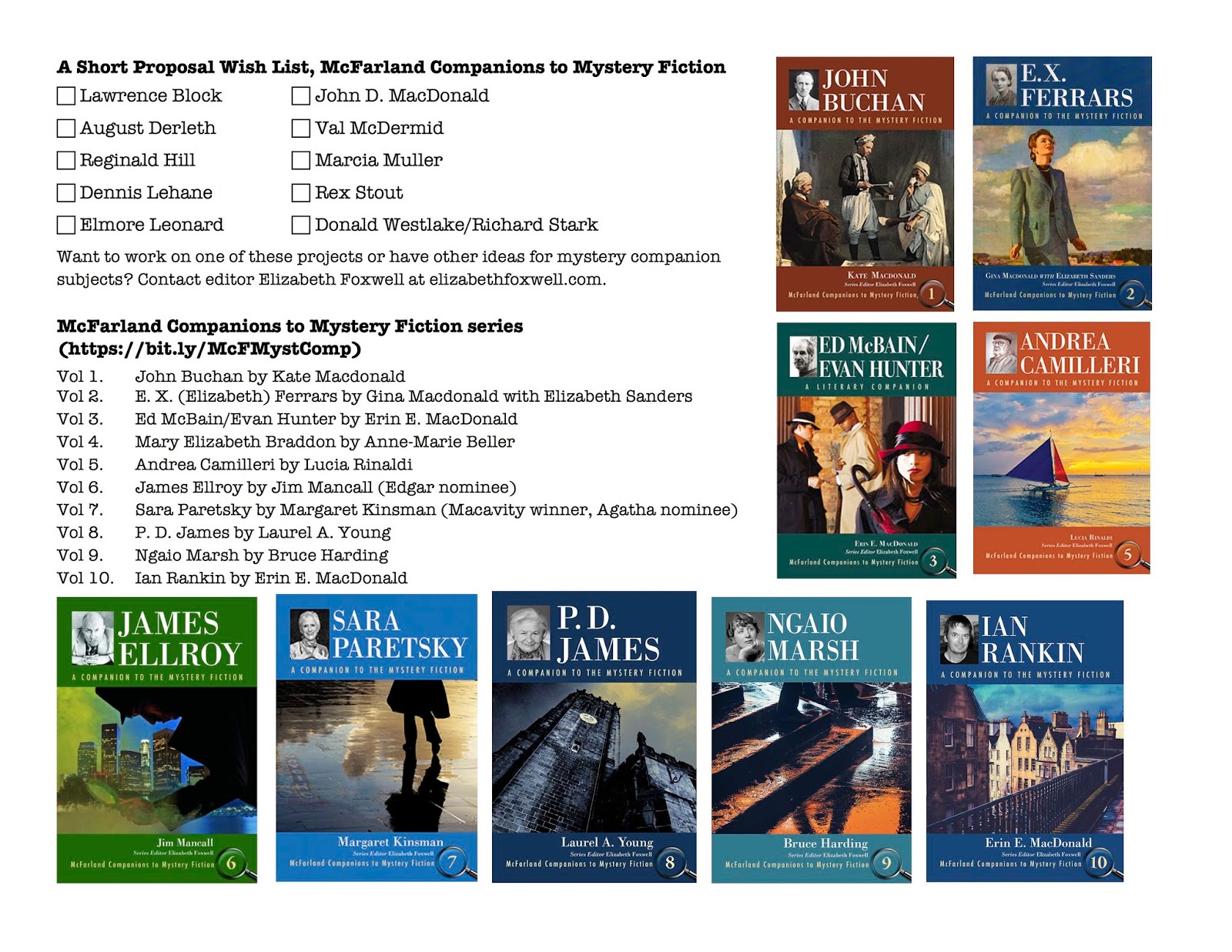
I have a wishlist for proposals for the McFarland Companions to Mystery Fiction series that I edit (see below), but I also am interested in hearing from those who would like to prepare a proposal on alternative subjects. Potential subjects must have a substantial body of work (roughly defined as a minimum of 25 books).
• Further details on the elements of a proposal.
• If interested, contact me.

• Further details on the elements of a proposal.
• If interested, contact me.
Tuesday, November 26, 2019
"Somebody Loves You" (1960).
Screenwriter Liam O'Brien created the scenario for the 1960 TV series Johnny Midnight. It starred his brother, Edmond O'Brien, as an actor turned PI investigating crimes in the New York theatrical world, often drawing on his talent for disguise and usually involving some sort of fight sequence. In the episode "Somebody Loves You," Johnny looks into the suicide attempt of a celebrated Swedish actress. J. Pat O'Malley costars.
Monday, November 25, 2019
Matthew Surridge on The Best of Manhunt.

Tuesday, November 19, 2019
Find the Blackmailer (1943).
In Find the Blackmailer, private detective Jerome Cowan goes on the trail of a talking crow, which can implicate politician Gene Lockhart in blackmail and murder.
Monday, November 18, 2019
"The Missing Number" (1922).
 |
| Elisabeth Ellicott Poe, right, 1918. Library of Congress, Prints & Photos Div. |
 |
| Vylla Poe Wilson, left, 1918. Library of Congress, Prints & Photos Div. |
The Poe Sisters are buried in DC's Glenwood Cemetery. Read Elisabeth's "Poe, the Weird Genius" (Cosmopolitan, Feb. 1909).
 |
| Excerpt from "The Missing Number," Washington Post, 31 May 1922. |
 |
| Ad for "The Missing Number" Washington Post, 19 May 1922: 2 |
Wednesday, November 13, 2019
The return of Dorothy Bowers.

The books are:
• Postscript to Poison (Inspector Dan Pardoe, 1938)
• Shadows Before (Pardoe, 1939; Kirkus review)
• A Deed without a Name (Pardoe, 1940; Kirkus review)
• Fear for Miss Betony (Pardoe, 1941; Kirkus review)
• The Bells at Old Bailey (Detective Inspector Raikes, 1947. "a literate and entertaining excursion into murder"—Jack Glick, New York Times)
Tuesday, November 12, 2019
"Rebecca" (1962).
This April 1962 version of Daphne du Maurier's Rebecca aired on Theatre '62 and featured James Mason as Maxim de Winter and Joan Hackett as the second Mrs. de Winter. Nina Foch took on the role of housekeeper Mrs. Danvers, and Lloyd Bochner was Rebecca's cousin Jack Favell.
Tuesday, November 05, 2019
The Chase (1946).
Based on The Black Path of Fear by Cornell Woolrich, The Chase features Robert Cummings as a troubled World War II veteran who becomes chauffeur to gangster Steve Cochran and entangled with Cochran's wife (Michele Morgan). Peter Lorre costars.
Monday, November 04, 2019
New exhibition on Rex Stout and his work.

Tuesday, October 29, 2019
Monday, October 28, 2019
Knopf and Cain tussle over The Postman Always Rings Twice.
 |
| James M. Cain with Lana Turner |
Tuesday, October 22, 2019
Yellow Canary (1943).
 |
| Richard Greene and Anna Neagle in Yellow Canary (1943) |
Tuesday, October 15, 2019
Crime Unlimited (1935).
In Crime Unlimited, a Scotland Yard detective (Esmond Knight) goes undercover in a gang of jewel thieves, seeking to unmask its mysterious leader. The film is based on the 1933 book of the same name by David Hume (aka former journalist John Victor Turner). Costars include Lilli Palmer as a Russian dancer associated with the gang.
Monday, October 14, 2019
Restored 1954 recording of Ngaio Marsh.
 |
| Ngaio Marsh companion (2019) published by McFarland |
Tuesday, October 08, 2019
The Seventh Survivor (1942).
In The Seventh Survivor, World War II secret agents square off after a ship is torpedoed.
Monday, October 07, 2019
Sherlock Holmes essay contest for students.
 |
| Joseph Pennell, "Baker Street," ca. 1908. Library of Congress, Prints & Photographs Div. |
Tuesday, October 01, 2019
Strangers in the Night (1944).
 |
| William Terry in Strangers in the Night (1944) |
In this film adaptation of a story by Philip MacDonald, a Marine looks into the identity of a mysterious woman who has been writing letters to him.
Monday, September 30, 2019
Exhibition on Florence Chandler Maybrick.

Tuesday, September 24, 2019
Train of Events (1949).
Train of Events tells the stories of people involved in a train crash, including a man who has killed his cheating wife and placed her body in a basket. The cast includes Peter Finch, Valerie Hobson, Michael Hordern, and Miles Malleson.
Monday, September 23, 2019
Oct 1 deadline for Clues theme issue,
"Crime's Hybrid Forms."
The deadline is October 1, 2019, to submit to the Clues theme issue on "Genre-Bending: Crime's Hybrid Forms" that will be guest edited by Maurizio Ascari (University of Bologna).


Tuesday, September 17, 2019
Dead of Night (1945).
In Dead of Night, a man fears that his recurring dream foretells dire events to come. Michael Redgrave (as a disturbed ventriloquist), Googie Withers, and Miles Malleson star.
Monday, September 16, 2019
FSU mystery exhibition curated by 12-year-old.

Tuesday, September 10, 2019
The Trans-Atlantic Mystery (1932).
 |
Donald Meek, left, and John Hamilton |
This short-film follow-up to The Wall-Street Mystery once again is written by S. S. Van Dine and features Donald Meek as criminologist Dr. Crabtree and John Hamilton as Inspector Carr. This time, they contend with stolen gems and two deaths.
Monday, September 09, 2019
The talents of Charles Altamont Doyle.
Through September 23, the Huntington Library is featuring an exhibition of work by Charles Altamont Doyle, the troubled artist father of Arthur Conan Doyle. The Doyle family had significant artistic talent: Charles's father, John, was a political cartoonist; his brother, Richard, was an illustrator; and his son, Conan Doyle, showed substantial ability in his own sketches. Given Conan Doyle's belief in fairies, the fairy subject matter of several of his father's works may be of interest.
 |
| "Hutton—The Bookseller." Illustration by Charles Altamont Doyle for James Hogg's Men Who Have Risen (1861) |
Tuesday, September 03, 2019
Dual Alibi (1947).
In Dual Alibi, Herbert Lom plays twin trapeze artists who compete for the same woman and become entangled in murder.
Monday, September 02, 2019
Clues 37.2: Interwar mysteries.

Ebook versions available: GooglePlay, Kindle, and Nook.
Introduction / VICTORIA STEWART. The guest editor of Clues 37.2 on interwar mysteries discusses its contents, including articles on Agatha Christie, Mary Fitt. Ngaio Marsh, Clifford Orr, Raymond Postgate, Dorothy L. Sayers, and Josephine Tey.
Detecting Histories, Detecting Genealogies: The Origins of Golden Age Detective Fiction / STACY GILLIS (University of Newcastle, UK). This article traces interwar attempts to define detective fiction, with an emphasis on how critics such as Dorothy L. Sayers, H. Douglas Thomson, and T. S. Eliot traced its origins in classical, biblical, and more recent texts. It argues that this demonstrates an anxiety relating to conceptions of literary taste on the part of these commentators.
“The Ghost of Dr. Freud Haunts Everything Today”:
Criminal Minds in the Golden-Age Psychological Thriller / STEFANO SERAFINI (Royal Holloway, University of London). This essay provides new insights into the development of interwar crime fiction by investigating how, and to what extent, two such apparently irreconcilable subgenres as the classic detective story and the psychological thriller interact and intertwine in the work of often-neglected Golden Age writers.
Killing Innocence: Obstructions of Justice in Late-Interwar British Crime Fiction / J. C. BERNTHAL (University of Cambridge). This article analyzes Agatha Christie’s And Then There Were None and Raymond Postgate’s Verdict of Twelve, both written toward the end of the interwar period and published at the outset of World War II. Christie and Postgate interrogate ethics in the British criminal justice system, using the figure of the child-victim to complicate interwar constructions of innocence.
Capital Punishment and Women in the British Police Procedural: Josephine Tey’s A Shilling for Candles and To Love and Be Wise / EVIE JEFFREY (University of Newcastle, UK). This article considers Josephine Tey’s engagement with contemporary capital punishment debates through considering the phenomenon of the “wrongful” arrest. It argues that women are central to the exploration of these debates, particularly when reading the novels as part of the subgenre of police procedurals within the Golden Age of detective fiction.
Subscribe to:
Posts (Atom)