The "Mapping Fiction" exhibition at Los Angeles' Huntington Library features the role of maps in fiction and is on view until May 2. It includes Loren Latker's "Shamus Town" map of the Raymond Chandler Mystery Map of Los Angeles and an orange crate label from Tarzana Hills (originally named in honor of Edgar Rice Burroughs's Tarzan).
Monday, January 24, 2022
"Mapping Fiction" exhibition, the Huntington.

Monday, January 17, 2022
Hornung's John Dollar.
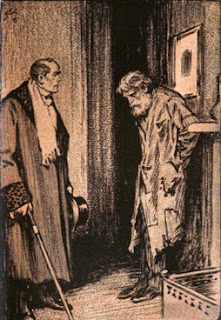 |
| Illustration by Frederic Dorr Steele from "The Physician Who Healed Himself" by E. W. Hornung. Everybody's Magazine, May 1913, p. 599. |
On the Interesting Literature blog, Oliver Tearle (Loughborough University) discusses criminal psychologist John Dollar, created by Arthur Conan Doyle's brother-in-law E. W. Hornung. The Dollar stories can be read here.
Monday, January 10, 2022
Avery Hopwood, Mary Roberts Rinehart, and "The Bat."
 |
| Avery Hopwood with dancer Rose Rolanda, n.d. Library of Congress, Prints and Photographs Div |
Monday, January 03, 2022
Taibo on le Carré.
 In Jacobin magazine, distinguished novelist Paco Ignacio Taibo II writes of his great admiration for the work of John le Carré. Says Taibo, "The grace of le Carré’s style lies not in great anecdotes but in the
journey through a human landscape peopled by agents addicted to the love
of adrenaline or danger or the dilettantes, civil servants, schemers,
and Cold War bureaucrats’ impossibly abstract fidelity and
professionalism."
Monday, December 27, 2021
Now available: Dorothy L. Sayers Companion.

Monday, December 20, 2021
Opening soon: "Sherlock Holmes in 221 Objects" exhibition.

• Letters and an "idea book" from Arthur Conan Doyle
• A handwritten speech with Conan Doyle's explanation for killing off Holmes
• Original artwork of Holmes by British and US illustrators
• A pirated edition of The Sign of the Four
An exhibition catalog is available.
Monday, December 13, 2021
In praise of R. Austin Freeman.

Monday, December 06, 2021
Agatha Christie and Egypt.

Monday, November 29, 2021
Upcoming National Museum of Scotland exhibition.
 |
| Sketch of William Burke. From George MacGregor, The History of Burke and Hare and of the Resurrectionist Times (1884) |
Tuesday, November 23, 2021
"Investigating Detectives" exhibition.

Monday, November 15, 2021
LeRoy Lad Panek, 1943–2021.
 |
| Panek's last book |
His last book is the newly published Nineteenth Century Detective Fiction: An Analytical History. His other works include the following:
• Before Sherlock Holmes: How Magazines and Newspapers Invented the Detective Story
• After Sherlock Holmes: The Evolution of British and American Detective Stories 1891–1914
• The American Police Novel: A History (Edgar nominee)
• Early American Detective Stories: An Anthology (ed. with Mary Bendel-Simso)
• The Essential Elements of the Detective Story, 1820–1891 (coauthored with Bendel-Simso)
• Introduction to the Detective Story (Edgar winner)
• The Origins of the American Detective Story
• Reading Early Hammett: A Critical Study of the Fiction Prior to The Maltese Falcon
• Watteau's Shepherds: The Detective Novel in Britain 1914–1940 (Edgar nominee)
Panek's Westminster Detective Library (a project with Bendel-Simso) is an invaluable online repository of short detective works published in the United States prior to 1891.
Monday, November 08, 2021
Wordsworth blog: Collins, Le Fanu.
 |
| "These two figures crossed the floor diagonally." Illustration from Sheridan Le Fanu's "Mr. Justice Harbottle," Harper's Bazaar, February 1872. NYPL |
Catching up with the blog on the Wordsworth Editions website:
- David Stuart Davies discusses the career of Wilkie Collins: "Remarkably, The Moonstone received a somewhat cool reception from
the critics. Even Collins’s friend Dickens was of the opinion that,
‘The construction is wearisome beyond endurance, and there is a vein of
obstinate conceit in it that makes enemies of the readers.'"
- Stephen Carter examines the work of legendary Irish ghost story writer Sheridan Le Fanu: "Le Fanu’s reputation was crowded out of Victorian literature by his contemporaries, Dickens, Thackeray, Wilkie Collins, and the Brontës; all of whom he in some form influenced and whose sales he frequently rivalled."
I'm looking forward to Davies's upcoming post on Edgar Wallace.
Monday, November 01, 2021
Exhibition on race and dime novels.

West Virginia University's Downtown Library is offering the new online exhibition "American Dime Novel: Racialization/Erasure" that focuses on ethnic and racial stereotypes in dime novels. Mystery-related items include the following:
- Tiger Dick, the Faro King; or, The Cashier's Crime (1878) by Philip S. Warne (the mixed-race Warne may be the earliest African American mystery writer)
- Darkie Dan, the Colored Detective (1881) by Prentiss Ingraham
- Chin Chin the Chinese Detective; or, the Dark Work of the Black Hand (1887) by Albert W. Aiken
- Nick Carter's Well Laid Plot (1909)
- The Black Hand Nemesis (1909)
Also included: Maum Guinea and Her Plantation Children (1861) by Metta Fuller Victor, which had a similar effect in Britain about the evils of slavery that Harriet Beecher Stowe's Uncle Tom's Cabin had in the United States. Victor wrote the first U.S. detective novel: The Dead Letter (1864).
Nancy Caronia, the curator of the exhibition and a teaching associate professor in WVU's Department of English, will be giving a free, virtual presentation about the exhibition on November 4.
Monday, October 25, 2021
"Women & crime fiction" resource, UF Tampa Libraries
 |
| Margaret Lewis's biography of Edith Pargeter/Ellis Peters |
Monday, October 18, 2021
Oct 21 webinar on Christie.
 | ||
| Agatha Christie, 1964. Dutch Nat Archives |
Monday, October 11, 2021
Clues 39.2: Christie, Austen-Leigh, Robinson, Upfield, and more.

Volume 39, no. 2 (2021) of Clues: A Journal of Detection has been published. The issue abstracts follow below; contact McFarland to order a print copy.
Update, 12-12-21. Ebook versions of the issue are now available: Kindle, Nook, Google Play
Introduction: So Many Books, So Little Time
CAROLINE REITZ (John Jay College of Criminal Justice-CUNY/CUNY Graduate Center)
Caroline Reitz, the new executive editor of Clues, provides an overview of the issue, including articles on authors such as Lois Austen-Leigh, Raymond Chandler, Agatha Christie, Didier Daeninckx, Fergus Hume, Philip Kerr, Peter Robinson, and Arthur Upfield.
Australian Rules: Forensic Culture in the Fiction of Arthur W. Upfield
BETTY J. BRUTHER
Four novels in Arthur W. Upfield’s Napoleon Bonaparte series—Winds of Evil (1937), Death of a Swagman (1946), The Widows of Broome (1950), and The Bachelors of Broken Hill (1950)—deal with multiple murders committed by a single individual in the outback. Each novel reveals the forensic culture of Australia: common investigative techniques, criminal profiling, forensic psychology, and the examination and interpretation of temporary trace evidence on the landscape.
Murder Most Incidental: Arthur Upfield’s Death of a Lake (1954)
RACHEL FRANKS AND ALISTAIR ROLLS
(University of Newcastle)
Arthur Upfield is well-known for positioning an Aboriginal detective, Inspector Napoleon “Bony” Bonaparte, as the protagonist for his series. In Death of a Lake (1954), Upfield challenges the conventions of mid-twentieth-century Australian crime stories not only through privileging an Indigenous man but also through disregarding the central concept of the modern crime novel: murder.
The Mysteries of the Colonial Metropolis: Fergus Hume’s The Mystery of a Hansom Cab and
Donald Cameron’s Mysteries of Melbourne Life
ORLA DONNELLY ((Trinity College Dublin)
Fergus Hume’s The Mystery of a Hansom Cab (1886) and Donald Cameron’s Mysteries of Melbourne Life (1873) follow the tradition of urban crime writing. This essay examines three essential elements in these Melbourne crime novels: the treatment of crime and detection, the themes of physical and social mobility, and the exoticized images of urban street folk.
Death in a Literary Context: Detective Novels of the Golden Age as Enacted Criticism
ANDREW GREEN (Brunel University)
This article explores the nature of Golden Age crime narrative. It argues that the works of these authors are “enacted criticism”—creative acts that are fundamentally critical responses to genre—that can be read as mutually constitutive meaning-making “spaces”—texts within which form is constantly renegotiated within a literary context.
Clue-Burying and Misdirection-Making in Peter Robinson’s When the Music’s Over (2016)
CHRISTIANA GREGORIOU (University of Leeds)
Close stylistic inspection of detective novel writing can shed light on the skill of weighing up interpretations. In When the Music’s Over, Robinson relies on readers’ schematic expectations, stereotypes, and prejudices to generate false leads and bury a killer into the narrative background until his significance needs to be foregrounded.
Writing History into Fiction in Didier Daeninckx’s Meurtres pour mémoire
JOHN GLEESON
This article demonstrates Didier Daeninckx’s unique blending of historical fact and fiction, particularly the use of state archives in his breakthrough novel Meurtres pour mémoire (1984). It also examines intertextual references to nineteenth-century writers and the French New Wave cinema that expand the traditional boundaries of the genre.
History Detective: Reading the Weimar Republic in Philip Kerr’s Last Novel Metropolis (2019)
NEIL H. DONAHUE (Hofstra University)
Philip Kerr’s last novel Metropolis (2019) returns his detective, Bernie Gunther, to 1928 as both prequel and epilogue to his series of 14 novels. This essay locates the key to Gunther’s identity and actions in his relation to arch-Nazi Arthur Nebe.
Monday, October 04, 2021
A new chapter.

I'm always interested in receiving proposals for the Mystery Companion series; prospective subjects should have a substantial body of work (loosely defined as a minimum of 25 books or a substantial combination of books, short stories, and other mystery-related works). For further details on submitting a proposal, contact me.
Monday, September 20, 2021
Radio show, Christie's The Secret of Chimneys.

Tuesday, September 14, 2021
The return of F. Tennyson Jesse.
 |
| F. Tennyson Jesse |
Monday, September 06, 2021
The illustrated Raymond Chandler.
On Creative Boom, Emily Gosling discusses an illustrated Chinese edition of Raymond Chandler's The Long Goodbye (some illustrations from the book included in the post). The artist is Klaus Kremmerz.
Subscribe to:
Posts (Atom)