Tuesday, March 14, 2017

The Argyle Secrets (1948).

Marjorie Lord, left, with her
daughter, Anne Archer, ca. 1958
In The Argyle Secrets, a political columnist tells reporter William Gargan about a compromising list of businessmen who made deals with Nazi Germany. Gargan is then accused of the columnist's murder, while he and an unscrupulous gang search for the list. Ralph Byrd, Marjorie Lord, John Banner, and Barbara Billingsley costar.

Monday, March 13, 2017

Northern Public Radio on NIU's dime novel collection.

Northern Public Radio highlights the digitization of the Johannsen Collection of dime novels and story papers at the Northern Illinois University libraries. The NIU libraries, in partnership with Villanova University, will digitize 5400 dime novels through a grant of nearly $450,000 from the Digitizing Hidden Collections initiative of the Council on Library and Information Resources. More than 2000 works compose the library's current online offerings, including dime novels by early mystery writer-editor Metta Victoria Fuller Victor and the extensive Nick Carter series.

Wednesday, March 08, 2017

Orczy's Lady Molly on BBC Radio 4 Extra.

Baroness Orczy, from the
Aug. 1913 The Bookman
Now airing on BBC Radio 4 Extra are stories featuring Lady Molly of the "Female Department" of Scotland Yard, penned by Baroness Orczy in 1910. The 10 episodes narrated by Sophie Thompson include "The Ninescore Mystery" (featuring a village murder), "The Irish-Tweed Coat" (featuring a man accused of murder), and "A Day's Folly" (featuring a case of blackmail).

Tuesday, March 07, 2017

"The Blue Landscape" (1955).

Illustration of Peter Lorre,
ca. 1935
In this episode of The Star and the Story, inspector Peter Lorre of the Sûreté takes on a case involving murder and the theft of a painting. Hillary Brooke costars as an insurance investigator. The script is a product of screenwriters DeWitt Bodeen (Cat People), Frank Burt (Dragnet), and Lou Rusoff (Terry and the Pirates).

Monday, March 06, 2017

BFI's lists on "perfect crime" and noir films.

From an ad for The Killing (1956)
One of the latest lists on the British Film Institute blog is on "10 Great Films on Committing the Perfect Crime." These include The Asphalt Jungle (1950), Les Diaboliques (1954), Lift to the Scaffold (1958), The Killing (1956), and Thief (1981).

Another is a list of "10 Great American Film Noirs." Among expected entries (The Big Sleep, Double Indemnity, Laura) are The Lady from Shanghai (1947) and The Reckless Moment (based on Elisabeth Sanxay Holding's The Blank Wall, 1949).

Tuesday, February 28, 2017

A Place of One's Own (1945).

Margaret Lockwood,
ca. 1946
An Edwardian retired couple (James Mason, Barbara Mullen) move into their new residence, only to find that it is haunted and has a strange effect on the wife's companion (Margaret Lockwood). The film is based on the short story of the same name by Osbert Sitwell.

Monday, February 27, 2017

A new take on "The Musgrave Ritual."

Illustration from "The Musgrave
Ritual." Salt Lake Herald,
5 Nov. 1905
The Law & Humanities blog highlights Ross E. Davies's map in The Green Bag that accompanies "The Musgrave Ritual" (1893), which attempts to identify when and where Holmes told Watson about the case and provides the historical backdrop to the ritual.

Monday, February 20, 2017

The mysteries of Isaac Asimov.

My essay "'I Write Christie': The Mysteries of Isaac Asimov" has been published in Salem Press's Critical Insights: Isaac Asimov edited by M. Keith Booker (U-Arkansas). It assesses Asimov's mystery fiction, as there is little critical work on this area of Asimov's oeuvre (aside from his science fiction mysteries with detective Elijah Baley and robot R. Daneel Olivaw). The essay looks at Asimov's vastly underrated debut mystery novel, The Death Dealers (aka A Whiff of Death, rooted in his graduate school experiences at Columbia); Murder at the ABA (with a protagonist based on sci-fi author Harlan Ellison); Black Widowers mystery short stories (with characters modeled on other sci-fi writers); Union Club short stories (with an Asimov alter ego); the Baley-Daneel series; children's mysteries; and assorted other stories. Asimov was a Golden Age mystery fan, and his puzzle mysteries reflect this tradition.

Check out the table of contents.

Monday, February 13, 2017

Upcoming exhibition:
Clever Criminals and Daring Detectives.

Illustration from Arthur Conan
Doyle's "The Adventure of the
Empty House," San Francisco
Call
, 5 Mar. 1905
Opening in April at the Rosenbach Museum and Library in Philadelphia will be the exhibition "Clever Criminals and Daring Detectives" that will take a historical look at criminals and detectives in fiction. Materials on display will include the original manuscript of Arthur Conan Doyle's "The Adventure of the Empty House" and reflections on mystery collecting of Ellery Queen.

Wednesday, February 08, 2017

Podcast on 1970s female detectives on TV.

Kate Mulgrew in Mrs. Columbo (1979)
The Law & Humanities blog calls attention to this podcast on 1970s female TV detectives from Advanced TV Herstory. The episode covers the Nancy Drew TV series with Pamela Sue Martin, Mrs. Columbo with Kate Mulgrew, and Charlie's Angels.

Tuesday, February 07, 2017

The Phantom Light (1935).

Gordon Harker. NYPL
In The Phantom Light, the murder of a lighthouse keeper is complicated by the appearance of a mysterious light and a band of wreckers. Starring Gordon Harker (great-uncle of actress Susannah Harker) and Ian Hunter, the film is directed by Michael Powell (before he and Emeric Pressburger formed the Archers), from a play cowritten by Australian-born Evadne Price (who wrote Not So Quiet... Stepdaughters of War under the pseudonym Helen Zenna Smith). Mystery author Joseph Jefferson Farjeon (aka Anthony Swift) provided some dialogue.

Monday, February 06, 2017

The banning of Conan Doyle and Hammett.

Dashiell Hammett.
Yank 30 Nov. 1945
The Department of Special Collections of the Kenneth Spencer Research Library at the University of Kansas has posted online the catalog (with images) of its 1955 exhibition on banned books, which received ALA's Letter Library Award in 1956.

The exhibition includes, under Russia, works by Arthur Conan Doyle, "because they dealt with occultism and spiritualism."

The U.S. section reveals that Dashiell Hammett's The Maltese Falcon (1930) was removed from State Department libraries abroad in June 1953—part of efforts to drop or destroy works characterized by the department as written by communists. (In 1951, Hammett went to prison in Kentucky for contempt of court; he had refused to reveal the names of those who posted bail for four communists.) The NEA Big Read Web page on The Maltese Falcon states that Sen. Joseph McCarthy (R–WI) was responsible for this move, but Hammett's books were restored by a fan: President Dwight D. Eisenhower.

Another interesting entry: a biography of Lawrence of Arabia by Richard Aldington, suppressed by friends of T. E. Lawrence because Aldington made controversial assertions such that Lawrence was untruthful about his experiences and did not acknowledge help of literary figures on The Seven Pillars of Wisdom. However, the book was published in French in 1954 and English in 1955, and critics have since questioned its level of objectivity.

Tuesday, January 31, 2017

Remembering Barbara Hale:
The Clay Pigeon (1949).

Bill Williams and 
Barbara Hale with their son,
William Katt, in 1957
Besides her long run as Della Street in Perry Mason, Barbara Hale—who died at age 94 on January 26—also appeared with her husband, Bill Williams, in The Clay Pigeon (1949). Former sailor Williams is accused of treason and murder, but because he has blackouts, he does not know if these charges are true. Hale plays the widow of a war friend who helps him. The screenwriter is Carl Foreman (High Noon, The Guns of Navarone, etc.).

Monday, January 30, 2017

Exhibition, Poe in Baltimore and elsewhere.

Edgar Allan Poe,
from the New York
Tribune
, 3 Jan. 1909
The exhibition "The Enigmatic Edgar A. Poe in Baltimore & Beyond" closes at Johns Hopkins University's George Peabody Library on February 5, but you can check out this online version that discusses his cities of residence and the genres in which he wrote, including "Mysteries & Puzzles" that has images of some of his works.

Tuesday, January 24, 2017

Emil and the Detectives (1931, 1935).

Overlook Press ed. of
Emil and the Detectives
Erich Kaestner's classic 1929 children's novel about a boy pursuing the man who robbed him and enlisting the aid of a band of child detectives had two early film adaptations: a 1931 version scripted by Billy Wilder and a 1935 version.


Monday, January 23, 2017

New Web site for Conan Doyle estate.

Arthur Conan Doyle.
Wellcome Library, London
The Arthur Conan Doyle estate has debuted a new Web site with various texts, correspondence, photos, memorabilia, and films about the creator of Sherlock Holmes and his many roles, including author, physician, advocate, and spiritualist. An interesting account is his less than enthusiastic attitude toward the knighthood offered to him in 1902.

Tuesday, January 17, 2017

She Played with Fire (aka Fortune Is a Woman, 1957).

Illustration of
Jack Hawkins, ca. 1958
Reuniting with a former girlfriend (Arlene Dahl) means arson, blackmail, and murder for insurance investigator Jack Hawkins in She Played with Fire, another product of the team of Frank Launder and Sidney Gilliat, who adapted the novel by Winston Graham (Marnie, Poldark). Gilliat also directs. Costars include Ian Hunter, Bernard Miles, and Christopher Lee.

Monday, January 16, 2017

Hammett, Chandler, and the Writers Guild.

Ad for Mister Dynamite (1935)
In the Writers Guild Foundation's online On the Shoulders of Giants: Early Writers Guild History are the following goodies:
  • Cover of the guild's July 1947 The Screen Writer, which lists Raymond Chandler's "Critical Notes" that critique the contents of the May 1947 issue. One of his observations (in response to an article by Joseph L. Mankiewitz) is "I do not think a writer has to become a producer or director to be an independent artist . . . there is a cleavage between the creative art of writing and the arts of directing and producing..." (31). The July 1947 issue also has "Writing and Realization" by Meyer Levin (author of the Leopold and Loeb-inspired Compulsion) about a film in Palestine that involved him.
The foundation also has posted "The Top 20 Best Written TV Series." No. 15 is Hill Street Blues, no. 9 is The Wire, no. 3 is The Twilight Zone, and no. 1 is The Sopranos.

Tuesday, January 10, 2017

I See a Dark Stranger (aka The Adventuress, 1946).

Irishwoman Deborah Kerr and British soldier Trevor Howard become embroiled in World War II espionage involving a little black book and D-Day in this screenwriting effort by Frank Launder and Sidney Gilliat (The Lady Vanishes, Night Train to Munich, The Green Man, etc.); Launder also directs.

Monday, January 09, 2017

Sherlock Holmes in newspapers.

Illustration from "The Adventure of
the Three Students," Denison [IA]
Review
, 13 Sept. 1905
The British Newspaper Archive blog looks at Sherlock Holmes in newspapers, including a peek into the re-creation of 221B Baker Street in London's Sherlock Holmes pub. In one clipping, Arthur Conan Doyle discusses the fallout of "The Final Problem": "I was amazed at the concern expressed by the public. . . . 'You brute,' was the beginning of a letter of remonstrance which one lady sent me."

Monday, January 02, 2017

BBC Radio 4: The life of Wilkie Collins.

Vanity Fair cartoon of Wilkie
Collins by Adriano Cecioni,
Feb. 1872
This week on BBC Radio 4 is Peter Ackroyd's examination of the life of Wilkie Collins, including his relationship with his artist father, his friendship with Charles Dickens, his unusual personal life, and his landmark mystery works The Woman in White and The Moonstone.

Tuesday, December 27, 2016

Two Thousand Women (1944).

Frank Launder in 1947.
In Two Thousand Women, Flora Robson and Phyllis Calvert are two of the British women interned in World War II France who try to aid downed RAF airmen. The screenwriter-director is Frank Launder (The Lady Vanishes, Night Train to Munich).

Monday, December 26, 2016

Listen to Chester Himes in 1969.

Chester Himes in 1967.
Fotocollectie Anefo,
Dutch National Archives
University of Rochester's online exhibition on writer John A. Williams features a May 1969 audio clip in which fellow author Chester Himes talks about Paris, Richard Wright, and the CIA.

Tuesday, December 20, 2016

See Conan Doyle in 1918 and 1922.

At about minute 2:00 in this February 1918 newsreel held at the Imperial War Museum, Arthur Conan Doyle arrives for the opening of the Chevrons Club (a club for noncommissioned officers of the army and navy).

And here he is with his family in 1922.

Monday, December 19, 2016

The art of Dell design.

For those who love Dell paperbacks, two selections from the Thomas Fisher Rare Book Library at the University of Toronto:


Philip Ketchum,
from U-Denver's
1925 Kynewisbok


Tuesday, December 13, 2016

The Glass Alibi (1946).

In The Glass Alibi, a reporter (Douglas Fowley) hooks up with a gangster's girlfriend (Anne Gwynne, grandmother of Star Trek actor Chris Pine) and marries a terminally ill woman (Maris Wrixon) for her money, but complications ensue when she does not die as expected and the gangster (Cy Kendall) escapes from prison. The screenwriter is Mindret Lord (Strange Impersonation).

Monday, December 12, 2016

Dick Tracy's Chester Gould at Northwestern.

Chester Gould, left, with
producer Henry Saperstein of the
Dick Tracy TV series in 1961
The "Notable Northwestern Alumni" exhibition spotlights Chester Gould, the creator of Dick Tracy and member of Northwestern's class of 1923.

Friday, December 09, 2016

Happy centenary, Kirk Douglas.

Kirk Douglas and Jan Sterling in
Billy Wilder's Ace in the Hole (1951)
Actor-producer Kirk Douglas turns 100 today, and starting today, the Jewish Film Institute will celebrate by showing Paths of Glory, Lust for Life, Spartacus, 20,000 Leagues Under the Sea, Ace in the Hole, The Bad and the Beautiful, Lonely Are the Brave, and The Vikings.

Tuesday, December 06, 2016

Strange Impersonation
(dir. Anthony Mann, 1946).

Mindret Lord (born Loeb)
in 1923
A scientist (Brenda Marshall) resorts to extreme measures after her car hits a pedestrian and she is blackmailed, while her assistant (Hillary Brooke) plots to steal her boyfriend (William Gargan). One of the film's screenwriters is Mindret Lord, who also wrote as Garland Lord with his then-wife, Isabel Garland (daughter of author Hamlin Garland); their novels include Murder's Little Helper (1941), She Never Grew Old (1942), and Murder with Love (1943). Lord committed suicide in 1955.

Tuesday, November 29, 2016

For GivingTuesday:
Consider mystery collections.

Phoebe Atwood
Taylor. From
Barnard College's
Mortarboard, 1930
Today's Giving Tuesday focuses attention on charitable contributions, as people consider the organizations or causes to support or to make a contribution in someone's name during the holiday season.

Libraries and archives need support to acquire, preserve, catalog, and digitize their collections as well as to present exhibitions or other programs involving their holdings. Consider contributing to your alma mater's library or one of the following collections with significant mystery elements:

• Ray and Pat Browne Popular Culture Library, Bowling Green State University

• Center for Southwest Research, University of New Mexico (home of the papers of Tony Hillerman)

• Howard Gotlieb Archival Research Center, Boston University (home of manuscripts of many authors such as Harry Kemelman, Jane Langton, Elizabeth Linington, Phoebe Atwood Taylor, Hillary Waugh, and Donald Westlake)

• Lilly Library, Indiana University Bloomington (home of the papers of author-critic Anthony Boucher and Mystery Writers of America)

• Harry Ransom Center, University of Texas at Austin (home of Erle Stanley Gardner's "plot wheel")

• Rose Library, Emory University (home of one of the largest collections of Victorian yellowbacks)

• Special Collections, University of California Irvine (home of the papers of Kenneth Millar, aka Ross Macdonald, and Margaret Millar)

• Special Collections, University of South Carolina (home of the papers of James Ellroy, George V. Higgins, and John Jakes. An ongoing and major project of the USC libraries is the preservation and digitization of 2000 Fox Movietone newsreels.)

• Wisconsin Center for Film and Television Research (home of the papers of Vera Caspary, Kirk Douglas, and Dalton Trumbo. The center has recently established a portal at the Internet Archive that includes a home movie of theater legends Alfred Lunt and Lynn Fontanne.)

The Library of Congress offers several options for supporting its work (don't forget that it houses the papers of luminaries such as James M. Cain), including the National Book Festival.

Monday, November 28, 2016

Leopold and Loeb exhibition.

Northwestern University's online exhibition "The Murder That Wouldn't Die: Leopold & Loeb in Artifact, Fact, and Fiction" examines the 1924 murder of young Bobby Franks through items such as ransom notes, confessions and psychological evaluations of Leopold and Loeb, court transcripts, trial photos, and fictional versions of the case such as Meyer Levin's Compulsion and Alfred Hitchcock's Rope.


Nathan Leopold (top) and
Richard Loeb in 1924.

Tuesday, November 22, 2016

Rex Stout/Bertrand Russell on civil liberties.

Top: Bertrand Russell, ca. 1936. NYPL.
Bottom: Mitch Miller, Edward Whitehead, and
Rex Stout compare beards in Feb. 1957.
Ogdensburg [NY] Journal
Mystery author Rex Stout hosted the NBC radio program Speaking of Liberty during World War II. In a July 1941 episode on civil liberties (program no. 14) with philosopher-mathematician Bertrand Russell, Russell states, "Intolerance is dangerously inconsistent with the goal of liberty." Stout replies, "Nothing is more fundamentally antidemocratic or actually more uncivilized."

Monday, November 21, 2016

The crossroads of German detective fiction.

The Virginia Gazette talked to Bruce Campbell, associate professor of German studies at the College of William & Mary, about his collection (edited with Alison Guenther-Pal and Vibeke Ruetzou Petersen) Detectives, Dystopia and Poplit: Studies in Modern German Genre Fiction. Covered in the book are intersections among crime fiction, science fiction, politics, the Nazis, and the Holocaust.

Related: Campbell discusses German detective fiction on the radio program With Good Reason.

In addition, watch Campbell's Oct. 2016 W&M Tack Faculty Lecture on "The Detective Is (Not) a Nazi: German Pulp Fiction." In his lecture, Campbell discusses detective fiction, culture, and memory in Germany, and recommends some authors in English translation (such as Friedrich Duerenmatt, Friedrich Glauser, and Doris Gercke). He also points out that a German detective novel (Adolf Muellner's Der Kaliber) was published in 1828, well before Edgar Allan Poe's 1841 "The Murders in the Rue Morgue," and that the longest-running TV series in the world is the German Scene of the Crime (aka Tatort).

Tuesday, November 15, 2016

Simenon's "The Old Lady of Bayeux" (1952).

Georges Simenon, May 1965.
Fotocollectie Anefo,
Dutch National Archives
In this Sept. 1952 episode of Suspense directed and produced by Robert Stevens with lots of dramatic organ music, a wealthy widow dies, and a visiting Inspector Maigret (Luis Van Rooten) doubts that a heart attack was the cause of death. The episode is based on Georges Simenon's Aug. 1952 EQMM story of the same name (trans. of "La Vieille Dame de Bayeux," 1939).

Monday, November 14, 2016

A British mystery author's work with Holocaust survivors.

Charity Blackstock.
Photo by Mark Gerson
The Neglected Books blog highlights The Children (1966) by mystery writer Charity Blackstock (pseudonym of Ursula Torday, 1912–97; 1959 Edgar nominee for The Woman in the Woods). The Children are those traumatized by the Holocaust who came for a holiday in England, sponsored by a group headed by Torday (a Gentile). The New York Times called it a "moving and remarkable memoir."

Tuesday, November 08, 2016

Tourneur's "Into the Night" (1955).

Eddie Albert and Ruth Roman
in "Into the Night"
In this episode of GE Theater directed by Jacques Tourneur (Out of the Past, etc.) from a story by Charles Hoffman (The Blue Gardenia, Peter Gunn, Hawaiian Eye), a husband and wife (Eddie Albert and Ruth Roman) engage in a battle of wits with two carjackers (Dane Clark and Robert Armstrong) fleeing robbery and murder charges; Jerry Mathers appears briefly as their son. Chris Fujiwara's book on Tourneur notes the episode's parallels with Ida Lupino's The Hitch-Hiker (1953).

Monday, November 07, 2016

A silent film actor's mystery novel.

Silent film actor and author
James W. Morrison
in 1916
. . . suddenly the quiet was broken by the sharp report of a pistol, followed by the piercing sound of a police whistle.
—Woods Morrison, Road End 185
As the Daily Illini wrote on 18 June 1927, Charlie Chan creator Earl Derr Biggers stated, as the bookshelves were overflowing with mystery stories, "how pleasant it would be if all but three or four mystery novelists could be taken out and painlessly drowned. Only I can never decide as to the survivors . . . ."

However, the debut mystery of Woods Morrison, Road End (1927), had caused a rethink by Biggers. ". . . Whether I want to or not, I've got to welcome Woods Morrison. . . . [O]nce he gets going, he deals out thrills with the speed and nonchalance of a river gambler dealing cards" (4).

The first novel of Morrison (1888–1974)—a University of Chicago graduate who acted under the name James W. Morrison (including roles in the silent films Black Beauty, The Little Minister, and Captain Blood) and later taught drama at the Packer Collegiate Institute in New York—focuses on murder, the theft of a pearl necklace, strange wailing, and other mysterious occurrences at an elegant Long Island house, with a down-on-his-luck young man taking on the roles of chauffeur and sleuth. (The ending, however, is rather weak.) The book was serialized in the Philadelphia Inquirer in Feb.–May 1934 (note that some of the pages are faint, and the following are all the parts I could find):

• Chapters 1–2 
• Chapter 3
• Chapters 5–6
• Chapters 6–7
• Chapters 7–8
• Chapters 10–11 
• Chapters 12–13
• Chapters 14–15
• Chapters 16–17

Silent film scholar Anthony Slide paints a sad picture of Morrison later in life crippled by arthritis, living in a small Greenwich Village apartment, and considering his silent film career to be insubstantial (despite Slide's views to the contrary).

The following are other works by Morrison:

• April Luck (1932). "The moving story of a sensitive girl whom fate made into a glamorous adventuress"

• "Under Pressure" (Liberty magazine, 17 Dec. 1932)

•  "Alias Miss Williams" (Brooklyn Daily Eagle, 8 Oct. 1933)

Wednesday, November 02, 2016

Richard Atwater on detective novels, 1930.
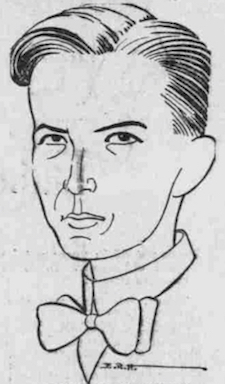
Illustration of Richard Atwater, frm
21 Oct 1922 Bisbee Daily Review
Richard Atwater (1892–1948) was coauthor of the Newbery Award-nominated Mr. Popper's Penguins, a classics professor at the University of Chicago, and a frequent contributor to Chicago newspapers. In a 7 Jun 1930 article in The Chicagoan, Atwater asserted that "there are only six detective novels in existence: the rest being a rewriting of the same plots" (15). The following were his picks for the two best detective novels partly because "neither . . . has a butler in it":
• G. K. Chesterton, The Man Who Was Thursday (1908). Chesterton's classic tale of unlikely agent Gabriel Syme infiltrating an anarchist group
• James Branch Cabell, The Cream of the Jest (1917). It is unusual to characterize this book as a detective work, as it is a satire—a fictional work with fantasy elements within a fictional work.
Tongue planted firmly in cheek, Atwater then floated his idea for a detective novel, in which a valet named Rudy offends because of his crooning (one suspects that Atwater was no fan of Rudy Vallee), and decorators "mistaking Rudy for the new wall paper, . . .  paste him to the wall of the master's study. As the master never studies, nobody discovers the error, and the crime is never known" (15).

Tuesday, November 01, 2016

The Moonstone (1934).

David Manners, who plays
Franklin Blake in
The Moonstone (1934)
There's a new BBC One version of Wilkie Collins's The Moonstone, which is the seventh adaptation for the screen of the tale about a stolen gem and its effect on a family. The third screen adaptation was in 1934, with Sergeant Cuff promoted to a Scotland Yard inspector.

Tuesday, October 25, 2016

"The Town that Slept w/the Lights On" (1958).

Edmond O'Brien,
ca. 1954
Edmond O'Brien directs this episode of Schlitz Playhouse as well as plays a hard-hitting New York reporter investigating two murders in a small town and doubting the Hispanic suspect fingered by vigilantes. The episode (which has a hardboiled-style voiceover and discussion of domestic violence) is written by Liam O'Brien, Edmond's screenwriter-producer brother (Police Story, Hawaii Five-0, Miami Vice).

Monday, October 24, 2016

A mystery parody by Harry Stephen Keeler?

Harry Stephen Keeler, from
his 1916 passport application
In the latest issue of Keeler News, the newsletter of the Harry Stephen Keeler Society, Morgan Wallace posits plausibly that mystery/sci-fi writer Keeler wrote a 1920 PI parody, "The Keenwit Case," for the Chicago Ledger under the pseudonym Lon Riggs to make a point about the types of material that could come over the transom at a periodical. "The Keenwit Case" is reproduced in the newsletter and features such immortal statements as "[t]hen he lighted a cigar, and smoked viciously. This indicated that his brain was very active, and that without a doubt the clever criminal would be in irons before the close of another day."

Of related interest:
• Link to cartoonist Al Hirschfeld's caricatures of Keeler
• "The Life and Death of Harry Stephen Keeler" by Vincent Starrett

Wednesday, October 19, 2016

Frances Chesterton, wife of G. K.

Stephanie A. Mann provides some insights on poet-playwright Frances Chesterton, wife of G. K. and niece of art historian Mary Margaret Heaton, and mentions the 2015 biography by Nancy Carpentier Brown, The Woman Who Was Chesterton. Brown blogs on Frances Chesterton here. Both writers paint a touching picture of a devoted couple. According to the 13 Dec. 1938 New York Times, G. K. regarded Frances as "in all ways a kindred spirit," and longtime G. K. friend E. C. Bentley (Trent's Last Case) called her G. K.'s "right-hand in all his dealings with the world" (qtd in Brown).

Of related interest: Frances Chesterton being mistaken for The Lodger author Marie Belloc Lowndes and her response: "I am quite willing to feel honored by [the] mistake, but they [Hilaire Belloc and Marie Belloc Lowndes] might feel aggrieved." Belloc (brother of Marie Belloc Lowndes) and G. K. Chesterton were close friends.

Monday, October 17, 2016

Paretsky companion published.

Just published is Sara Paretsky: A Companion to the Mystery Fiction (vol. 7 of the McFarland Companions to Mystery Fiction series) by MWA Raven recipient Margaret Kinsman. I edit the series. Goodies abound in this in-depth analysis of Paretsky's groundbreaking detective V. I. Warshawski and other subjects in the author's fiction and nonfiction works, including Margaret's discussion of Paretsky's first published piece (which she wrote at age 11).

Tuesday, October 11, 2016

Theodore Sturgeon's "No Answer" (1958).

A con man (Donald Cook) who targets wealthy widows seems to have an unshakeable alibi when one of his victims is murdered. Keenan Wynn stars as the police officer frustrated by his previous unsuccessful attempts to nab the man. This Dec. 1958 episode of Schlitz Playhouse is based on the story "Dead Dames Don't Dial" (1956; repr. in And Now the News...) by Theodore Sturgeon (1918–85, best known for science fiction) and is directed by Arthur Hiller (Alfred Hitchcock Presents, Naked City, Perry Mason, The Americanization of Emily, etc.).

Monday, October 10, 2016

At Yale: An illustration of Edgar Allan Poe.

The Room 26 Cabinet of Curiosities blog of Yale's Beinecke Library highlights its new acquisition: postcards that reproduce paintings by artist Peter Oresick. One of them is a portrait of Edgar Allan Poe.

Tuesday, October 04, 2016

Lady in the Death House (1944).

In Lady in the Death House, a woman (Jean Parker) is on death row for the murder of a blackmailer, although she claims she was framed for the crime. A criminologist (Lionel Atwill) looks into the case, seeking to save her from the electric chair. The film is based on "Meet the Executioner" by Frederick C. Davis.

Tuesday, September 27, 2016

Mrs. O'Malley and Mr. Malone (1950).

Based on "Once upon a Train, or the Loco Motive" (1950) by Stuart Palmer and Craig Rice, the comic Mrs. O'Malley and Mr. Malone features Marjorie Main as a radio contest winner and James Whitmore as a lawyer who stumble over constant corpses on their train to New York. Note the sleuths are handcuffed together a la Robert Donat and Madeleine Carroll in The 39 Steps.

Monday, September 26, 2016

Mapping Sherlock Holmes.

Violet Smith pursued in "The
Solitary Cyclist." Detail from
the Sherlock Holmes
Mystery Map (1987).
One of the treasures accessible online via Recollection Wisconsin is the "Sherlock Holmes Mystery Map" (1987) created by Jim Wolnick and Susan Lewis and published by Aaron Blake Publishers. Complete with a "Dancing Men" border, it provides a visual guide to 130 locales in the Holmes canon.

Tuesday, September 20, 2016

A 2001 flashback with Ed McBain.

WYSO's The Book Nook recently rebroadcast Vick Mickunas's 2001 interview with Ed McBain (aka Evan Hunter, 1926–2005) that coincided with the release of McBain's 87th Precinct novel Money, Money, Money. Mickunas describes it as one of his favorite interviews. In addition to Money, Money, Money, McBain discusses The Blackboard Jungle (the first Hunter novel), Cop Hater (the first McBain novel), The Chisholms (a Western), and Candyland (the innovative novel with the double byline of McBain and Hunter). He also talks about growing up in New York City, visiting the Apollo Theater, and working for the Scott Meredith Literary Agency (including editing P.G. Wodehouse).

Monday, September 19, 2016

Murder in song.

University of Kentucky law professor Richard H. Underwood looks at the real-life cases behind ballads featuring murder in Crime Song: True Crime Stories in Southern Murder Ballads. Individuals covered include Frankie Silver, Frankie Bailey (of Frankie and Johnny fame), Delia Green (of Delia's Gone), and Mary Phagan and Leo Frank (of The Ballad of Mary Phagan).  (Thanks to Law & Humanities blog)