 |
| Clues 30.1, with Brooks Hefner article on S. S. Van Dine |
Tuesday, October 14, 2014
Van Dine's Calling Philo Vance (1940).

Monday, October 13, 2014
Great Lives: Dorothy L. Sayers.

Tuesday, October 07, 2014
"The Deceiving Eye" (TV, 1955).
In this episode from Stage 7, a criminology professor teaches about the unreliability of eyewitness testimony, only to find himself accused of murder.
Monday, October 06, 2014
Ed McBain speaks.
 |
| Evan Hunter, NYPL |
Listen to the program here.
Thursday, October 02, 2014
T. S. Eliot in publishing (at age 10).
 |
| T. S. Eliot, ca. 1923 |
Perhaps things picked up for him when he joined Faber in 1925...
Wednesday, October 01, 2014
BackStory: History of the police.
The history radio program BackStory discusses the development of law enforcement in the United States from an ad hoc configuration of sheriffs and constables into a professional force. Discussion includes the LA police and a case that appears in James Ellroy's LA Confidential.
Tuesday, September 30, 2014
Innes's Candleshoe (1977).
Mystery author and Oxford professor John Innes Mackintosh Stewart, aka Michael Innes, was born today in Edinburgh in 1906. The creator of a long-running series with Sir John Appleby, Innes also wrote the novel Christmas at Candleshoe (1953), which was adapted as Disney's Candleshoe (1977) with screenplay work by Rosemary Anne Sisson (e.g., Sayers's Have His Carcase with Edward Petherbridge). In the film, unscrupulous David Niven thinks there is a cache of treasure in the house of Helen Hayes and enlists Jodie Foster to help him find it.
Monday, September 29, 2014
University of the Air: Bernard Herrmann.
 |
| Bernard Herrmann, left, with chorale director Roger Wagner, center, and director Ralph Levy 1954 TV production of A Christmas Carol |
Friday, September 26, 2014
Friday Forgotten Book:
Atwater's Crime in Corn Weather (1935).
Was William Breen at that moment on a train or an airplane on his way to unextraditable ease with a few hundred thousands of the bank's funds in a modest suitcase at his feet? Mr. Vane knew how it could have been done. He had worked out a perfect system years ago. Now, of course, it would be too late—for him. Why hadn't he done it first? He pretended he believed it was his moral uprightness that had prevented, but as a matter of fact he was afraid of airplanes and got desperately seasick even in a rowboat on the lake. Of such things are virtue made sometimes. (Crime in Corn Weather 51)

Mary Meigs Atwater (1878–1956) was referred to as the "dean of American handweaving" and as "gun toting" and "chain smoking" in the Interweave Press 1992 reprint of Crime in Corn Weather (iii). She was a granddaughter of Montgomery C. Meigs, the Union quartermaster general during the Civil War who later played a key role in the development of Arlington Cemetery, the Pension Building (now the National Building Museum), and the Washington Aqueduct. Her sister, Bryn Mawr professor Cornelia Meigs, received a Newbery Medal for Invincible Louisa, a biography of Louisa May Alcott. In the Interweave Press edition of Crime in Corn Weather, there is a tantalizing reference to an unpublished mystery manuscript by Atwater.
Tuesday, September 23, 2014
Orczy's The Emperor's Candlesticks (1937).
 |
| Baroness Orczy, from the July 1908 Brooklyn Daily Eagle |
Monday, September 22, 2014
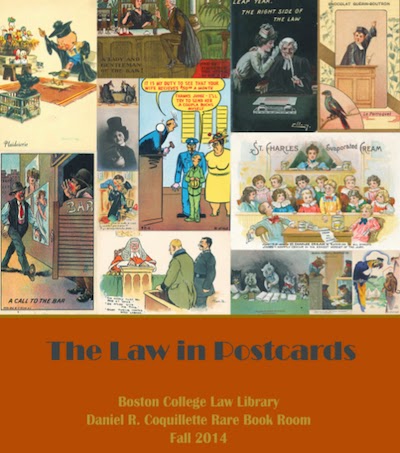
Boston College's "The Law in Postcards."
Saturday, September 20, 2014
Clues 32.2: Global crime fiction.

Just published is vol. 32, no. 2 of Clues: A Journal of Detection—a theme issue on global crime fiction guest edited by Stewart King (Monash University) and Stephen Knight (University of Melbourne). If interested in ordering the issue or subscribing, email McFarland.
The cover features Swedish author Arne Dahl. The table of contents follows below. I will add links when available.
The Challenge of Global Crime Fiction: An Introduction
STEWART KING AND STEPHEN KNIGHT
Crime Fiction as World Literature STEWART KING
This article explores crime fiction within a world-literature framework. It argues that the study of national traditions can blind us to the dialogue across borders and languages between texts and authors. It proposes a reading practice that aims to develop a more nuanced understanding of this truly global genre.
Beyond National Allegory: Europeanization in Swedish Crime Writer Arne Dahl’s Viskleken KERSTIN BERGMAN (Lund University)
Swedish crime fiction is experiencing a strong move toward Europeanization; increasingly more novels are set in Europe and discuss European identities and transnational criminality. The author examines how national and European perspectives clash and interact in Arne Dahl’s Viskleken (Chinese Whispers, 2011), a novel featuring a multinational police team within Europol operating across borders.
Hackers Without Borders: Global Detectives in Stieg Larsson’s Millennium Trilogy NICOLE KENLEY (University of California, Davis)
The article argues that Stieg Larsson’s Millennium Trilogy is a response to the challenges of mediating digital crime. It suggests that as the technological aspects of global crime threaten to dissolve national borders, Larsson’s novels offer the computer hacker as a detective figure capable of partially managing these emerging threats.
Wednesday, September 17, 2014
Anna Katharine Green's
Three Thousand Dollars (1910).
 |
| Anna Katharine Green, from The Reader (June 1907) |
Tuesday, September 16, 2014
Creasey's Gideon's Way (TV, 1964-67).
John Creasey, thought to be one of the most prolific mystery authors ever, was born on September 17, 1908, in Surrey. The TV series Gideon's Way (aka Gideon C.I.D.) with John Gregson was based on Creasey's novels under the pseudonym J. J. Marric. These featured Scotland Yard's George Gideon (played by Jack Hawkins in the film Gideon's Day) and are important in the history of the police procedural. This episode, "The Tin God" (Nov. 1964), stars John Hurt in a tale about a gangster wanting revenge on the wife who put him in prison.
Monday, September 15, 2014
Coming soon: ME exhibition on pulp cover art.

Tuesday, September 09, 2014
Remembering Andrew McLaglen: Man in the Vault (1956).
Director Andrew McLaglen, son of actor Victor McLaglen, died on August 30 at age 94. Known for his work in Westerns (such as Gunsmoke), he also attracted early attention for his crime film Man in the Vault, in which locksmith William Campbell (Star Trek) is pressured by a mobster to steal $200,000 or face dire consequences to his girlfriend. Anita Eckberg and Paul Fix also star.
Monday, September 08, 2014
Beer and mystery.

Wednesday, September 03, 2014
UCLA: "Exile Noir."
As part of its "Exile Noir" program this month, the UCLA Film & Television Archive plans to screen Bluebeard (1944); The Blue Gardenia (1953); Caught (1949); City That Never Sleeps (1953); The Dark Mirror (1946); Hollow Triumph (1948); Jealousy (1945); The Locket (1946); Sleep, My Love (1948); Sorry, Wrong Number (1948); and Whirlpool (1950).
It also notes the upcoming exhibition that will open at the Skirball Cultural Center on October 23: "Light & Noir: Exiles and Emigres in Hollywood, 1933-1950."
It also notes the upcoming exhibition that will open at the Skirball Cultural Center on October 23: "Light & Noir: Exiles and Emigres in Hollywood, 1933-1950."
Tuesday, September 02, 2014
"Twelve Angry Men" (TV, 1954).
Most people are familiar with the 1957 film starring Henry Fonda as the juror who isn't so sure that the defendant in a murder trial is guilty, but there was also an earlier Studio One version directed by Franklin Schaffner and starring Robert Cummings, Franchot Tone, Norman Fell, and Edward Arnold.
Monday, September 01, 2014
Academe: More notable U.S. espionage novels.
On the Academe blog Martin Kich (Wright State University) continues his series on "Fifty Notable American Espionage Novels" with the following:
• Helen MacInnes, Assignment in Brittany (1942)
• Colin MacKinnon, Finding Hoseyn (1987)
• Joe Maggio, The Company Man (1972)
• John P. Marquand, Stopover Tokyo
(1957; Mr. Moto takes on the communists)
• Wilson McCarthy, The Detail (1973)
• Charles McCarry, The Miernick Dossier (1973)
Here's a rundown of Kich's earlier choices.
 |
| Peter Lorre in The Mysterious Mr. Moto (1938) |
• Colin MacKinnon, Finding Hoseyn (1987)
• Joe Maggio, The Company Man (1972)
• John P. Marquand, Stopover Tokyo
(1957; Mr. Moto takes on the communists)
• Wilson McCarthy, The Detail (1973)
• Charles McCarry, The Miernick Dossier (1973)
Here's a rundown of Kich's earlier choices.
Tuesday, August 26, 2014
Remembering Richard Attenborough: Seance on a Wet Afternoon (1964).
Among the many distinguished performances of Richard Attenborough, who died at age 90 on August 24, was in Seance on a Wet Afternoon with Kim Stanley (1964, dir. Bryan Forbes). It was based on the novel Seance by Australian Mark McShane, which Anthony Boucher considered one of the best debut mysteries of 1962.
Monday, August 25, 2014
A look at a Victorian murder case.

Wednesday, August 20, 2014
UM: Literary maps (including mystery authors).
 |
| T. S. Stribling The Century, Oct. 1921 |
• "Raymond Chandler's Los Angeles" (want to see where Philip Marlowe lives?)
• The Southern map includes Truman Capote, William Faulkner, Edgar Allan Poe, and T. S. Stribling
• The Michigan map includes Charlotte Armstrong, Loren Estleman, Steve Hamilton, and Elmore Leonard
• Links to interactive maps include Brooklyn, Detroit, Manhattan, and San Francisco
Tuesday, August 19, 2014
Ira Levin's "The Pattern" (1951).
In "The Pattern," a May 1951 episode of Lights Out, a man is haunted by an incident during World War II when he could not prevent the bombing of an army barracks. The episode, written by Ira Levin (A Kiss before Dying, The Stepford Wives, Rosemary's Baby, Deathtrap), features John Forsythe and Rita Gam.
Monday, August 18, 2014
BFI hunts for missing A Study in Scarlet (1914).
 |
| Ad for the 1914 American version of A Study in Scarlet, starring Francis Ford |
BFI also has reported on its successes in locating missing films, including the country-house mystery Three Steps in the Dark (1953).
Thursday, August 14, 2014
Poe mural, UK.

Tuesday, August 12, 2014
James Hilton's "The Mallet" (Suspense, 1950).
In "The Mallet," a man hawking questionable medicines believes he has the formula to commit the perfect murder. Walter Slezak made his TV debut in this Dec. 1950 Suspense episode based on a 1929 story of the same name by Lost Horizon's James Hilton, who sometimes moonlighted in mystery.
Monday, August 11, 2014
"Forensic Chemistry in Golden-Age Detective Fiction."

Wednesday, August 06, 2014
British spies in World War II.
On the International Spy Museum's SpyCast, Michael Goodwin (King's College London) talks about the formation of the British Joint Intelligence Committee.
Faber has launched a new nonfiction blog called The Curious Files. Its podcasts include historian Roderick Bailey on British spies in World War II Italy and Matthew Sweet on still more World War II spies running around London's West End hotels.
Faber has launched a new nonfiction blog called The Curious Files. Its podcasts include historian Roderick Bailey on British spies in World War II Italy and Matthew Sweet on still more World War II spies running around London's West End hotels.
Tuesday, August 05, 2014
Remembering Dorothy Salisbury Davis: "House of Masks" (1952).
MWA Grand Master Dorothy Salisbury Davis died on August 3 at age 98. The June 1952 Suspense episode "House of Masks" (based, I think, on Davis's A Town of Masks) features Geraldine Fitzgerald resenting the interference of her sister in her life and promoting the presence of a shady gardener.
With the passing of Davis, there remains only one living writer on the Haycraft-Queen Cornerstone List: Helen Eustis.
With the passing of Davis, there remains only one living writer on the Haycraft-Queen Cornerstone List: Helen Eustis.
Thursday, July 31, 2014
Frank Drebin lives:
New Naked Gun soundtracks.

Good news for Frank Drebin fans: Film Score Monthly announced that La La Records has released a limited edition of Ira Newborn's scores for The Naked Gun: From the Files of Police Squad, The Naked Gun 2 1/2: The Smell of Fear, and The Naked Gun 33 1/3: The Final Insult.
Wednesday, July 30, 2014
Irish Humanities Alliance:
"The Success of Intl Crime Fiction."
The Irish Humanities Alliance offers a podcast on "The Success of International Crime Fiction," drawing from a June 2014 conference at Queen's University Belfast. Discussing the topic (and the flexibility of crime fiction to encompass all sorts of commentary) are Kate Quinn (University of Galway), who presented a paper on crime fiction in Chile; writer Garth Carr; and David Platten (University of Leeds).
Tuesday, July 29, 2014
Alias John Preston (1955).
In Alias John Preston, wealthy Christopher Lee arrives in an English village, has disturbing dreams, and may have a dark secret in his past. Psychiatrist Alexander Knox delves into the case.
Monday, July 28, 2014
UNM's Tony Hillerman Portal.

Wednesday, July 23, 2014
Mystery reading group guides.
For those looking for mystery reading group guides:
• The New York Review of Books has guides for William Lindsay Gresham's Nightmare Alley, Jean-Patrick Manchette's Fatale, and Georges Simenon's The Engagement.
• Michigan Center for the Book has a Reading Guide to Robert Traver's Anatomy of a Murder.
• The New York Review of Books has guides for William Lindsay Gresham's Nightmare Alley, Jean-Patrick Manchette's Fatale, and Georges Simenon's The Engagement.
• Michigan Center for the Book has a Reading Guide to Robert Traver's Anatomy of a Murder.
Tuesday, July 22, 2014
Knight without Armor (1937).
In Knight without Armor, British secret agent Robert Donat must rescue aristocrat Marlene Dietrich from Bolshevik baddies. The film (produced by Alexander Korda) is based on Without Armor by Lost Horizon's James Hilton, with a screenplay by early Hollywood pioneer Frances Marion.
Monday, July 21, 2014
"Behind the Badge:
The US Postal Inspection Service."
 |
| Front page of the Evening World of October 25, 1921, reflecting the largest robbery of the time |
Saturday, July 19, 2014
Philip K. Dick speaks.
 |
| The Best of Philip K. Dick (Echo Point Books, 2013) |
Wednesday, July 16, 2014
Religion and fictional detectives.
 |
| G.K. Chesterton |
Tuesday, July 15, 2014
Rinehart's The Bat (film, 1926).
 |
| Ad for The Bat. Film Daily Jan-Dec 1925 |
Monday, July 14, 2014
Academe: Notable American espionage novels.
 |
| James Fenimore Cooper. NYPL |
James Fenimore Cooper, The Spy (1821)
Richard Congdon, The Manchurian Candidate (1959)
Brian Garfield, Hopscotch (1975)
Dorothy Gilman, The Amazing Mrs. Pollifax (1970)
James Grady, Six Days of the Condor (1975)
Bill Granger, The November Man (1979)
Nicholas M. Guild, The Summer Soldier (1978)
Noel Hynd & Christopher Creighton, The Krushchev Objective (1987)
Aaron Latham, Orchids for Mother (1977)
Robert Littell, The Amateur (1981)
Tuesday, July 08, 2014
A Shriek in the Night (1933).
In A Shriek in the Night, reporter Ginger Rogers teams up with rival journalist Lyle Talbot to investigate murders in an apartment building.
Monday, July 07, 2014
Vintage Paperback Index, BGSU.
 |
| Edgar winner Lawrence G. Blochman from UC-Berkeley's The Blue and Gold (1922) |
Thursday, July 03, 2014
CBC's "100 Novels That Make You Proud to Be Canadian."

• Linwood Barclay,
No Time for Goodbye
• Giles Blunt, Forty Words for Sorrow
• Will Ferguson, 419
• Louise Penny, Still Life
• Andrew Pyper, Lost Girls
Wednesday, July 02, 2014
Rod Serling speaks.
Some Rod Serling items I discovered:
• Binghamton, NY, is moving its Walk of Fame for preservation reasons. The first star was given posthumously to native son Serling.
• At a May 1971 UCLA event, an often witty and blunt Serling commented on Twilight Zone episodes "The Monsters Are Due on Maple Street" and "A Stop at Willoughby"; Night Gallery episode "They're Tearing Down Tim Riley's Bar"; and the Hallmark Hall of Fame production "Storm in Summer." As can be expected given Serling's continual criticism of television, he had things to say about the state of TV in general:
• Binghamton, NY, is moving its Walk of Fame for preservation reasons. The first star was given posthumously to native son Serling.
 |
| Rod Serling, from 1959 Mike Wallace Interview |
"It . . . points out one of the major, in-bred problems of television: that however moving and however probing and incisive the drama, it cannot retain any consistent thread of legitimacy when after 12 or 13 minutes, out come 12 dancing rabbits with toilet paper."He plugged science fiction authors such as Arthur C. Clarke and a young filmmaker by the name of George Lucas ("Science fiction is becoming an altogether legitimate art form") and good writing ("You judge good writing by its lasting quality . . . nothing I've written in my life . . . will ever be remembered 100 years hence"). He considered his best work to be "Requiem for a Heavyweight," The Rack, and Seven Days in May.
Tuesday, July 01, 2014
23 Paces to Baker Street (1956).
Directed by Henry Hathaway and based on Warrant for X (aka The Nursemaid Who Disappeared) by author-screenwriter Philip MacDonald (The List of Adrian Messenger, etc.), 23 Paces to Baker Street features Van Johnson as a blind playwright who overhears a kidnapping plot.
Monday, June 30, 2014
E. W. Hornung's unpublished diary.
Libraries are always so interesting: a man's bookcase is something more interesting than the man himself, sometimes the one existing portrait of his mind.
—E. W. Hornung, The Crime Doctor
 |
| E. W. Hornung. NYPL |
Sadly, Oscar—the only child of Hornung and Constance, Arthur Conan Doyle's sister—was killed in action at Ypres in July 1915. Seeking solace, Hornung served as a YMCA volunteer during the war—working in a canteen; maintaining a wartime library for soldiers in Arras, France, and a postwar one in the vicinity of Cologne, Germany; looking for friends of Oscar; and hoping to encounter Conan Doyle's serviceman son, Kingsley (who died of flu in 1918). His Notes of a Camp Follower on the Western Front (1919) tells about his war experiences and provides insight into what servicemen were reading (popular authors included Mary Elizabeth Braddon, Edward Bulwer Lytton, Marie Corelli, Anthony Hope, and E. Phillips Oppenheim). Interestingly, he reports only one reader for Wilkie Collins's The Woman in White. Pertaining to the works of his brother-in-law, he wrote, "Messrs. Holmes and Watson were the most flourishing of old firms, and Gerard the only Brigadier taken seriously at my counter" (Notes 141). His own output was not ignored:
"When I was up the line," said one of my friends, bubbling over with a compliment, "a chap said to me, 'You know that old—that—that elderly man who runs the Rest Hut? He's the author of Raffles.'"Adds Hornung in mock outrage, "Elderly! One would as lief be labelled Virtuous or Discreet" (Notes 144–45). Hornung died of pneumonia in 1921 at 54, hardly an advanced age.
King relates that Hornung kept a diary between December 1917 and March 1918 that took the format of letters to his wife. He drew on this diary to write Notes, but King indicates that the diary reveals more about Hornung's reasons for war service than Notes does. Hornung's friend Shane Chichester preserved a typescript of the diary, which is now in the University of Birmingham's Cadbury Research Library along with other papers. King also provides a heart-warming glimpse of Hornung at work via the World War I memoir of Carlos Paton Blacker, Oscar's Eton classmate who became a noted psychiatrist.
King's article follows "The A. J. Raffles Stories Reconsidered: Fall of the Gentleman Ideal" by Jeremy Larance from the first 2014 issue of English Literature in Transition.
Thursday, June 26, 2014
War, Buchan, and The Thirty-Nine Steps.


Wednesday, June 25, 2014
Happy birthday, Dorothy Gilman.
She left us in 2012, but her work lives on. Grand Master Dorothy Gilman was born today in 1923 in New Brunswick, NJ—just like her most famous creation, senior-citizen secret agent Mrs. Pollifax. Here is a behind-the-scenes look at the making of Mrs. Pollifax-Spy with Rosalind Russell.
Tuesday, June 24, 2014
Woolrich's "Post Mortem" (May 1949).
In this 1949 episode of Suspense based on Cornell Woolrich's "Post Mortem" (Black Mask, Apr. 1940) and directed by Robert Stevens (Alfred Hitchcock Presents, Twilight Zone), a woman marries a doctor who has a disturbing track record when it comes to life insurance.
Monday, June 23, 2014
O'Donnell's Modesty Blaise, BBC Radio 4 Extra.
 |
| One of the Modesty Blaise graphic novels from Titan Books |
Wednesday, June 18, 2014
The return of Caspary's The Man Who Loved
His Wife (1966).

Tuesday, June 17, 2014
Glaspell's Trifles (2009).
 |
| Susan Glaspell. NYPL. |
Monday, June 16, 2014
McDermid on Pinkerton.
 |
| Allan Pinkerton. NYPL. |
Wednesday, June 11, 2014
MS review, Ellroy companion.

Tuesday, June 10, 2014
Sayers's "Suspicion" (Mar. 1949).
Why not celebrate Dorothy L. Sayers's birthday coming up on Friday by checking out the 1949 Suspense episode "Suspicion," based on the Sayers short story of the same name? Disregard the ID of Charlton Heston in this YouTube selection; there were two versions of "Suspicion" for Suspense, and this one is the Mar. 1949 version (Heston was in the Nov. 1949 version).
Monday, June 09, 2014
Art Detective Web site.
 |
| The "unknown rheumatologist"— solved |
Wednesday, June 04, 2014
Coming from U-Chicago Press:
Oppenheim, Westlake.

- New paperback editions of spy fiction and thriller pioneer E. Phillips Oppenheim's The Great Impersonation (1920) and The Spy Paramount (1935). Both are out in September, distrib. for the British Library.
- Consistent with the press' reprinting of the Richard Stark novels of the late Donald Westlake is a new volume, The Getaway Car: Donald Westlake Nonfiction Miscellany (introd. Lawrence Block, out in September). This book includes interviews, lively pieces from an unpublished autobiography, and tributes to fellow writers.
 |
| Photo from The Great Impersonation (1935), starring Edmund Lowe and Valerie Hobson |
Tuesday, June 03, 2014
Woolrich's "The Listener" (1956).
In this February 1956 episode of Four Star Playhouse based on Cornell Woolrich's "Eyes That Watch You," Ida Lupino has some dark plans in store for her husband—but are she and her accomplice the only ones who know? Playing her brother is Richard Lupino (a cousin to Ida Lupino and Buster Keaton).
Monday, June 02, 2014
BL's "Discovering Literature:
Romantics and Victorians."
 |
| 1877 Chatto & Windus edition of Wilkie Collins's The Moonstone |
- Under "the Gothic" are features on "The Victorian Supernatural," "An Introduction to The Woman in White," and Robert Louis Stevenson's The Strange Case of Dr. Jekyll and Mr. Hyde.
- Under "The Imperial Gothic" are works by H. Rider Haggard and Richard Marsh, as well as Wilkie Collins's The Moonstone.
- Under "Crime and Crime Fiction" are "Crime in Oliver Twist," "Crime in Great Expectations," and "Juvenile Crime in the 19th Century." Also featured (by Judith Flanders, author of The Invention of Murder: How the Victorians Revelled in Death and Detection and Created Modern Crime that I reviewed) are "The Creation of the Police and the Rise of Detective Fiction" "Jack the Ripper," "Murder as Entertainment," and "Penny Dreadfuls" (including The Boy Detective, 1865).
Update. The BL has corrected the attribution for Revelations of a Lady Detective.
Wednesday, May 28, 2014
Upcoming in film music: Schifrin, Jarre.
Film Score Monthly reports that the score to the spy film The Fourth Protocol (1987, book by Frederick Forsyth) will be out shortly after long unavailability; Lalo Schifrin is the composer (best known for the Mission Impossible theme).
Also interesting is the list of top sellers on the FSM Web site; no. 1 is the not yet released, limited-edition score to The Train (dir. John Frankenheimer and featuring Burt Lancaster, 1964) composed by Maurice Jarre.
Also interesting is the list of top sellers on the FSM Web site; no. 1 is the not yet released, limited-edition score to The Train (dir. John Frankenheimer and featuring Burt Lancaster, 1964) composed by Maurice Jarre.
Tuesday, May 27, 2014
David Goodis...To a Pulp (2010).

Monday, May 26, 2014
Recalling two Army nurses' deaths, 1917.
 |
| From left: Helen Burnett Wood, Edith Ayres, and Emma Matzen, WWI Army nurses. Chicago Examiner 22 May 1917: 3. |
Wednesday, May 21, 2014
Arsenic, the Marsh test, and mystery fiction.

Tuesday, May 20, 2014
Hell Is a City (1960).
 |
| Stanley Baker in Hell Is a City |
Monday, May 19, 2014
Whitman's story of murder.
 |
| Walt Whitman. NYPL. |
Wednesday, May 14, 2014
Rose Macaulay's Mystery at Geneva (1922).
"They must be found, gentlemen. Alive or (unthinkable thought) dead, they must be found. The Assembly must do nothing else until this sinister mystery is unravelled. We must employ detectives. We must follow every clue."
Miss Longfellow said, "My! Isn't it all quite too terribly sinister!" (Rose Macaulay, Mystery at Geneva 110)
 |
| Rose Macaulay by W. W. Seaton Shadowland Mar-Aug 1923 |
Tuesday, May 13, 2014
No Hands on the Clock (1941).
Adapted from the novel by screenwriter-author Daniel Mainwaring (who wrote as Geoffrey Homes and is best known for Build My Gallows High, aka Out of the Past), No Hands on the Clock features Chester Morris as a fast-talking PI on the trail of a missing person. He learns that the case is connected to a string of bank heists, which interests the G-men. Jean Parker co-stars.
Monday, May 12, 2014
ABA Journal's contest for legal short fiction.
 |
| Raymond Burr as lawyer Craig Carlson in Please Murder Me (1956) |
Tuesday, May 06, 2014
Eight Witnesses (1954).
In Eight Witnesses, a scientist is murdered, and the only witnesses are eight blind people. Peggy Ann Garner stars in a story by screenwriter Halsted Welles (Alfred Hitchcock Presents, Mannix, 3:10 to Yuma, Rod Serling's Night Gallery).
Friday, May 02, 2014
Guardian review, Ellroy companion.

Subscribe to:
Posts (Atom)